




Malaysia's foreign policy faces new realities
Popular understanding of the foreign policy of Malaysia has mostly been fragmentary as the country is not only multi-ethnic, multi-faith and multi-lingual with many external linkages, but it is also geographically positioned as a critical crossroad of the world.
Moreover, there has been a lack of academic ambition to construct a overall discourse or narrative of the country's foreign policy from a historical perspective with all its continuities and changes.
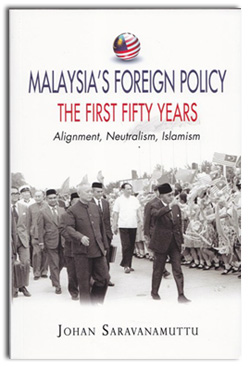
The highly acclaimed book ‘Malaysia's Foreign Policy: The First Fifty Years - Alignment, Neutralism, Islamism' attempts to fill the gaps and provide a fuller picture...
Popular understanding of the foreign policy of Malaysia has mostly been fragmentary as the country is not only multi-ethnic, multi-faith and multi-lingual with many external linkages, but it is also geographically positioned as a critical crossroad of the world.
Moreover, there has been a lack of academic ambition to construct a overall discourse or narrative of the country's foreign policy from a historical perspective with all its continuities and changes.
 The highly acclaimed book ‘Malaysia's Foreign Policy: The First Fifty Years - Alignment, Neutralism, Islamism' attempts to fill the gaps and provide a fuller picture.
Malaysiakini interviewed its author, Dr Johan Saravanamuttu ( left ), who is former dean of School of Social Sciences at the Penang-based Universiti Sains Malaysia (USM) and currently a visiting senior research fellow at Singapore's Institute of South East Asian Studies (ISEAS).
Malaysiakini: In ‘Malaysia's Foreign Policy: The First Fifty Years', you observe that the foreign policy of Malaysia has gone through three stages, namely alignment, neutralism and Islamism. How do you characterise the essence of Malaysia's foreign policy under PM Najib Razak?
Johan: First, let me stress the point that any prime minister's role in foreign policy is a function of societal forces and political currents of the day and, most crucially, a representation of previous thrusts of foreign policy.
This said, there can also be departures to existing polices as shown during the Abdul Razak tenure when he shifted Malaysia's policy from Western alignment to non-alignment.
Dr Mahathir Mohamad also made some significant departures from existing polices and paradoxically was responsible for the Islamist shift in foreign policy. This was consolidated by his successor Abdullah Ahmad Badawi.
My sense is that Najib will make few major changes to Malaysia's foreign policy as I've said in the postscript of the book. However, like Abdullah and unlike Mahathir, he is shown to be not strident against the West and the US.
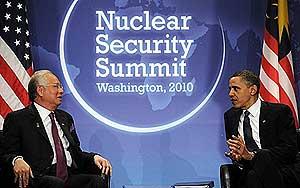 Indeed, most recently Najib has cozied up to the US and was very happy to be invited by Barack Obama to the Nuclear Security Summit in April 2010.
In appreciation, Malaysia passed the Strategic Trade Act which forbids trading in strategic material (as had occurred in the Scomi affair). The Act was passed just before the nuclear summit and it pleased the Americans.
Najib's policy towards Singapore also shows a warming up, with some significant actions such as the Tanjong Pagar deal. However, the Singapore tilt is really a continuation of the earlier Abdullah approach.
But, especially with respect to Singapore, we have seen the interesting phenomenon - if not the spectacle - of a former PM sniping at his successors and objecting to their actions. This is brand new in Malaysian foreign policy and I would say a really bad precedent!
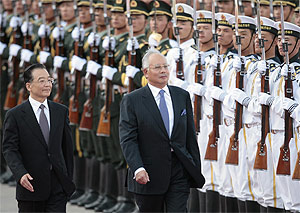 Back to the broad thrusts of Malaysian foreign policy under Najb, it should remained strongly non-aligned and with a continuing orientation toward China economically - Najib was given special reception during his visit (to Beijing) in November 2009. However, there will be a great deal of ‘hedging' with the West and the US.
During Najib's tenure, Islamism seems to have receded although it will always be there. What I find odd is that Wisma Putra (Foreign Ministry) calls Malaysia a "Muslim nation". I think this is incorrect - we are a multicultural state with a Muslim majority.
In your observation, is there now tension within Malaysia's foreign policy-making establishment between those who strive to retain the Islamist character and those who aspire to recalibrate a new balance between Islamism and Westernism/Americanism? If there is, what are the material and ideational forces, global or domestic, which have given rise to the tension?
My last point leads into the answer to this question. I do think such a tension exists, that is, between those who would like to keep foreign policy free of religion, Islam in particular, and those who feel Islam is the construct for certain stances and approaches in foreign policy be it in the political or economic realms.
I feel it is a mistake to drive foreign policy (and politics) on the basis of Islam - any religion for that matter. Religion should be something kept in the private sphere. Look at what is happening in Egypt today - a wonderful development - but the revolution is not driven by Islamism at all, it is driven by young people and progressive forces who want genuine democracy.
I think Turkey would be a good example of how we could maintain good moral stances on foreign policy which are consonant with Islam while keeping politics and foreign policy secular for all intents and purposes.
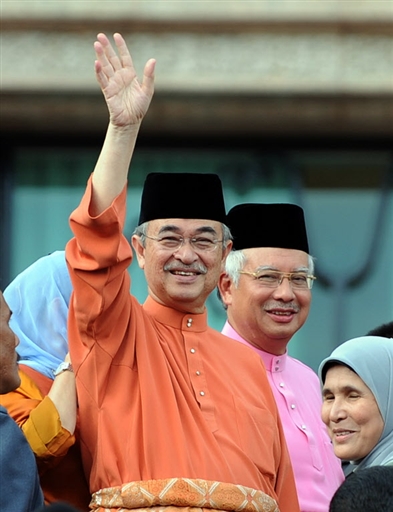 Abdullah Badawi may have tried to project a ‘moderate Islamism' with his Islam Hadhari but he ultimately failed because his own government and its actions were riddled with ethical ellipses and missteps. He was saddled with the ramifications of the Altantuya Shaariibuu murder and the Scomi/Scope incident which involved the shady Bukhary Syed Tahir.
For Malaysia, is not so much the choice between Islamism and Westernism/Americanism in foreign policy but maintaining a non-aligned policy with nationally-driven goals to serve the needs of all Malaysians regardless of creed and race and, for that matter, ideological persuasions.
The material force driving Malaysia today is a rising middle-class and the revolution of rising expectations which in turn drives the imperative for more democracy for its multiethnic society. Again, my thoughts turn to the Egyptian revolution which is many senses is like the Indonesian and Malaysian ‘reformasi' movements.
The strongest ideational force in the developing world today is democracy and, along with it, the politics of reform.
As the result of the continuing global financial crisis, Britain has announced a deep cut in its defence budget for the next five years and America too has begun to debate the slashing of its military budget. How would - and should - Malaysia respond to these developments in its foreign policy, especially the defence and security dimension of it?
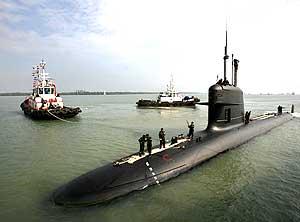
I have noticed that Malaysia has just gone on another spending binge with Mindef (Defence Ministry) announcing a RM10 billion-plus budget. Obviously, there's a lot of money to be made in defence contracts. We saw this in the submarine deals.
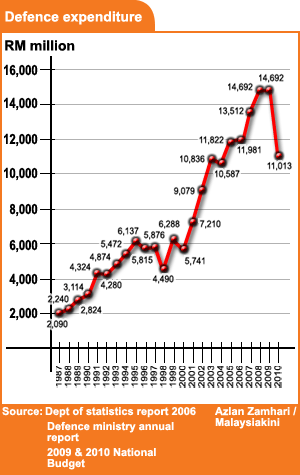 We are more or less listed as a lower-rung ‘middle power' with military spending the equivalent of Finland, Indonesia, Thailand or Venezuela. But take the example of Costa Rica - it has had no army since 1948 and the money is spent on basic internal security and other domestic needs.
As I have argued in my book, ‘middle-powermanship' does not necessary involve military hardware, it is rather the function of ‘soft power', that is the ability to attract goodwill with stances and actions of good global citizenship.
Malaysian has done reasonably well in this area, such as in brokering of peace talks in Mindanao. We were also very active in the Cambodian peace process and have contributed a great deal to UN peacekeeping operations. That is how I would like to see Malaysia use of its military capability.
It is now fashionable to analyse or speculate in general terms on the resurgence of China and India. In your assessment, what specific adjustments should Malaysia made to respond to the new realities in China and India?
Yes, the rise of Asia and China and India, of course - this is often exaggerated but in the last chapter of my book, I've touched on this. It is very important to balance and hedge Western and US hegemony, which is a fact of international life. China's rise economically and political is not only inevitable but already a fact; I'm less sure of India.
 Malaysia should maintain its policy of non-alignment, and in the South China Sea, where we have interests and have occupied five reefs and islets, we should maintain a stance of cooperation.
We have been highly successful in setting up Joint Development Areas (JDA) to exploit hydrocarbon resources in the Gulf of Thailand with Thailand and also with Vietnam; the same could be done in the South China Sea. We now already have a JDA with Brunei in the South China Sea.
In terms of overall foreign policy, the Asia-Pacific region will see what I would call ‘hegemonic sharing' between China and the US unlike those who see a coming clash of China and the US.
Malaysia as a small or middling power should maintain balance between the two, for example, by promoting as we have done in the past the region as zone of peace, freedom and neutrality and, as far as possible, free of nuclear weapons. The same could be done in the Indian Ocean.
In your observation, how does Malaysia's foreign policy-making establishment view the widely reported or speculated progress made in China's defence modernisation in recent months as well as the American response to it? What is the ideal Sino-US relationship that serves Malaysia's foreign policy objectives best?
Related to the last point, China would have to have a sort of power-sharing with the US (and Japan, US's ally) in maintaining what realists call ‘hegemonic stability' in a globalised world driven by neo-liberal economic principles and capitalist development.
 It would be in Malaysia's interest to see a
modus vivendi
established between these two major powers to maintain regional stability.
It would be in Malaysia's interest to see a
modus vivendi
established between these two major powers to maintain regional stability.
The role of a middle force like Asean, of which Malaysia is member, is not to be underestimated. Asean, along with other middle powers, like Australia, could fashion various institutional arrangements, forums, platforms to stabilise the Asia-Pacific region.
The most acceptable broad-based forum - although it has its weaknesses - is the Asean Regional Forum (ARF). However, there seems to be many ideas and concepts floating around. The term that has come into vogue is "forum shopping".
It appears that in this fluid period of international politics the most optimal forums have yet to be found. One way or another, they would have to include the two major global powers, US and China, not to forget, Russia.


Are you sure you want to delete this comment?
This action cannot be undone.