




Untold stories of tycoon Ngan Ching Wen
OBITUARY The funeral service of prominent businessman and philanthropist Ngan Ching Wen will take place in his home town, Ayer Tawar in Perak, tomorrow.
And his former secretary Wenly Chin and I, his special assistant from 2004 to 2007, decided we must attend this last event of his life on Saturday.
OBITUARY The funeral service of prominent businessman and philanthropist Ngan Ching Wen will take place at his home town in Ayer Tawar, Perak, tomorrow.
And his former secretary Wenly Chin and I, his special assistant from 2004 to 2007, decided we must attend this last event of his life on Saturday.
"Tan Sri had been a very nice and kind boss to us. We must make sure we follow his cortege for some distance and bid our last goodbye to him on Saturday," Wenly said last night over the phone, as
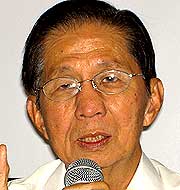 we finalised our travel arrangements from Kuala Lumpur for Friday.
My eyes immediately turned wet. Yes, he was not only a good boss but a decent businessman and outstanding Chinese community leader who had earned my respect since I began to report on Chinese guilds, politics and business from the 1980s, as a reporter with The Star and later with the international news agency Reuters .
During the early years of the 1980s, when extremist political forces were suppressing Chinese education and the legitimate rights of non-bumiputra businessmen, I saw Ngan - as a learned and vocal leader of the Selangor Chinese Chamber of Commerce and Chinese Assembly Hall - speaking up boldly on all these issues affecting the community.
Unlike other timid leaders, he allowed reporters to quote him openly and honestly, and you would never see him saying he was "misquoted" on sensitive topics when these reports landed him on the wrong side of the authorities.
In fact, his effective leadership in the Chinese chambers and guilds in the 1980s and 1990s had partly ensured that laws impeding businesses were either repealed or amended.
When others buckled, he stood
One such example was the controversial Industrial Coordination Act of 1975. And the Chinese community - and may be the country at large - should thank him for his foresight, ideas and contributions.
Sad to say, after him, very few Chinese community leaders have demonstrated his level of sensitivity to social, political and economic issues. Many leaders appear to first weigh the impact on their own business interests before making any statement on community issues.
And journalists wouldn't see any "bite" in their ambiguous statements and wonder how they can serve their communities well.
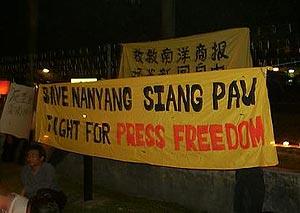 I had a chance to work with Ngan in May 2001, when he led the Chinese community to oppose the sale of Nanyang Press Holdings to Huaren Holdings, an investment arm of the MCA, on grounds that the freedom of expression in the Chinese media would be curtailed.
Nanyang Siang Pau at that time was publishing a lot of scandals connected to top MCA leaders, as well as critical commentaries from leading Chinese scholars. It had definitely angered then party president Dr Ling Liong Sik.
I was in between jobs then, when all these events were unfolding. I offered to help Ngan write speeches and organise an international press conference, for free.
My involvement enabled me to see how some seemingly bold leaders buckled under pressure. Yet, Ngan stood firm. Finally, when everything was over, it was Ngan who had to foot all the expenses related to the events.
Returning to society in show of gratitude
It was my great respect for his eagerness and selflessness to serve the Chinese community and society at large that in early 2004, I accepted his offer to help him beef up the secretariat of the Malaysia-China Chamber of Commerce (MCCC), when he was its president.
And in the chamber, I saw him using his own international influence to bring in China's leading economist, Prof Dr Justin Lin (now chief economist to the World Bank), to give a series of talks in Malaysia.
He used his own money to hire professionals to upgrade the secretariat of the chamber, which at that time was manned by an old retired school headmaster.
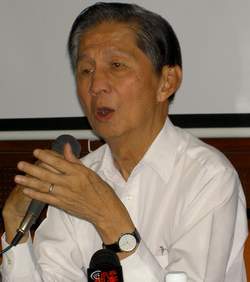 My salary and another's were paid by him personally. As a result of his leadership and generosity, the profile of MCCC was raised substantially.
When he was no longer the president of the MCCC, I was posted to Kunming for a year to help him manage a private school, which housed many poor students. This was a case of him giving back to society from property development gains he enjoyed in China.
While in China, it was also one of my tasks to ensure that his donations to the abject poor in Yunnan Province in seven remote villages were put to good use.
Though in his 70s, Ngan had personally gone to the most remote, landslide-prone areas of Yunnan in four-wheel drives just to see the dilapidated conditions of schools and the cramped, dark quarters of pupils, with rotting food lying around.
When wearing shoes means respect
I was to ensure his millions in unpublicised donations turned into new school buildings and livable quarters for poor children. During Chinese New Year, teachers were given red packets containing RMB500 each (RM230) and children given RMB50 (RM23) each.
Indeed, it was an emotional encounter for me to go to these remote places, particularly to a Meow village where I saw bare-footed children telling me that they would only wear their shoes (donated by Ngan) when he came to officially open the new buildings.
For Ngan, perhaps the darkest moments of his life was when he was declared a bankrupt on April 1, 2004. I was with him in the Putrajaya court then. And though shaken, the first thing he did was to console his wife and me: "Don't worry. Nothing will happen to me."
Indeed, this was a case of getting into hot soup after helping a friend. He guaranteed a big bank loan for a friend who died before paying up.
Then the bank went after Ngan, who then helped to pay up the rest of the principal and had the bank agree to forego the accumulated interest. But later, the bank reneged on the agreement and sued Ngan for the interest, and Ngan contested the case right to the end.
With my background and experience, I was glad I could help him handle the media and adverse publicity, as well as his legal matters.
I advised him to go to the press with the full story and his arguments, at the risk of being hauled up for contempt of court, as restoring his good image and reputation was more important to him at this stage of his life. He did and the damage was substantially mitigated.
Good time friends take flight
Before his bankruptcy was voided by the High Court in April 2006, Ngan saw some friends deserting and dissociating themselves from him.
From being a rich and famous person, life suddenly became dark and cruel. His daily phone calls fell drastically and I could see an active man ageing by the day, yet pretending nothing had affected him.
But he was lucky that some close friends, notably Lim Guan Teik and Meow Jin Seng, stood by him during his difficult moments.
When I was working for Ngan, Lim had suggested several times that I write a biography of his good friend to document his life, speeches and contributions to society.
He said Ngan was one rare leader with vision and guts. But Ngan would brush off this idea, saying: "I am just an ordinary person doing what I think is correct."
Hence, I left Ngan and Ngan Holdings without writing a book on its founder, but I did co-author a book on other Chinese community leaders sponsored by Ngan in 2005. Whatever it is, I am sure his life and times deserve volumes, not just one book.
HO WAH FOON, a veteran journalist, is editorial consultant to Smart Investor magazine and an international bank.


Are you sure you want to delete this comment?
This action cannot be undone.