




Sabah BN 'neglecting' NCR issues
A native land rights activist in Sabah has pointed out that Dusun-based BN political parties should provide leadership to their communities on issues that involve adat ( custom) “if they want to remain relevant”.
A native land rights activist in Sabah has pointed out that Dusun-based BN political parties should provide leadership to their communities on issues that involve adat (custom) “if they want to remain relevant”.
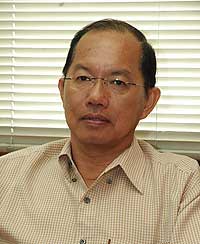
Kong Hong Ming, who heads the Land Development and Management Committee in the Sabah PKR presidential council, was referring in particular to land to which native customary rights (NCR) have been exerted.
For years now,
 such land has been eyed by the state government, state agencies, government-linked companies (GLCs) and private companies, and often taken over for logging and plantation activities.
“It’s not enough to jump on the bandwagon and hail a court decision that is in favour of NCR landowners,” said Kong, who is also Tawau PKR division head.
He was commenting on deputy premier Muhyiddin Yassin’s statement last weekend in Sandakan, blaming NCR issues on “the incompetence of leadership”.
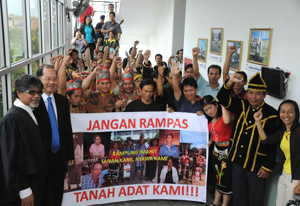
He pointed out that the United PasokMomogun KadazanDusunMurut Organisation, for example, had been quick to hail Justice David Wong’s decision last Saturday in favour of six natives in Tenom. They had been charged with trespassing into the Kuala Tomani Forest Reserve.
At the same time, the party was silent when Sabah Attorney-General Roderic Fernandez told the local media that the state government may appeal against the High Court decision, said Kong.
“The KDM - KadazanDusunMurut - parties should have urged the state government not to drag the natives to court when it’s clearly frivolous, vexatious and an abuse of the process. This approach is one of a sore loser,” noted Kong, a lawyer by training.
 He urged the state government and the Sabah Forest Department to drop their plan to appeal against the decision.
The main point to be considered in this case, said Kong, was the common law position that while the state may establish title to land - as in the case of forest reserves - it could not claim beneficial ownership at the same time when NCR is involved.
He cited the well-known case of Nor Anak Nyawai & Others v Borneo Pulp Plantation Sdn Bhd & Others [2001] CLJ 769 which held that “customary law is a practice by habit of the people and not the dictate of the written law”.
Kong stressed that the principles governing NCR land are well established both by adat and common law positions covering the entire Commonwealth and such rights cannot be extinguished by law.
‘Best option’
Many natives have lost their NCR land, said Kong, attributing this to their inability to take up the matter in court and the failure of the political leadership to come forward on their plight.
“There are lands which have bee
 n lost, lands which are in the process of being lost and other lands which are being recovered through the courts. This (recovery) is a long, costly and time-consuming exercise,” he said.
Not all NCR landowners have the knowledge, means and resources or the stamina to take on the authorities when threatened with the loss of their properties. As such, Kong said it would help if the political leadership “would stand up and make their voices heard on the issue”.
Asked why native leaders have remained silent on NCR land issues when it comes to the state government, state agencies, GLCs and private companies, Kong attributed it more to the mistaken belief that these have been “acting in good faith”.
“Native leaders belabour under the notion that NCR land can be better developed in joint-venture,” said Kong who begged to differ.
NCR land, he said, is best developed by the owners themselves as part of a network of small, independent farmers. The state government could provide technical help, training and access to credit, marketing and market access as in Australia and New Zealand, to cite two examples.
“The state government and the politicians should not force NCR landowners into joint ventures no matter what the benefits. NCR land is an important social safety network for the natives.”
Kong said 977
 complaints of land grabs and encroachment of NCR land had been reported to the Human Rights Commission between 2005 and 2010, while 32,352 native families have been documented as holding NCR claims in the state.
“The state government should complete a full settlement exercise once and for all, to return all NCR land to the native communities,” he said.
Under the Sabah Land Ordinance, the state can - by a gazette notice - carry out a settlement exercise to identify, survey and determine NCR land and then issue communal titles to indigenous communities or individual titles to natives who have established their claims on state land.
“According to the records of the British administration, full settlement exercise of NCR land in Sabah (then North Borneo) was only partially completed,” said Kong.
He warned that without NCR land, the natives in Sabah would end up like the landless Orang Asli and other displaced communities in Peninsular Malaysia.
Kong said he hopes that native leaders will work together with the state government and the legal community to save NCR land and recover those lost over the decades.
“It may not be practical to physically recover the NCR land which has been lost. However, the law provides (for compensation of) lost land with similar land from the state, or (with) monetary compensation at the market rate.”
Kong said he is not in favour of monetary compensation, as this goes against the NCR principle as well as the need for a social safety network.
“The interests of future generations must be taken into consideration,” he added.


Are you sure you want to delete this comment?
This action cannot be undone.