




Gov't ticked off for mixed signals on ICC
Human rights watchdog Suaram has criticised the federal government for sending mixed signals on Malaysia's commitment to the International Criminal Court (ICC).
Human rights watchdog Suaram has criticised the government for sending mixed signals on Malaysia's commitment to the Rome Statute on the International Criminal Court (ICC).
Suaram secretariat member Cynthia Gabriel described as deplorable the conflicting remarks by government officials on the need to ratify the Rome Statute.
Gabriel was referring to the comments by Minister in the Prime Minister's Department Mohd Nazri Abdul Aziz's commendations for the ICC, which was quickly followed by Attorney-General Abdul Gani Patail's statement that Malaysia is not ready to ratify the statute.
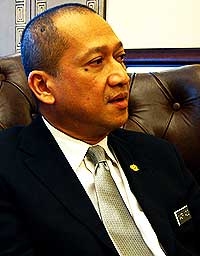 Nazri's comments were made at the Asia-Pacific Parliamentary Consultation on the Universality of the Rome Statute of the ICC, held at the Parliament on March 9 and 10.
Gabriel described the conflicting statements coming from a cabinet minister and the head of the government's legal affairs department as a case of "Jekyll and Hyde" played out before an audience that included ICC president Justice Sang-Hyun and MPs, lawyers, policy makers and government officials from the Asia Pacific and Europe.
"While stopping short of stating Malaysia's commitment to ratify the (Rome Statute), Nazri, however, sent strong signals that the Rome Statute needed the resolute support of more Asian countries to end impunity and restore justice.
"In contrast, the cautious remarks of the attorney-general the following day threw a wet blanket onto the consultation by dashing any hope that the participants could have had on Malaysia's position on the ICC," she said in a statement today.
Drop 'two-faced' personality
Gani said, among other things, that Malaysia should not ratify the Rome Statute "just to look good" and that there are " little-little things " that need to be scrutinised.
He did not did not explain what these "little-little things" were.
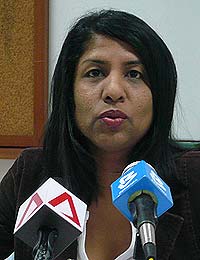 Gabriel (
right
) argued that Malaysia should commit to the ICC because the country has a poor track record on many human rights issues.
Gabriel (
right
) argued that Malaysia should commit to the ICC because the country has a poor track record on many human rights issues.
"Malaysia lags behind many other countries in respecting and signing core international conventions on human rights.
"To date, it has only ratified the Convention on All Forms of Discrimination Against Women (Cedaw) and the Convention on the Rights of the Child (CRC)," she said.
Suaram wants the government to drop its "two-faced personality" on human rights and justice by immediately ratifying core international treaties, including the Rome Statute.
"This must, of course, commensurate with improvements to the domestic human rights situation and the repealing of all anti-human rights laws with immediate effect," Gabriel added.
AG criticised
In a related development, organising secretary for the inter-parliamentary seminar M Kulasegaran criticised Gani's speech during the event, in which he had stated his objections to the ICC.
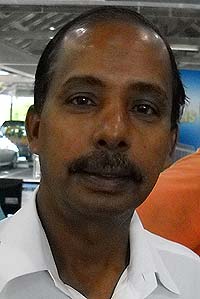 According to Kulasegaran
(right)
, Gani stated that Malaysia would have to amend or repeal a host of laws in order for it to comply with requirements to ratify the Rome Statute.
According to Kulasegaran
(right)
, Gani stated that Malaysia would have to amend or repeal a host of laws in order for it to comply with requirements to ratify the Rome Statute.
Such laws include the Internal Security Act, which allows detention without trial, and other laws that violate human rights.
“The attorney-general said his role is merely to advise the government but policy is set by the government. But the reasons he gave were unfounded,” said Kulasegaran.
Kulasegaran, the Ipoh Barat MP and a lawyer by profession, said Malaysia has ratified other international treaties before, such as Cedaw and CRC, and only amended relevant laws years after.
“Supporting the ICC is in Malaysia’s interest to portray an image that it respects the rule of law. About 120 of 195 countries have already ratified the Rome Statute.
“It is important to us and the world because the ICC acts as a deterrent to disorder and brutal regimes. The ICC has taken up cases against brutal rulers such as Libyan leader Muammar Gaddafi and Serbian leader Slobodan Milosevic."


