




MACC man admits graft-buster has problems
A senior official of the national anti-graft commission admitted today that there are several areas in its management and enforcement that need mending.
A senior official of the national anti-graft commission admitted today that there are several areas in its management and enforcement that need mending.
Malaysian Anti-Corruption Commission (MACC) deputy commissioner Mohd Shukri Abdull conceded to the royal commission of inquiry into the death of political aide Teoh Beng Hock that there were problems in the way the graft-busting agency works.
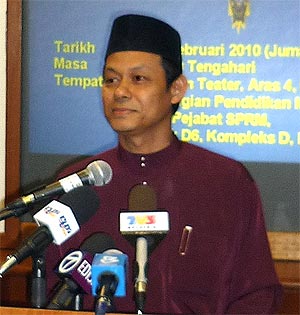 Among the problems Shukri (
right
) cited were the conduct of enforcement officers in following procedures as well as the lack of manpower and space.
Among the problems Shukri (
right
) cited were the conduct of enforcement officers in following procedures as well as the lack of manpower and space.
“The practice at the MACC is to jot down the important points (pertaining to investigation) of that day, so that one or two days later it can be written as a narrative in investigation diary (ID) form,” he explained.
Bar Council lawyer Cheow Wee had asked Shukri on guidelines for enforcement officers, especially those involved in investigation and operations in filing their investigative diaries.
“In practice, because an officer has plenty of cases, we jot down important points. Then when there is time, we narrate in the ID,” said Shukri.
At this juncture, inquiry panel head James Foong interrupted Shukri and reminded him how several of the officers involved in Teoh’s case had neglected to fill the pages of their ID until weeks to months later.
“Your officers seemed (to be) like Superman,” said Foong, as Mohd Anuar Ismail, the MACC investigations officer in the case where Teoh appeared as a witness, had typed out his ID only a month later.
 However, Shukri immediately responded, “I am not going to defend my officers. If they did something wrong, it is wrong”.
Teoh was taken in as a witness to the Selangor MACC office on the 14th floor of Plaza Masalam, Shah Alam on July 15, 2009, and held overnight to assist the agency, which was investigating his employer, Seri Kembangan assemblyperson Ean Yong Hian Wah, who was accused of swindling state funds.
His body was discovered sprawled on the fifth floor landing of the same building the next day.
The royal panel was set up in January following public pressure after an 18-month long inquest into Teoh’s death delivered an open verdict.
Besides getting to the bottom of causes and circumstances surrounding the political aide’s death, the inquiry is also tasked to check on the MACC if they had violate human rights in course of their investigation and to improve its methods.
‘A candid officer’
Foong, who appeared to have a liking for Shukri for his blunt acquiescence, said, “You are a candid officer. Your answers are logical, (unlike) the others”.
Cheow then asked if enforcement officers are allowed to edit their IDs, and Shukri replied only if the officer had missed out on facts of the case.
He also concurred with Foong that it is wrong for officers to record IDs a few months after the investigation was carried out.
Shukri informed the inquiry that there have been reforms since March this year on how operations are tackled as well.
“All high profile cases must be reported to the MACC headquarters from the moment the investiagtions papers are opened,” said Shukri, pointing out several reforms that have been undertaken since Teoh’s death two years ago.
This measure, he said, was in addition to the already existing “corruption reporting information system “(C-RIS)”.
“Covert investigations (such as intelligence) are not registered under C-RIS to protect the secrecy of the probe to others and this may disrupt investigations,” he said.
Quizzed on the cumbersome workload of the Selangor MACC officers, who were on duty round-the-clock during the operation on state fund misappropriation, Shukri said the agency is immensely stretched until an operation ends.
“We are going on road shows to hire staff but there are still many who are reluctant,” he said.
MACC’s success rate
Foong pointed out that the MACC has a “less and than favourable” image of “letting go of the big sharks”.
Shukri agreed that this was the reason for the mediocre success of the Malaysian anti-graft agaency.
“In China, they have a 100 percent success rate in tackling corruption, in Hong Kong and Singapore it’s 90 percent, while Malaysia has only (achieved) 76 to 80 percent success rate in convicting (offenders),” he complained.
 As an example, Shukri said that the MACC has only eight experts in the field of information communications technology (ICT).
“It is not about increasing manpower. It is about the quality of manpower. We have accepted more professionals lately. More bankers, accountants and lawyers,” he said.
Meanwhile, touching on the types of techniques used on witnesses and suspects to elicit their statements, Shukri denied that any force is used.
The responsibility of a witness is to tell the truth, said Shukri, “We don’t look at the issue of force. A witness must tell the truth and disclose all the facts they know to the MACC.”
“We use many techniques. We show whatever documents we have and tell the witness not to lie. We use techniques like explaining it from a religious point of view. We convince them that corruption can cause trouble for their family or we make them believe that they are not the only ones who are corrupt,” said Shukri.
“We use these techniques to get the truth. In many corruption cases, many people do not want to come forward as the giver and taker are friends, business partners or employer and employee,”
“They are very close, so we must use psychological methods,” he said.
The inquiry resumes tomorrow with Shukri on the stand.


Are you sure you want to delete this comment?
This action cannot be undone.