




Ministry to act against 'fake eggs' dealers
Those behind the distribution of ‘fake eggs’ in the country would be penalised under the Consumer Protection Act 1999, said the Deputy Domestic Trade, Cooperative and Consumerism Minister Tan Lian Hoe.
Those behind the distribution of ‘fake eggs’ in the country would be penalised under the Consumer Protection Act 1999, said the Deputy Domestic Trade, Cooperative and Consumerism Minister Tan Lian Hoe.
She said the ministry would not permit the spread of such fraudulent activities. It was also looking to use other relevant acts to speed up action on these illegal sales.
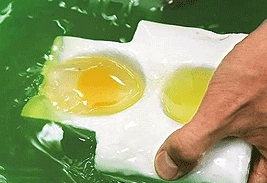 "Our officers are still on the ground checking on the matter and we hope to catch hold of the culprit behind it soon, because we cannot sacrifice our consumers’ lives for their (businessman) profits," she said.
She was speaking after the presentation of a RM10,000-cheque for earthquake and tsunami victims in Japan here on Friday.
The cheque, from Wanita Gerakan, was presented to the Japanese embassy’s deputy chief of mission, Koichi Ito.
Tan added that the sale of "fake eggs" was prohibited.
She also advised consumers to lodge a report with the ministry if such profiteering took place in their neighborhoods.
"As consumers, they should come forward to inform the ministry and, at the same time, boycott this type of business because it is non-ethical.
"The businesses that we want are win-win situations where the consumer obtains satisfaction from the goods offered by businessmen," she added.
On Thursday, the ministry's officers seized 270 eggs from stalls at Pulau Tikus, Penang wet market, following claims that "fake eggs" were being sold.
'Why do we need fake eggs?'
Meanwhile, an egg supplier in George Town finds it hard to believe that ‘fake eggs’ are sold in Penang as they are obtained directly from chicken farms.
The supplier, who just wants to be known as Tan, said news of ‘fake eggs’ had adversely affected business as consumers doubt the authenticity of eggs sold in the market.
“Why do we need fake eggs. Supply is not a problem and the profit is not much,” said Tan, a major supplier of eggs in Penang.
On Wednesday, the Consumers Association of Penang (CAP) claimed that a buyer who bought eggs from a market at Pulau Tikus foudn them to be fakes.
The ‘fake eggs’ are said to be larger, odourless, shiny and infuced with chemicals feared to be harmful to consumers.
CAP's investigation found that the egg shell is made of synthetic paraffin wax, gypsum and calcium carbonate powder and the yolk and white consist of natrium alginate, alum, gelatin, benzoic acid, calcium chloride, water and food colouring.
Tan, 40, said that he received his supply of eggs from poultry farms in Seberang Prai, Kedah and Johor.
“I have been a supplier of eggs for about 30 years and have never heard of such things here. However I did hear about such eggs in China.
“The eggs in question are probably bad. As for the size, eggs come in many sizes, colours and and shapes.”
Tan, who supplies eggs to markets, hotels, restaurants and retail shops, said that he could supply up to 180,000 eggs daily.
- Bernama


Are you sure you want to delete this comment?
This action cannot be undone.