




Taib cult spawns stories of traffic with the occult
Governing, no matter who does it, is part philosophy, part exigency, part panic, part payoff. And it's never easy to ascribe precise percentages to each part.
When the tenure of one leader goes on interminably, there's is often another factor that figures in the conjecture about the reasons for its longevity: willingness to traffic with the occult that supposedly confers immunity against adversity.
Independent candidate for Balingian, Salleh Jafaruddin, has alluded to the "foreign witchcraft apparatus" around Chief Minister Abdul Taib Mahmud, shedding hints of plots hatched to divert the country's most durable state chief executive from the writing on the wall, which is that it is time he went quietly into retirement...
Governing, no matter who does it, is part philosophy, part exigency, part panic, part payoff. And it's never easy to ascribe precise percentages to each part.
When the tenure of one leader goes on interminably, there's is often another factor that figures in the conjecture about the reasons for its longevity: willingness to traffic with the occult that supposedly confers immunity against adversity.
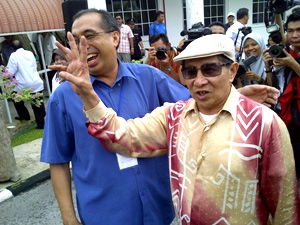 Independent candidate for Balingian, Salleh Jafaruddin (
right
), has alluded to the "foreign witchcraft apparatus" around Chief Minister Abdul Taib Mahmud, shedding hints of plots hatched to divert the country's most durable state chief executive from the writing on the wall, which is that it is time he went quietly into retirement.
Independent candidate for Balingian, Salleh Jafaruddin (
right
), has alluded to the "foreign witchcraft apparatus" around Chief Minister Abdul Taib Mahmud, shedding hints of plots hatched to divert the country's most durable state chief executive from the writing on the wall, which is that it is time he went quietly into retirement.
The fact that Salleh is a cousin of the CM's and has imputed devious motives to a sister of Taib's, a flunkey of the sister's and a state minister, supplies grist for the rumour mills.
Photographs in the media of one or other members of this retinue have only heightened the suspense in what Salleh purports to tell.
Reports of palace intrigues take on a more sinister hue when someone with blood ties to the inner sanctum drops out to prattle on the goings-on.
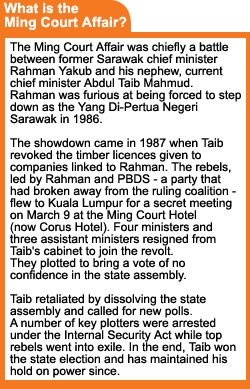 Though Salleh has long been estranged from Taib - he was a key player in the move to topple Taib in the Ming Court Affair of the mid-1980s - he has connections to the ruling elites in Kuching to make intelligent guesses about what is going on in Demak Jaya, where Taib resides.
Salleh, if he were not so unlucky which incurred him a spell as a bankrupt, could have parlayed ties of kinship to Melanau families into credentials for succession to the post of chief minister.
For the past four decades, the Melanau of the western coasts of the topographical oddity of land that is Sarawak, have supplied the plotters in the state's political dramas.
Some of these players have gone to an early grave, frustrated by failure to unseat Taib; others have reconciled with Taib, like his uncle and former nemesis, Rahman Ya’kub; but a few like Salleh have persisted in their opposition, and are now circling like vultures over carrion.
They know Taib's days are numbered and are hoping to position themselves to advantage for the post-Taib phase of Sarawak politics.
Unable to come up with alternative visions for the state's future, they think it's more effective to rely on matters that are actually difficult to verify - like trafficking with the occult - as means to depose the CM.
In a state whose history's is drenched in stories of leaders who have displayed charms and amulets, Salleh's allegations against Taib are horribly passé.
Endowed with mystical powers
Taib does not believe in shamans and bomohs as in kiai, the religious teacher, of Javanese provenance, who is endowed with mystical powers.
A student of comparative religion - Taib is familiar with the scriptures of not just his native Islam, but also of Christianity and other established religions - the CM was introduced to a kiai by his first political secretary, Abdul Rahman Hamzah, in the early years of his now 30-year tenure.
Since then there have been a number of kiai who have had their turn in Taib's religious cohort, their influence waning or waxing in tandem with the ebb and flow of their powers.
On occasion Taib has introduced his kiai to rulers, foreign and domestic, one or the other of them having gone on to wax rich on the favour of personages that took to them.
However, Taib once dryly observed to a political aide that Dr Mahathir Mohamad, the former prime minister, "is not bothered about these matters."
Indeed it's hard to envisage one with Mahathir's mind-set dabbling in "these matters;" the latter has too empirical a bent to want to fritter his time on the esoteric.
It was understandable that as Taib's ability to outwit plots and overcome adversaries became evident, myths of his invulnerability grew around this prowess.
Inevitably, adversaries began to give a sinister hue to Taib's consultations with kiai. The longer he endured on his CM's seat, the more resilient were the stories about his reliance on what was bruited about as not natural. This was the inevitable by-product of his longevity in power.
One of the stories of the renowned novelist Joseph Conrad, set in the East Indies in the 1890s, was about a local chieftain, a raja, who in a crisis, having lost his magical counselor, swims out one night to one of the merchant ships in the harbour, to ask the sailors, representatives of the immense power that has come from the other end of the world, for an amulet, a magical charm.
The sailors are at a loss, but then someone among them gives the raja a British coin, a sixpence commemorating Queen Victoria's jubilee, and the raja is well pleased.
Conrad loaded the story with philosophical implications for both sides. The story is an allegory for the philosophical hysteria that reigns on one side and the philosophical adequacy that holds sway on the other.
Trying to assign the sides in this Conradian fable to the players in the tussle for Balingian would not be easy, except to note that both Taib, supposed harbinger of modernity for Sarawak, and Salleh, sometime CM presumptive, are insufficiently liberated from the yen for amulets and charms.
TERENCE NETTO has been a journalist for close on four decades. He likes the occupation because it puts him in contact with the eminent without being under the necessity to admire them. It is the ideal occupation for a temperament that finds power fascinating and its exercise abhorrent.


Are you sure you want to delete this comment?
This action cannot be undone.