




Five days to go, polls campaign at fever pitch
With five days to go before polling in the Sarawak state election, campaign fever is at a white-heat.
The news that BN chairperson and Prime Minister Najib Razak is devoting the remaining days to the vote to barnstorming the state is evidence that the ruling coalition, not seriously challenged except in 1987 for political supremacy in Sarawak, is facing difficulties...
With five days to go before polling in the Sarawak state election, campaign fever is at a white-heat.
The news that BN chairperson and Prime Minister Najib Razak is devoting the remaining days to the vote to barnstorming the state is evidence that the ruling coalition, not seriously challenged except in 1987 for political supremacy in Sarawak, is facing difficulties.
Normally, campaigning for the BN is, in the main, the task of the deputy prime minister, but this time the No 1 in the ruling coalition has plunged in full tilt at the tail-end.
 Big crowds at Pakatan rallies in Kuching, Sibu and Miri may be the reason for the shift in the campaign burden from the DPM to the PM.
The fact the crowds are largely youngish-looking support speculation they have had access to wider sources of information than available in the mainstream media that is uniformly subservient to the ruling oligarchy.
Based on past practice, the PM's presence in the campaign period of a Sarawak state poll is sporadic and strategic: he appears at points when the overall BN message can be conveyed in the most symbolic manner and in the saffron glaze of blanket TV coverage.
So for the PM to descend on the state in full campaign gear and over an extended period is being read as an unprecedented signal of distress in BN's calculation of its overall prospects.
 Also, that the PM was at pains to assure audiences on his campaign trail yesterday that Chief Minister Abdul Taib Mahmud is indeed going to quit soon reinforces the impression that, for the first time in his long tenure, the CM's overstaying in office is a pivotal issue.
In a state where issues like corruption and transparency of governance, which can be relied on to excite urban voters on the peninsula but lack traction here, Taib Mahmud's lingering stay has allowed the electorate to personalise their resentments.
BN faces a confluence of issues
True, the state BN has probably never before faced such a confluence of issues that places it at a disadvantage.
Not only matters of recurrent concern like threats to Native Customary Rights land, but also the impoundment of Malay language bibles, and the uprooting of hamlets in the deep to make way for the building of dams, have combined to besiege the BN in this election.
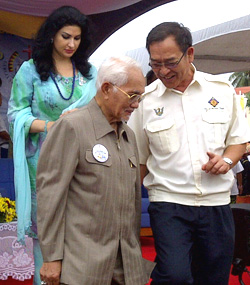 Into this welter of issues that stirs popular resentment, the matter of the long-staying CM, about whose wealth stories are legion and of the carping kind, has become an issue that is readily personalised.
The Pakatan posters festooning strategic entry points into urban thoroughfares in cities in the state equate support for beleaguered BN component, SUPP, with support for Taib, captured the mood simply and strikingly.
The history of successful political campaigns corroborates the theory that parties and candidates ride to power on the wave of a salient message that can be encapsulated in a striking word or image.
The Pakatan equation of a vote for SUPP with a vote for Taib's continuance in power and Najib's scramble to assure voters that the CM is indeed retiring soon condenses the pivotal issue of the 10th Sarawak state poll into a bellwether.
It is the reason for Pakatan's confidence going into the final week of the campaign as it has certainly been the cause of a shift of campaign duties from the DPM to the PM.
But as seasoned observers of Sarawak polls know, the last 72 hours before polling are decisive to the eventual result. That is when the moneybags appear and village chiefs are drawn into a collusion whose contractual obligations help sway the vote down the corridors of longhouses.
If Pakatan do well, it will be because new allegiances have overridden traditional patterns of voting behaviour. As in tectonic shifts, they have to come from the ground up.
TERENCE NETTO has been a journalist for close on four decades. He likes the occupation because it puts him in contact with the eminent without being under the necessity to admire them. It is the ideal occupation for a temperament that finds power fascinating and its exercise abhorrent.


Are you sure you want to delete this comment?
This action cannot be undone.