




Slew of M'sia-China projects signed during Wen visit
Malaysia and China signed a slew of economic agreements Thursday, reinforcing an uptick in relations and a bid to identify new areas of regional economic cooperation.
Malaysia and China signed a slew of economic agreements Thursday, reinforcing an uptick in relations and a bid to identify new areas of regional economic cooperation.
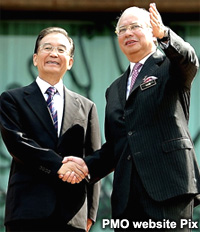 The deals, witnessed by premier Najib Razak and his Chinese counterpart Wen Jiabao during a two-day visit to the Malaysian capital, will see the setting up of power plants, an aluminium smelter and other infrastructure projects in the country.
The deals included a contract between China Huadian Engineering Co and Malaysia's Janakuasa to build a coal-fired plant and a pact between DiGi and China's ZTE Corporation to supply telecommunications network infrastructure, according to a statement from the Malaysian government.
Aluminium Corporation of China also signed a joint venture agreement with Smelter Asia Sdn Bhd to build a smelter in Malaysia.
The Chinese company had earlier inked a framework agreement for a US$1 billion aluminium smelter in Sarawak, though the project has yet to get off the ground.
Joint ventures
The agreements come as Wen concludes a two-day official visit to the country on Thursday.
"Today's signing to expand and deepen economic and trade cooperation signifies a deep commitment between the two governments to identify new areas of economic collaboration that should stimulate more trade and investment between both countries," Najib said following meetings with Wen.
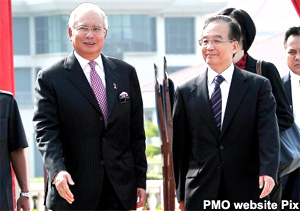 "We are very confident that given (Wen's) strong leadership that China will continue to grow and provide strong impetus for global economic growth," he added.
Najib also expressed appreciation "of Premier Wen's commitment that China will continue to buy big quantities of palm and palm oil products."
"We also touched on ways to increase investment and identified certain important infrastructure projects that Chinese investors can get into," he added.
The Chinese premier said that "the development of an equal and beneficial relationship would bring greater benefit to both countries."
"China appreciates Malaysia's role in enhancing the ties of China with other Asean countries," he added.
Wen also said Malaysia's central bank has been given approval to set up a representative office in Beijing.
In 2009, China signed currency swaps with Malaysia and Indonesia in a bid to give the yuan a bigger international role.
Big buyer of palm oil
China is a big buyer of Malaysian palm oil although its imports of the vegetable oil last year fell 12.5 percent to 3.4 million tonnes.
The Asian giant is the second largest buyer of Malaysian palm oil after India, purchasing over 3.4 million tonnes last year, a 12.5 percent drop from 2009, say officials.
Last January, China's leading power grid operator SGCC and Malaysian development fund 1MDB announced plans to establish hydropower plants and a massive aluminium smelter in Sarawak.
An official told AFP that Thursday's deals were in addition to those announced in January, but did not give further details.
China was Malaysia's largest trading partner with bilateral trade worth $45.66 billion last year, its second largest export destination and largest source of imports.
Malaysia has also been China's largest trading partner in the 10-member Asean grouping since 2008.
A China-Asean Free Trade Agreement came into effect in January last year, forming an economic bloc of 1.9 billion people.
- Agencies


Are you sure you want to delete this comment?
This action cannot be undone.