




Investors wary of slow NEM reforms, says report
Malaysia needs to speed up major structural reforms under its ambitious New Economic Model (NEM), if it intends to capitalise on its “vast unrealised growth potential”, said the World Bank.
Malaysia needs to speed up major structural reforms under its ambitious New Economic Model (NEM), if it intends to capitalise on its “vast unrealised growth potential”, said the World Bank.
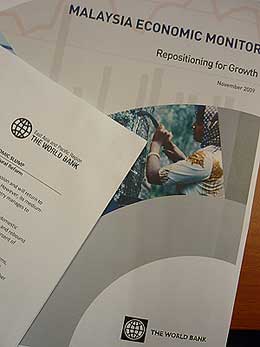
Its Malaysia Economic Monitor report, released yesterday, pointed out that investors both locally and overseas remain sceptical over the impact of the NEM’s “cross-cutting” reforms plans, with many leaving the proposed measures out of their medium-term forecasts for the country’s economic growth.
 The report noted that investors instead flagged the NEM’s measures - which entail major structural shifts in the way government agencies work with each other - as upside risk factors, or variables that may contribute to higher than expected returns.
The very issue of inter-agency coordination, as part of a need for a “comprehensive overhaul of policy frameworks”, is dogging investor confidence in Malaysia as such efforts require many years of steady implementation before any results can be seen.
This, said the report, ties in with the issue of perception, where a “gradual and incomplete implementation” of the NEM would do little to stem the erosion of the Malaysian economy’s strength domestically and globally.
“Given the importance of the cross-cutting policy reforms, the apparent high level of scepticism and the perceptions issue, it is in our view critical that NEM implementation is accelerated.
“Bolder efforts will be needed to sway investor sentiment and tap into Malaysia’s vast unrealised growth potential amidst intensified regional competition,” the report said.
The report, the fourth in a series of twice-annual reports published by the World Bank, said that if Malaysia fails to push the NEM forward, the economy would likely suffer a double whammy from regional and local factors.
In such a scenario, the country would be left on the hind foot as regional competition for trade, talent and foreign direct investment (FDI) is expected to get tougher as shown over the past decade with new economic powerhouses, such as China, coming to the fore.
“In addition, Malaysia is chasing a moving frontier, since other countries are implementing reforms. There is, for example, a great similarity between the measures proposed under Malaysia’s NEM and the policy directions taken under China’s 12th Plan.”
Billions in ‘untapped’ FDI
Locally, the World Bank said Malaysia is likely to face a continued trend of weakened dynamism that followed the period of the Asian financial crisis in the late 1990s, in the absence of an “incisive course correction”.
The need for structural reforms was again brought into stark contrast by a study carried out by the World Bank on Malaysia’s potential FDI from Organisation for Economic Cooperation and Development (OECD) member countries between 2007 and 2009.
The study showed that Malaysia earned some US$3.8 billion in FDI over the period, despite predictions that the country would earn some US$5.5 billion.
It was however projected that with just a slight improvement to policy reforms, Malaysia could have nearly doubled its FDI earnings to US$7.1 billion.
In a third scenario, with Malaysian policies elevated to best practices status on par with neighbouring Singapore, the predicted FDI inflow shot up exponentially to US$15.3 billion.
The study concluded that while Malaysia has done “spectacularly well” in attracting FDI between the 1970s and 1990s, coupled with rising wages and improved infrastructure, the country at the same time lagged in expansion of its workforce’s skills base and innovation of firms and does not have an investment policy regime that is as open as comparable economies in the region.
“The results show that with further structural reforms in the FDI policy regime and innovation-related activities, Malaysia has the potential to do much better in attracting FDI in the future,” the report said.


Are you sure you want to delete this comment?
This action cannot be undone.