




S'pore ministers and their staggering salaries
According to The Economist , Singapore's prime minister is the highest paid leader in the world.
Lee Hsien Loong’s annual salary of USD2,183,516 (RM6,593,129), is about 24 times Prime Minister Najib's monthly salary of RM22,826
According to The Economist , Singapore's prime minister is the highest paid leader in the world.
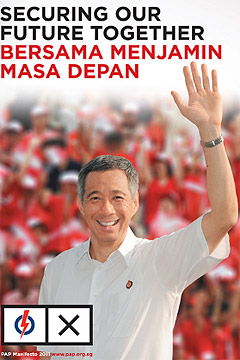 Lee Hsien Loong’s (
right
) annual salary of US$2,183,516 (RM6,593,129), is about 24 times Prime Minister Najib's monthly salary of RM22,826
Lee Hsien Loong’s (
right
) annual salary of US$2,183,516 (RM6,593,129), is about 24 times Prime Minister Najib's monthly salary of RM22,826
On top of the Singapore PM's salary, he and other ministers also get a pension if they have served for at least eight years in office.
As ministers’ pensions was a hot issue during Singapore's recent general election on May 7, the secretary to the Prime Minister's Office had to write a letter to the Singapore Straits Times to clarify how much ministers get by way of pensions.
In this connection, I would like also to refer to the article ‘Pension about a tenth of minister's pay’ ( Straits Times , May 14).
According to the budget, the Singapore government's liabilities as at March 31, 2010 for the pension fund is S$10.6 (RM25.9) billion.
Since this is the provision for the pensions payable to eligible civil servants and political appointees in Singapore, how much of this sum is attributable to political appointees, like ministers, members of parliaments (MP), parliamentary secretaries and so on?
How many political appointees in Singapore are currently receiving pensions?
 To illustrate the sums involved, take as example a 27-year-old new political appointee (such as Singapore ruling PAP's youngest MP from the recent election) who eventually becomes a minister, and steps down at 50.
Since the latest available Singapore Public Service Division (PSD) figures for 2009, that an entry-grade minister received an annual salary of S$1.57 (RM3.83) million, the annual pension may be around S$157,000 (RM383,000).
If the retiring minister lives to 90 years old (life expectancy for a female at around the 20 percent survival probability), the total lifetime payout is S$6.28 (RM15.32) million, or a present value liability to Singapore taxpayers of about S$3.6 (RM8.8) million, using the current 3 percent discounting formula applied in computing pension liabilities.
Selective revival of abandoned pensions?
As the above example is for just one entry-grade minister, how much would the figure be for a cabinet minister in Singapore?
 Also, since the Invest Fund of S$469 (RM1,145) million, is the provision for the pensions of the Singapore Home Affairs (Ministry) Uniformed Services (HUS), does it mean that the total pensions liability is about S$11 billion (RM27 billion) (S$10.6 billion plus S$469 million)?
For example, according to the Singapore Health Sciences Authority's (HSA) financial statements for 2007/8, "In the prior year, a provision of S$240,734 (RM587,717) was made for three eligible officers who exercised the option to return to the pension scheme as offered by the government".
Since the pensions scheme was terminated many years ago in Singapore, why are 'eligible' officers allowed the option to return to the pension scheme?
Does this mean, for example, that a Singapore civil servant who is promoted to the Administrative Service, or becomes a political appointee, may be given this option?
When a pensionable civil servant resigns to stand as a candidate in the Singapore elections, does it mean that he or she will lose all service pensionable benefits, or does it mean that they may be transferred or credited in some way, if they become political appointees?
What is the criteria to qualify as an 'eligible' officer?
Too many questions
 Does this option to return to the pensions scheme mean that past service may also be credited for the purpose of the pension benefits, i.e. a sort of back-dating of benefits?
If this is the case, is any adjustment made for the Singapore employer's Central Providend Fund (CPF) contribution to the 'eligible' officer's CPF account over the years?
By the way, the liability under the Singapore Government Securities Fund is S$331 billion (RM808 billion).
In contrast, Malaysia's total government securities issued as of March 2010 is only RM55.4 billion.
The author thanks Joey Foo for raising the issue and providing all the research for this article.
LEONG SZE HIAN’s late father moved from Kuala Lumpur to Singapore in 1952. Since he was born in Singapore in 1953, there may be some confusion as to whether he was conceived in Malaysia or Singapore.


