




June 2 decision over Jenain's police report
The Sessions Court in Shah Alam today set June 2 for a decision as to whether the prosecution can tender the police report lodged by Cpl Jenain Subi in the case involving the death of teenager Aminulrasyid Amzah, after commencement of the trial.
The Sessions Court in Shah Alam today set June 2 for a decision as to whether the prosecution can tender the police report lodged by Cpl Jenain Subi in the case involving the death of teenager Aminulrasyid Amzah, after commencement of the trial.
Judge Latifah Mohd Tahar set the date after hearing arguments from both the prosecution and defence on the matter.
The matter arose after Jenain’s counsel M Athimulan objected to the prosecution’s attempt to question Jenain on the report, which was lodged by the accused a few hours after the teenager was killed.
Aminulrasyid died after he was hit by a bullet while trying to escape police during a high-speed chase here in the early hours of April 26 last year.
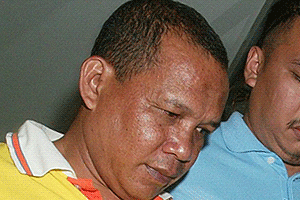 Jenain (
left
), 48, has been ordered to enter his defence to causing the death of Aminulrasyid, 15, between 1.10am and 2am at Jalan Tarian 11/2 in Shah Alam on April 26, 2010.
Jenain (
left
), 48, has been ordered to enter his defence to causing the death of Aminulrasyid, 15, between 1.10am and 2am at Jalan Tarian 11/2 in Shah Alam on April 26, 2010.
He has been charged under Section 304 (a) of the Penal Code which carries up to 30 years jail and also can be fined, if convicted.
Athimulan had argued that the prosecution’s move (to tender the police report) contravened Section 51 (a) of the Criminal Procedure Code (CPC).
“The prosecution should have given us a copy of the report earlier so that we can prepare our defence. It is not fair to us as this can cause testimony by our client to be impeached.
Section 51 (a) reads as follows:
(1) The prosecution shall before the commencement of the trial deliver to the accused the following documents:
(a) a copy of the information made under Section 107 relating to the he commission of the offence to which the accused is changed, if any;
(b) a copy of any document which would be tendered as part of the evidence for the prosecution.
However, deputy public prosecutor Mohd Dusuki Mokhtar contended that Section 145 of the Evidence Act permitted this.
‘Testimony contradicts police report’
He said, as such, Section 51 (a) became redundant because the prosecution did not tender the document at the prosecution stage but instead were doing it at the defence stage.
“The intention of Section 51 (a) is for all parties to prepare their case and have ready necessary documents so that the trial can proceed smoothly. In this case, this matter arose because the accused just testified and we find his testimony to be contradicting with his police report.
“The police report is being tendered for the process of impeachment of the accused’s testimony and not as part of evidence. As such, Section 51 (a) and Section 145 have to be read separately. Under Section 145, whether testimony by witness is contradictory or not, is for the judge to decide,” he said.
- Bernama


