




Electronics industry braces for higher costs ahead
The electronics industry is facing rising costs of doing business in Malaysia on the back of an increased electricity tariff, among others.
The electronics industry is facing rising costs of doing business in Malaysia on the back of an increased electricity tariff, among others.
According to Malaysian American Electronics Industry (MAEI) chairperson Wong Siew Hai, the hike which began on June 1 is expected to raise costs by three to five percent for the industry, which makes up about half of Malaysia’s manufacturing industry. Wong was speaking to reporters after presenting the MAEI’s annual survey on its 21 members.
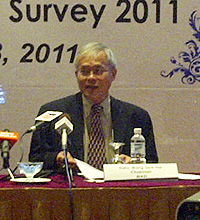 Beyond the tariff hike, Wong (
right
) said the strengthening of the ringgit will also burden the industry, which relies on export.
Beyond the tariff hike, Wong (
right
) said the strengthening of the ringgit will also burden the industry, which relies on export.
“The ringgit appreciation is expected to cut into the margins of exporters who deal with the US and whose terms of trade are fixed to the US dollar,” he said.
Wong added that the industry is also expecting higher cost as it grows its import of foreign labour from about 15,000 workers to 17,000 in 2011.
“Costs are expected to rise due to requirements like workers’ levy, insurance and minimum wage, which we hope to still discuss with the government to lower the cost of doing business,” he said.
He added that the government’s previous foreign labour policy flip-flop was also an added cost to companies which could not plan ahead to fill the high demand for labour in the industry.
“Hiring foreign labour is expensive but companies prefer it to local labour as about 50 percent of local labour leave their jobs after several months, incurring extra training costs for the company.
“With foreign labour we are guaranteed of staff for the next two years. The government says (local labour do not prefer manufacturing) because of the wages, but (operators) can make up to RM1,500 inclusive of benefits and bonuses,” he said.
MAEI is a committee under the American Malaysian Chamber of Commerce (Amcham) and consist of 21 members including electronics giants Western Digital and Texas Instruments, and computer manufacturer Dell.
The electronics industry makes up 54 percent of the nation’s manufacturing export and provides employment to about one million people, or about 30 percent of the sector.
“Where the industry goes is by and large where the Malaysian economy will go,” Amcham president Nicholas Zeffreys, who was also present, said today.


