




High Court rejects million ringgit land claim
The claim of 131 native litigants for 5,000 acres of native land in Pegagau, Sempoana, in a RM500 million suit was thrown out after two days of argument in the Kota Kinabalu High Court on the grounds that it had no original jurisdiction to hear cases involving such land or natives.
The litigants had alleged misrepresentation, breach of trust, fraud, cheating, and conspiracy in their plea before the court since, among others, the land in question has now been re-designated as country lease (non-native) land.
The claim of 131 native litigants for 5,000 acres of native land in Pegagau, Sempoana, in a RM500 million suit was thrown out after two days of argument in the Kota Kinabalu High Court on the grounds that it had no original jurisdiction to hear cases involving such land or natives.
The litigants had alleged misrepresentation, breach of trust, fraud, cheating, and conspiracy in their plea before the court since, among others, the land in question has now been re-designated as country lease (non-native) land.
The 131 litigants acted through six plaintiffs who acted on their behalf as well. Senior Kota Kinabalu lawyer Yunof Maringking was counsel.
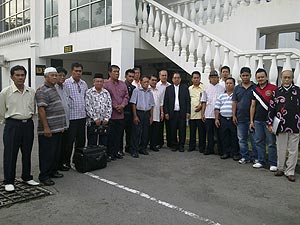 The six were named as Arasad bin Kibtiani, Abdul Rasul bin Ibnu Hassan, Ramlee bin Saraman, Abdil Hamzah bin Julkayani, Marasal bin Danial @ Mohd Salleh and Nurillah bin Amam Lauhari.
The plaintiffs' action against all five defendants including three from the government was dismissed with costs, to be taxed, unless otherwise agreed.
The Sabah state government, the Lands and Survey Department (LSD) and the Suruhanjaya Koperasi Malaysia Negeri Sabah, were the second, third and fourth defendants respectively.
Syarikat Kerjasama Perkembangan Tanah Pegagau Berhad and Syarikat P.J. Nagus Sdn Bhd of Kuala Lumpur were the first and fifth defendants respectively.
Judge Abdul Rahman bin Sebli, according to the note of proceedings released late yesterday evening, did not directly rule on what was the right forum for the natives and issues involving native land.
Chambers first then open court
The suit was almost entirely argued in chambers on Monday, the first day, before being heard in open court the following day.
"I am in entire agreement with the learned counsel for the first defendant that this court has no original jurisdiction to determine or make an order that the plaintiffs are the native customary rights owners (NCR) of the land in dispute," said Judge Rahman in his note of proceedings.
He noted that the other four other defendants support and had adopted the submissions of lead counsel Rakhbir Singh. He was appointed as counsel for the first defendant by Messrs Jahara & Associates.
"I am bound by the recent (2011) decision of the Court of Appeal in Darinsok Pangiran Apan & Others v Hap Seng Consolidated Bhd & Others - 1 LNS 537 - where it was held that the High Court does not have original jurisdiction to hear a claim of this nature," said Judge Rahman.
He added that he did not see how "the ratio decided in that case" has no application to the facts and circumstances of the present case. "It is clear that the Court of Appeal was making a general pronouncement of law applicable in all cases involving claims for native customary rights," he said.
Counsel Rakhbir, touching during his submissions on the right forum for the natives to seek relief cited Section 14 of the Sabah Land Ordinance (SLO) and Section 41(2) under native customary rights. "They (natives) must go to the land office - LSD - first for declaratory relief to declare native customary rights over the said land," said Rakhbir.
He also argued that any native, disgruntled or unhappy with the LSD about any notice, could invoke Section 13 and/or Section 14 of the SLO to compel the department to hear their complaints.
Special justice for native land
If they are (still) not happy, he stressed, "they can take out (a writ of) mandamus - to direct an inferior body - application by way of a judicial review (in the High Court)."
In short, the High Court could only act as an appellate body of sorts when it involves native land and natives.
The only issue before the court, reiterated Rakhbir, was the question of jurisdiction "and the issue of conspiracy (among others) does not arise since the court doesn't have original jurisdiction".
The plaintiffs, in an affidavit in opposition and further affidavit in opposition, pleaded that the Assistant Collector of Land Revenue (ACLR), Semporna, knew that "we had cultivated the land".
In a letter dated Dec 16, 1993, according to the plaintiffs, the ACLR recommended to the state government that it withhold approval of the first defendant's application (for the land) and "establish a smallholders' scheme on the land to prevent further problems".
The plaintiffs had prayed for six orders and declarations from the High Court.
Besides interests, costs and "any other order or relief this court deemed fit and just, the plaintiffs wanted the court to declare that the state government and the LSD had a duty under the state and Federal Constitutions "to protect their interest in the land". They cited Article 41 of the state constitution and Article 153(1) and Article 153(7) of the federal charter.
The plaintiffs wanted a further declaration that they have "permanent, heritable and transferable their right of use and occupancy of the said land under NCR" and their rights thereon were not extinguished by the issuance of the Country Lease (non-native) No. 125329946 to the land in question.
One final plea was for general, aggravated and exemplary damages to be assessed and not exceeding RM500 million from the defendants for inhuman acts and/or treatment suffered and accorded to them by the defendants.
Litany of alleged misdeeds
The colossal sum sought was also for breach of trust, cheating and fraud and/or humiliation, distress, mental anguish and trauma which the plaintiffs and their families suffered as a result of various actions by the defendants.
Counsel Yunof confirmed that he had instructions from his clients to lodge an appeal against the High Court verdict and, at the same time, go back to the LSD to re-visit their plight.
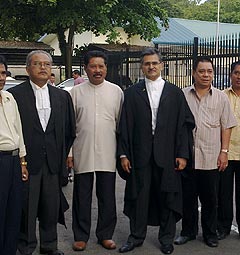 The crux of the natives claim is that the common law position is that NCR rights cannot be extinguished by law or any statue, a position reinforced elsewhere by several recent High Court of Sabah and Sarawak, Court of Appeal and Federal Court decisions involving land cases in Sabah and Sarawak.
The land in question, according to a statement of agreed facts filed in court, is currently either wholly or mostly-owned by the fifth defendant, Syarikat P.J. Nagus Sdn Bhd which has only one shareholder viz. Syarikat Perlating Jerneh Plantation Sdn Bhd.
The first defendant, Syarikat Kerjasama Perkembangan Tanah Pegagau Berhad, transferred the country lease over the said land to the fifth defendant on Oct 29, 1996, according to the statement of agreed facts.


Are you sure you want to delete this comment?
This action cannot be undone.