




Bar: Probe 5 MACC officers for culpable homicide
Unlike the royal commission of inquiry which found that political aide Teoh Beng Hock was driven to suicide , the Bar Council, which took an active role in the RCI, had recommended to the panel that five Malaysian Anti-Corruption Commission (MACC) officers be investigated for culpable homicide.
Unlike the royal commission of inquiry which found that political aide Teoh Beng Hock was driven to suicide , the Bar Council, which took an active role in the RCI, had recommended to the panel that five Malaysian Anti-Corruption Commission (MACC) officers be investigated for culpable homicide.
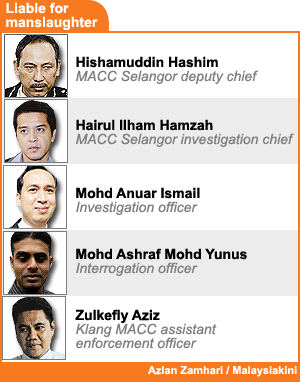 The five officers are former Selangor MACC deputy chief Hishamuddin Hashim, Selangor MACC investigations chief, Hairul Ilham Hamzah, investigating officer Mohd Anuar Ismail, interrogation officer Mohd Ashraf Mohd Yunus and Klang MACC assistant enforcement officer Zulkefly Aziz.
This is in contrast to the RCI finding which only implicates three officers namely Hishamuddin, Anuar and Ashraf.
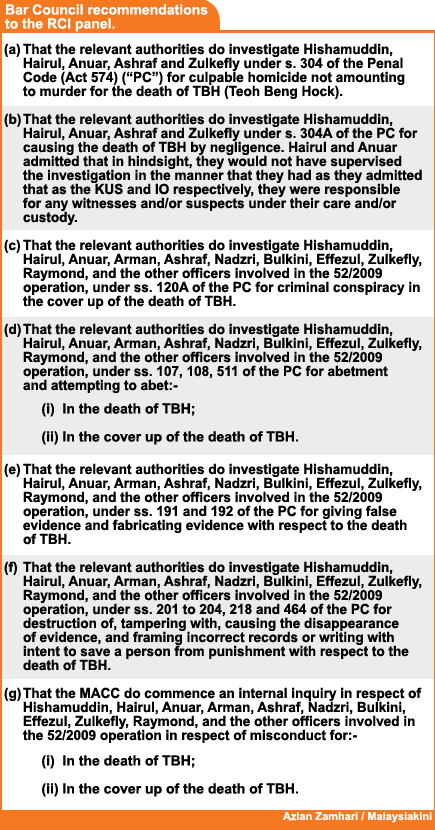
The Bar had recommended that the five be investigated under Section 304A of the Penal Code for causing the death of Teoh via negligence.
Section 304 of the Penal Code, prescribes punishment of between 10 to 30 years jail and a fine under the amended law.
Under 304A, they are liable to face a two-year jail term, a fine or both if found guilty.
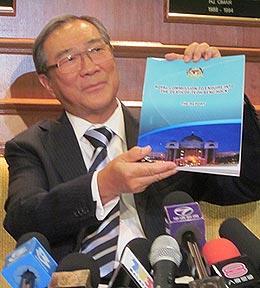
The Bar Council’s recommendation is contained in the 337-page submission to the RCI panel which was finally released to the Malaysian Bar members today. This follows a meeting held last night to discuss the matter.
The submission added that Hairul and Anuar had admitted in hindsight, they would not have supervised the investigations in such a questionable manner as they had as the Selangor MACC investigations chief and the investigation officer in charge of the investigations, and that they were responsible for witness or suspects under their custody.
Criminal conspiracy
The Bar also want the authorities to investigate 10 MACC officers including the five mentioned for criminal conspiracy under section 120A of the Penal Code.
 It also recommended that the 10 officers be investigated for abetment or attempting to abet in Teoh’s death or a cover-up to the political aide’s death.
Furthermore, they also proposed that the 10 officers be investigated for giving false evidence and fabricating evidence under section 191 and 192 of the Penal Code.
Teoh had died while being detained overnight at the Shah Alam MACC headquarters in Plaza Masalam on July 16, 2009.
The recommendations by the Bar for more MACC officers to be investigated is in contrast with what the RCI had recommended in its 124-page report.
The other five additional officers that the Bar Council has recommended action for criminal conspiracy, abetment to cover-up and also for giving false evidence are Bulkini Paharuddin, Effezul Azran Abdul Maulop, Arman Alies, Raymond Nion, and Mohd Nadzri Ibrahim.
Bulkini is the MACC officer who testified seeing Teoh and Kajang councillor Tan Boon Wah's alleged quarel. Effezul is the officer accused of abusing Tan.
Arman and Nadzri are MACC officers who interrogated Teoh, while Raymond is the last person to see Teoh alive.
Lowest category for suicide
The submission noted that when Teoh entered the MACC premises the political aide could be described as being in the lowest category for committing suicide.
"If Teoh had killed himself, the MACC must have done something between his entering custody and the time of his death, as the political aide was under the care and control of the MACC."
 Referring to forensic psychiatrist forensic psychiatrist Prof Paul Edward Mullen's report that states "things must have occurred in the 12 hours or so between his entering custody.
"There are interrogation techniques of the type alluded to in (investigator) Michael Squires's briefing note which can totally destroy a person's mental stability inducing such fear that even death seems preferable.
"Particularly vulnerable to such techniques would be a law abiding citizen with no prior experience, of being in the power of apparently constrained authority, particularly if they were cut off from all contact with sources of help and support," Mullens report states.
The Bar Council noted the existence of evidence on MACC officers capable of adopting such interrogation techniques apparent when they questioned Tan.
This is consistent with what Bar Council chairperson Lim Chee Wee, who said Mullen's conclusions did not include suicide.
MACC covered up circumstances
The Bar Council added there is direct and circumstantial evidence that the inquiry found what it calls "elaborate, massive, consistent and planned" attempt to cover-up the true circumstances to Teoh's death.
It revealed that the purpose of the exercise was to shield and protect certain individual officers directly involved in and responsible for Teoh's death and to cook up the suicide theory.
Hishamuddin, it added knew the state of affairs.
It also said that contrary to what the MACC states, Teoh was treated as a suspect (not a witness) who had voluntarily followed the MACC officers to assist in the investigations. It reported Teoh was not free to leave as he pleased and his handphone was not returned to him.
The submission also stressed to this dayTeoh's original statement had not been produced by the MACC and is said to be missing.
It also noted there was ample opportunity available ,despite claims to the contrary, for Hishamuddin, Ashraf and Zulkefly to clean-up and destroy any trace of evidence.
The submission noted two MACC officers Azian Umar and Azeem Hafiz Jamaluddin had attempted to advise against a cover-up or had expressed hopelessness at the situation.
"They were uncomfortable with the cover up. Azian had warned her superior Hairul, that it would not be beneficial to follow Hishamuddin's instructions as it would backfire.
Azeem was wary about Hishamuddin's heavy handness in directing how MACC officers were to explain his (Hishamuddin's) and their roles when required to so to the authorities."
Coaching of witnesses
"They were coached to render streamlined evidence, and the MACC officers were instructed not to volunteer information but adopt a non-co-operative approach (when testifying)," the report states.
It also alleges the cover-up may have extended to the upper echelons of the Attorney General Chambers, an institution meant to uncover the truth and protect justice, for justice cannot protect itself.
"The complicity of silence and inactivity in the search for the truth extended far beyond MACC to the upper echelons of the AGC.
As an example, Azian informed the RCI that Abdul Razak (Musa, the MACC prosecution head) had instructed him not to volunteer and to suppress information," it said, adding the Klang MACC officers seemed to know Teoh's death even before the body was "found".
Besides the recommended action above, the Bar Council found that Teoh died under MACC's care and custody, the officers perpetrated a cover-up, the MACC officers failed to discharge their duties to account for the political aide's death and they are responsible for it.
As with Bar Council's chairperson recommendation, in the submission the Bar Council wants the RCI to hold the MACC responsible for Teoh's death, the government and MACC to consider offering an unqualified written apology and his family be paid compensation.


Report this comment
Are you sure you want to delete this comment?
This action cannot be undone.