




PM to pump-prime as polls, slowing growth loom
Prime Minister Najib Abdul Razak is expected to unveil fiscal stimulus plans on Friday to shore up flagging growth and win support ahead of likely polls, but a global downturn could derail the government's deficit reduction plans next year.
Prime Minister Najib Abdul Razak is expected to unveil fiscal stimulus plans on Friday to shore up flagging growth and win support ahead of likely polls, but a global downturn could derail the government's deficit reduction plans next year.
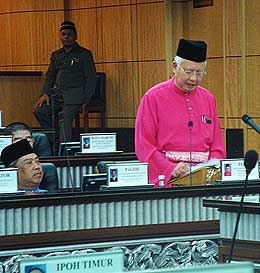
Najib will present the 2012 federal budget in parliament at 4pm, likely to be his last before snap polls that are expected to take place within the next 6 months.
 Citigroup estimates that government revenues will total RM207.7 billion (USD65 billion) this year, nearly a quarter higher than earlier projections, buoyed by higher energy prices and tax collection.
Economists say bigger coffers would enable the government to pump prime while trimming its deficit to around 5.0 percent this year, beating the official target of 5.4 percent and below the 5.6 percent logged in 2010.
"If the global economy slides into a recession, there is a strong possibility that the government will introduce stimulus spending even though it is increasingly finding it more difficult to manoeuvre, having run a budget deficit for the last 14 years," Peck Boon Soon, an economist with RHB Research, said in a note.
With sovereign debt at 53.3 percent of gross domestic product in 2010, a global slowdown could jeopardise the government's plans to cut the long-standing fiscal deficit, economists said.
Najib's biggest headache
Economists expect the government to announce spending plans to boost construction, agriculture and services sector to support growth, which could ironically turn out to be Najib's biggest headache if a global recession hits.
The authorities are also likely to further liberalise key services sub-sectors such as healthcare, education and professional services and announce incentives for the oil and gas industry.
Malaysian economic growth accelerated to a 10-year high of 7.2 percent in 2010 but annual inflation touched a 27-month high of 3.5 percent in June this year, hitting consumers' pockets.
 To cushion the impact of higher prices, Najib is expected to announce handouts on Friday including a bonus for 1.3 million
civil servants as well as food stamps and utilities cash vouchers for households earning less than RM3,000 ($936.125) a month.
Political analyst Ong Kian Ming said in the best case scenario, the handouts could help the ruling coalition win 10 more seats, bringing its tally to 147 seats and one short of the number needed for Najib to regain two-thirds control of the 222-seat legislature.
The government has said measures to mitigate the impact of the rising cost of living would be the centerpiece of Friday's spending plans, mindful of a backlash that contributed to former prime minister Abdullah Ahmad Badawi's early exit from power in 2009.
Signs of export slowdown
Few expect Friday's budget to articulate further on promised economic reforms to avoid unsettling voters, such as introducing a goods and services tax, a more aggressive rollback of subsidies, and restructuring a controversial affirmative action policy favouring the country's majority ethnic Malays.
 Malaysia needs an average of 6 percent annual growth to meet its aim of becoming a high-income nation by 2020, with the government targeting at least 5 percent growth this year.
OCBC Bank economist Gundy Cahyadi said signs are already emerging of an export slowdown due to softening demand, with exports contributing 89 percent of GDP in 2010.
"The slowdown will be hard to avoid, and if things go as what we foresee in 2012, Malaysia's GDP growth may ease to about 3.8 percent year-on-year from our projected 4.7 percent expansion this year," he said.
Some of the measures which analysts expect :
- Increased infrastructure spending and acceleration of public project contract awards;
- Incentives to spur the agriculture, services sectors as well as small and medium enterprises;
- Further liberalisation of key services sectors and additional incentives for key economic sectors including oil and gas. Sectors could include healthcare, education and professional services.
- Legislation on a minimum wage with a median benchmark that would be adjusted in differing locations based on cost of living. Figures suggested by workers and employees associations range from between RM700 a month to RM1,500.
- Announcement on plans to raise the retirement age for private- sector employees from 55 years to up to 64 years.
- Bonus payment or increase in cost of living allowances for the country's 1.3 million civil servants.
- Reduction in import duties on certain food items and a possible liberation of food imports to ease price pressures.
- Food stamps and cash vouchers or coupons for public transport and utilities for household incomes of below RM3,000.
- a cut in personal income tax for lower to middle income earners.
- Reuters
Related stories :
Pakatan MPs want 'plagiarist' judge removed
Shadow budget to rein in high cost of living
Dr M: Pakatan's budget like an empty pocket
Suhakam to meet 'upbeat' AG over security laws
RM9 million spent on PM's jet this year
'We haven't seen draft amendments to land code'
Mubarak: Consider plight of ex-reps in Budget 2012
'Banishment Act outdated, not practical'
Retirees seek cost of living allowance


