




2012 Budget based on too rosy growth projections
COMMENT One of the points of attack against Najib’s 2012 Budget was that he was basing it on too rosy growth projections. As such, the projected budget deficit of 4.7% of GDP, a reduction from the 5.4% in 2011, is probably not realistic.
COMMENT One of the points of attack against Najib’s 2012 Budget was that he was basing it on too rosy growth projections. As such, the projected budget deficit of 4.7% of GDP, a reduction from the 5.4% in 2011, is probably not realistic.
Upon going through the relevant figures in the Economic Report 2011/2012, my finding is as follows: If nominal GDP growth rates for 2011 and 2012 were cut by between 1% to 2%, the projected government deficit to nominal GDP would increase to 5.3% to 5.6% from the 4.7% announced. This can easily increase to beyond 6.0% if a supplementary budget of RM10b is passed after the 2012 Budget, especially if another ‘stimulus’ package is seen to be needed.
Real economic growth projections
According to the table below, the GDP at constant 2000 prices is projected to growth from RM559.6 billion in 2010 to RM588.4 billion in 2011, a projected increase of 5.2%, which is within the 5% to 5.5% projected growth rate announced by the PM in his budget speech.
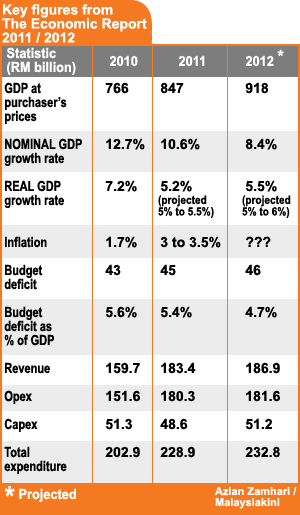 In the same table, GDP at constant 2000 prices is projected to increase to RM620.5b in 2012, a projected growth rate of 5.5%, which is within the 5.0% to 6.0% projected growth rate in the budget speech. Hence, the projected real growth rates used by the MoF are in the middle range of the growth projections - about 5.2% in 2011 and 5.5% in 2012.
Nominal economic growth projections
However, the budget deficit expressed as a percentage of GDP uses the nominal GDP as the denominator, which means that the effects of inflation have not been stripped out. Increases in nominal GDP include both increases in real economic activity as well as increases in price of goods and services.
Projected nominal GDP growth rates include both the real economic growth rate as well as price increases. For example, nominal GDP increased from RM680 billion from 2009 to RM766 billion in 2010, a nominal increase of 12.7%. In comparison, the real GDP growth rate in 2010 was 7.2%, after adjusting for price increases.
Nominal GDP is projected to increase to RM847 billion in 2011, an increase of 10.6% and to RM918 billion in 2012, an increase of 8.4%.
The projected increase in nominal GDP is 2012 is actually lower than the projected increase in nominal GDP in 2011, even though projected real GDP increase in 2012 is slightly higher than in 2011 (5.5% in 2012 compared to 5.2% in 2011).
One possible explanation is that the projected inflation rate for 2012 will be lower than the projected inflation rate of 3% to 3.5% in 2011, which may not be realistic if continued demand pressures and the lack of an increase in interest rates by Bank Negara maintains the inflation rate at around 3% in 2012.
Increases in government expenditure and revenue
The projected increase in government revenue is somewhat conservative at 1.9% from RM183.4b in 2011 to RM186.9b in 2012. Government revenue unexpectedly increased from RM159.6b in 2010 to RM183.4b in 2011, an increase of 14.9%, whereas the 2011 budget projected an increase of 2.3% to RM166b in 2010.
This means an additional RM17 billion was collected as revenue in 2011. The unexpected increase in budget revenues was due to an increase in the Petroleum Income Tax (from RM18 billion in 2010 to RM26 billion in 2011) and in corporate taxes (from RM36b to RM44b).
At the same time, the projected expenditure in 2012 of RM233b is a 9.8% increase from the RM212b projected budget in 2011 and is 1.7% higher than the RM229 actually spent in 2011 (including the supplementary budget). Of course, the projected expenditure of RM233b in 2012 may not be sufficient (as is usually the case) and an expected supplementary budget will probably be tabled in the middle of next year, thereby increasing the budget deficit. The supplementary
The table below summarises the key figures discussed above.
 What happens to the budget deficit and budget deficit as a percentage of GDP if economic growth is lower?
Some economists have questioned the projected growth rates for 2011 and 2012 saying that they are on the optimistic side. How will a lower GDP growth rate change the budget deficit?
Obviously, with a lower growth rate, government revenue from personal and corporate taxes will be lower. Taxes for 2011 should have been ‘locked in’ already for this fiscal year. The only question is the extent to which the revenues will be affected in 2012. Direct income taxes are projected to increase by 5.9% or RM5.6 billion from 2011 to 2012.
The bulk of this increase will come from increase corporate tax revenues (RM3.5 billion) and income tax revenue (RM1.7 billion). Revenue from corporate taxes are particular susceptible to changes in economic conditions as was seen in 2009 where nominal GDP decreased by 8.4% while corporate taxes decreased by 25%.
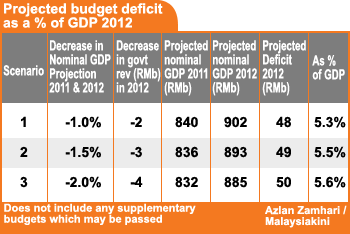
I have constructed three scenarios where I have decreased nominal GDP growth by 1%, 1.5% and 2% respectively for 2011 and 2012. Under each scenario, I have also decreased projected revenues by RM2, RM3 and RM4 billion respectively for the year 2012.
It is not unreasonable to project decreases in nominal GDP rates that are higher than possible decreases in real GDP growth rates because of the GDP deflator effect. The projected decreases in revenue will be felt in the collection of corporate taxes and possibly because of the lower oil prices. Using these projections, I recalculated the budget deficit as a percentage of the GDP for 2012. Table 2 below summarises the results.
While the increase in the projected budget deficit and budget deficit as a percentage of the GDP is not large (the UK government is currently running a budget which is 9% of GDP), it does call into question the longer-term commitment of the current government to reduce the overall debt burden and whether the objective of decrease the budget deficit to less than 3% of the GDP by 2015 is achievable.
This is especially a concern since there were no new revenue measures announced with the exception of changing the terms and conditions of imposing a 10% real property gains tax (RPGT) for properties sold within two years of purchase, is will only net the government a maximum of RM100 million at most.
Comparison with Pakatan Rakyat’s budget
In contrast, Pakatan’s budget caps spending at RM220 billion, has more reasonable revenue projections at RM181 billion (compared to RM186.9 billion for the actual budget), and has more reasonable growth projections of 4% to 4.5% for 2012. This allows for the budget deficit in Pakatan’s budget to be reduced to 4.4% of GDP under much more reasonable baseline assumptions.
DR ONG KIAN MING holds a PhD in political science from Duke University. He can be reached at im.ok.man@gmail.com
Related stories
FBC paid RM84mil 'to spruce up nation's image'
PM's trip to Kazakhstan cost over RM1mil
Deepavali-eve sitting of Parliament criticised
'PM's Perth trip was in his personal capacity'
Pakatan mulls taking Kg Baru Bill to Agong
Gov't to regulate electrical consumption


