




KLIFD: Similar projects have failed before, says Pakatan
Opposition parliamentarians today questioned the need for the Kuala Lumpur International Financial District (KLIFD) project when similar initiatives have proven to be failures.
Opposition parliamentarians today questioned the need for the Kuala Lumpur International Financial District (KLIFD) project when similar initiatives have proven to be failures.
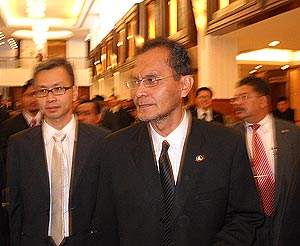 Kuala Selangor MP Dzulkefly Ahmad (
middle
) and Petaling Jaya Utara MP Tony Pua (
left
) said cites the BioValley, E-Village and Multimedia Super Corridor (MSC) as examples.
Kuala Selangor MP Dzulkefly Ahmad (
middle
) and Petaling Jaya Utara MP Tony Pua (
left
) said cites the BioValley, E-Village and Multimedia Super Corridor (MSC) as examples.
Describing the three projects as “unmitigated disasters”, they lament that the Najib administration is now granting KLIFD “generous incentives” under Budget 2012.
Pua said that these projects all failed because they were schemed as property development projects with the government providing financial incentives for companies to be on site.
"There is in reality no practical need for these companies to be sited physically next to one another for the industry to succeed.
"The government has described the role of KLIFD is to turn Kuala Lumpur into a 'new icon for the financial world', 'the global financial city of choice' and 'bring together world-class names to operate closely in a physical location'," Pua told reporters at the Parliament lobby today.
'BioValley became ghost valley'
Under Budget 2012, KLIFD will be given 100 percent tax exemption for 10 years and stamp duty exemption on loan and service agreements, among others.
Comparing the this to the hype behind the E-Village initiative in 2000 under the Mahathir administration, Pua said the project was touted to "attract international film producers" to the country but today E-Village looks like an abandoned ghost town.
"The 1,200-acres BioValley project sited at Dengkil on the other hand, was primed as the transformation project in the Budget 2003 to drive Malaysia's knowledge economy.
“(But) despite receiving generous incentives like all the other projects cited, the BioValley was unceremoniously buried two years later," he said.
Pua also cites a Nature magazine article in 2005 titled ‘BioValley - Valley of Ghosts’ to press his case further.
Proximity redundant in Internet age
Admitting that MSC had fared better, Pua said the project targets were still not met since its inception in 1996.
"We fear that the KLIFD will suffer a similar fate as there is no physical need for financial institutions and related professional services to be sited a stone's throw away from one another.
"There will be little synergy generated as telecommunications technology, video-conferencing facilities as well as secure and instantaneous electronic transaction obliterates the need for proximity," said Pua, who was once a IT entrepreneur before selling off his company to join politics.
He said that the 75 acre land where the Sungai Besi Airport now sits which was given to 1Malaysia Development Bhd to develop the KLIFD without any open bidding further shows that the government was not transparent in its business dealings.
"The government must learn from its failures of the past. The decision of global financial institution to site their offices in Malaysia will not be based on short term benefits as a result of the choice of real estate.
“It will instead be based on the demand for its services and funds, the sophistication of market instruments and the openness of the economy," he said.
Seek human capital, not real estate
Dzulkefly said that a real estate expansion will not guarantee a boost in the knowledge base industry as required by KLIFD.
“Going back to nbuts and bolts, we will never get to that high-income economy. We failed (before) and we will fail again,” he said.
“What we need are the professionals, what we fail to ask is are we getting the professionals especially in (areas such as) high and corporate finance?”
Dzulkefly pointed out that despite having grown substantially in the Islamic banking industry, the country is still highly depended on expatriates.
“As Pua pointed out it is not about putting everything in a physical geographical locations but about training human capital to manage these industries,” said Dzulkefly.
Related stories
Anwar calls for budget showdown


