




The winter of student discontent
COMMENT To paraphrase Shakespeare in his play Richard III, “now is the winter of student discontent, made glorious activism, by this son of Selangor”.
COMMENT To paraphrase Shakespeare in his play Richard III, “now is the winter of student discontent, made glorious activism, by this son of Selangor”.
The suspension and investigation of Selangor-born constitutional law expert Abdul Aziz Bari has sparked a return to the heady days when students took to the streets, and their footfalls did the nation shake, a hallowed tradition on a steady decline ever since.
 Abdul Aziz, an outspoken Universiti Islam Antarabangsa (UIA) law professor, was recently suspended and investigated by the institution for allegedly going against its interestd, amounting to smearing it’s good name.
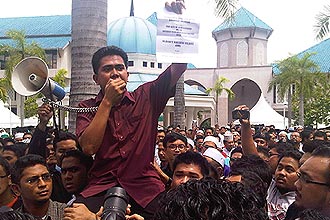
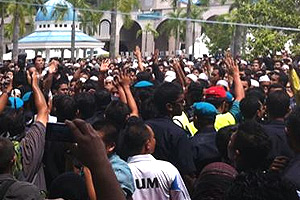
His suspension was greeted by a cacophony of protest from students, the public and academicians alike, culminating in a student demonstration by hundreds of students on the UIA just last week.
A Facebook page set up in his support has since garnered more than 10,000 followers.
 The law lecturer has since been taken off suspension, but may face charges under the Sedition Act for his comments on the statement of the Selangor Sultan regarding an Islamic authority’s ‘inspection’ of a function held on the premises of a Petaling Jaya church.
Student activism, what filmmaker Fahmi Reza ( right ) termed “Student Power”, has seen its sunset years in the last decades or so in Malaysian history, under the heavy thumb of the all-powerful University and University Colleges Act (UUCA).
A crippling Act
Codified in 1971, the crippling Act smothered student activism and took away the independence of higher learning institutions, as the law forced the once self-contained entities to adopt cookie-cutter restrictive regulations and practices, far from being the best.
 As critics of the Act deemed to be draconian argued, the real crimp in this particular piece of legislation is not only in limiting students from participating in socio-political spheres, outside campuses, but also demeaning university authorities into becoming marionettes-on-a-string.
But all is not lost, as the recent ‘student uprising’ against Abdul Aziz’s censure, has shown. Contrary to what many once thought, the heydays of the student-activist may be far from gone. Nor is it just the stuff of history, as Fahmi oft teased.
Of late, they are rising by the scores, the hundreds and thousands soon, a force long suppressed and dormant, now poised to become yet once more significant.
 Abdul Aziz’s story may be their catalyst, but the drumbeats and footfalls are the students’ alone. Theirs is the tempo, theirs is the gist, the once missing ‘
Darah Muda
’, the absence of which Fahmi oft regrets.
Abdul Aziz’s story may be their catalyst, but the drumbeats and footfalls are the students’ alone. Theirs is the tempo, theirs is the gist, the once missing ‘
Darah Muda
’, the absence of which Fahmi oft regrets.
As civil rights lawyer Latheefa Koya remarked in a recent forum on academic independence, the students were already primed, ready for a challenge, Abdul Aziz’s suspension, while significant, was in effect merely a catalyst to a momentum that is already in the building.
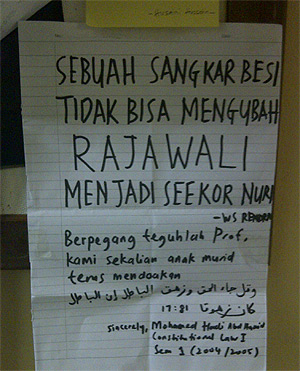
“I was just kind of providing the occasion. And now students, after some skirmishes, just can’t wait to strike back,” Abdul Aziz himself admitted to Malaysiakini recently.
The law lecturer is duly proud that those he once taught and other students are rising up to fight not for him, but for the cause of freedom and the justice he tried so very hard to inculcate in his teachings.
Student re-Renaissance
The students are rising, enraged by recent events like the censure against the UKM 4, arrested while on the campaign trail with an opposition party during a by-election, and other pressures brought to bear on students by a government so desperate to rein them in.
And if the assertions made by the film maker at the same forum discussing Malaysia’s lack of academic freedom are true, what a crescendo their voices might yet still sing.
If once in the seventies, as Fahmi posits, while few in numbers, the 8,000-strong student body shook the nation, now if only ten percent of the one million-strong students were to be activated and transformed into student-activists, they could perchance change the country’s historical course.
 It may not be the Arab Spring nor occupy anything, but student-activism that once shook Malaysia to its core with its round-the-nation student manifesto following the post-election racial riots of 1969, that so worried the government, is once again seeing an awakening.
A student re-Renaissance if you will.
The phenomena are not new, as comparisons have been drawn with what happened in late 2007, the first Bersih pro-electoral reform rally and later Hindraf’s. How these provided the impetus for the ‘political tsunami’ of 2008.
And as civil society has been ignited by the recent government over-reaction against Bersih 2.0, so has the ‘Aziz Bari phenomenon’ sparked the leading waves of student-activism.
Sceptics may claim that this is a dud, the government may play it down as another opposition muslihat (trick), but the distant drums are beating and the steady footfalls keening. The glorious days of student activism, may soon be upon us again. Amen.
As lawyer Fadiah Najwa, who also sat on the panel at the forum, proudly stated: “When we see that students can mobilise like this, all is not lost.”
The government should do well to listen and look out, for as Fahmi said, “The students are young, the want change now, they don’t want to wait.”
HAZLAN ZAKARIA is a member of the Malaysiakini team.


Are you sure you want to delete this comment?
This action cannot be undone.