




Europe faces grim outlook, Asia propels economy
A chief economist predicted that European Union economies will fall back into recession next year, while Asian nations especially China will stimulate the world economy.
A chief economist predicted that European Union economies will fall back into recession next year, while Asian nations especially China will stimulate the world economy.
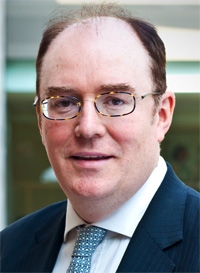 Gerard Lyons of Standard Chartered told China's
Xinhua
news agency in an interview, that year 2012 would see a suffering West and a resilient East in global economy.
Gerard Lyons of Standard Chartered told China's
Xinhua
news agency in an interview, that year 2012 would see a suffering West and a resilient East in global economy.
"It's a two-speed world, a fragile West, but no one can be decoupled from events elsewhere on the globe. Events in Europe are leading things down early in the year, and a rebound in China and Asia is leading things up later in the year," Lyons said.
The latest events in the European Union do not yet reveal a clear path to growth and stability, he said.
"In terms of the euro and Britain, the policy is almost bare and confidence has been hit hard. In terms of confidence, it is market impact, and also economic impact. It's not just a market-driven phenomenon, but what is happening in the market is contributing," Lyons said.
In its annual global economic forecast for the year ahead, Standard Chartered has predicted that Britain's economy would slip into recession, shrinking by 1.3 percent, and the eurozone would fare worse with a 1.5 percent decline.
The bank's figures for the British economy are worse than those of Finance Minister George Osborne and of the Office for Budget Responsibility, an independent economic statistics body.
The global picture, Lyons said, leads to a growing realization among developed economies that significant economic power is being wielded by the East, as many in the West struggle for economic growth amid growing pressures on credit and collapsing confidence among producers and consumers.
'Made in the East, felt in the West'
Lyons said that once there is economic recovery, it "would be a recovery made in the East and felt in the West."
While, on Asia, Standard Chartered has predicted that its gross domestic product (GDP) growth will slow to a still-robust 6.5 percent in 2012 from the 7.3 percent this year.
 The bank noted that there are significant underlying growth drivers across the emerging world, including a rapidly expanding middle class, rising infrastructure investment and growing business ties along the "new trade corridors" linking Asia, Africa, the Middle East and Latin America.
"The outlook depends on the interaction between the fundamentals, policy and confidence. The policy challenges will be very apparent in 2012," Lyons said.
"Emerging economies will use fiscal and monetary policy to boost growth in the first half of the year."
Meanwhile, he said, "the combination of further quantitative easing in the West and firm commodity prices may cause inflation risks to re-emerge" during the second half of the year.
"From an investment standpoint, this also raises the potential for a shift back towards macro-prudential measures, including stricter capital controls," Lyons said.
"It is important to stress that China is on the way up, but there will be setbacks on the way," he said, adding that the Chinese government has more leeway than European economies to choose policies and that confidence is more resilient there.
- Bernama


Are you sure you want to delete this comment?
This action cannot be undone.