




Doc backs Mat Sabu's account of injuries
PAS deputy president Mohamad Sabu's injuries sustained during the Bersih 2.0 rally on July 9 were consistent with his account of events on the day, a doctor said today.
PAS deputy president Mohamad Sabu's injuries sustained during the Bersih 2.0 rally on July 9 were consistent with his account of events on the day, a doctor said today.
Dr Nurul Azlean Norzan, 31, who was on standby for medical emergencies at the Jinjang police lock-up that day, said: "I accepted the patient's version ... that he was hit by a vehicle because I didn't see any injuries which indicated that he (Mohamad) could have fallen on the road directly.
"It could have been an injury sustained after falling from a high place. In his case, I didn't see much dirt, only swelling, redness and lacerations.”
She was replying to questions posed by human rights commissioner Mahmood Zuhdi Abdul Majid at a Human Rights Commission (Suhakam) public inquiry into issues relating to the massive street demonstration.
Asked if there were any circumstance, like Mohamed being dragged on the road, that could have caused the lacerations, Nurul Azlean said: “I did not find sand or gravel on his wounds to indicate (this).”
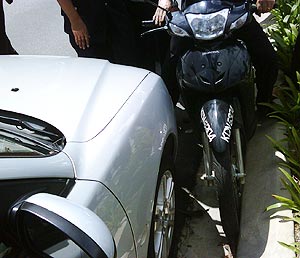 Mohamad, who is widely known as Mat Sabu, claimed that he was riding pillion on a motorcycle when a police Pajero rammed into him, causing the injury.
The police have denied this and have submitted the investigation papers to the Attorney-General’s Chambers.
Bar Council president Lim Chee Wee, who is holding a watching brief, asked Nurul Azlean to explain what she meant by "high place".
"(Injuries not sustained) from falling from a standing position. It was such that he could have fallen to the ground knee first.
Nurul Azlean, who is based at the Trauma and Emergency Unit at Hospital Kuala Lumpur (HKL), was the 11th witness to testify before the inquiry panel, which has set itself these terms of reference:
- To identify human rights violations on or before July 9;
- To determine how the violations occurred, and to identify the process and agency involved; and
- To make recommendations to prevent a recurrence.
The inquiry is headed by Suhakam vice-chairperson Khaw Lake Tee, and commissioners Mahmood and Detta Samen.
Earlier, responding to question by conducting officer Ameer Izyanif Hamzah, Nurul Azlean said that her initial observation of Mohamad's injuries indicated "these were not serious".
 "Not so serious that it could lead to death ... but while I was tending to him, he said that he had a heart condition and was on medication that thins the blood. So I just bandaged his knee, prescribed painkillers and gave an anti-tetanus shot.”
Khaw (right) asked if Mohamad had been referred to HKL because he has a heart condition or if there were other reasons.
Nurul Azlean said the swelling on his knee could have indicated a fracture, ligament tear or internal bleeding, but that she could not offer an accurate diagnosis given the limited facilities at the clinic.
"I therefore recommended that he should seek further treatment at HK.”
Similar medical opinion
The next witness, Dr Ankimtay Rutel, 33 - an orthopaedic expert who was then working at the HKL Orthopaedics and Traumatology Department - said he had attended to Mohamad when taken there from the police lock-up.
Ankimtay too indicated that the injuries to Mohamad's right knee, the abrasion and swelling corresponded with the latter’s version of the accident.
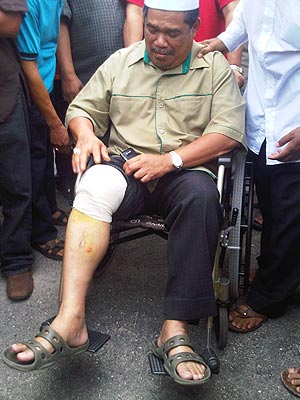 Khaw asked Ankimtay's inference, based on his eight years of experience as an orthopaedic expert, as to how the injuries could have been caused.
"When he was brought in, it was difficult to determine the extent of his injuries and the mechanisms that caused it. But looking at the external injuries, it would seem to me that he hit a blunt surface... that was not too rough.
"The abrasion was 1.5cm by 2.5cm and the knee was swollen. When I checked the sides and back I found the ligaments were normal but when I tried to press the internal ligament the patient complained that it was too painful.
"I couldn't proceed until the swelling subsided so I prescribed painkillers, and told the patient to wear a knee brace and rest at home.”
Mohamad was told to come for a follow-up check in two weeks, after the swelling had reduced, so that the doctors could determine if there was any internal ligament injury.
According to Ankimtay, an x-ray of Mohamad's knee showed that he did not suffer a fracture to the bone.
"Because the x-ray was not done at an acute setting it did not show any undisplaced fracture," he said.
In other words, he could only be sure of the extent of the injuries after the swelling subsided.
Mohamad did not keep the July 15 appointment with HKL. Instead, he sought treatment at the KPJ Selangor Specialist Centre where he had "an open reduction and internal fixation of the avulsion posterior cruciate ligament" and was discharged three days later.
Ankimtay agreed with Lim that an "avulsion fracture" could occur if Mohamad had been hit by the police vehicle.
Khaw told reporters that Suhakam has heard the testimony of 13 witnesses to date, and that 16 more would testify.
Three witnesses - one doctor and two police personnel - are scheduled to testify tomorrow.
Following this, those who participated in at the rally in Jalan Tun Perak, Tung Shin Hospital and KL Sentral would be called, she added.


Are you sure you want to delete this comment?
This action cannot be undone.