




Samad Said projects artist role as herald of change
COMMENT “Artists are the antennae of the race,” observed Ezra Pound, better known for his midwife role in the creation of literary masterpieces of the last century than for his own oeuvre.
It’s not too strenuous a leap from Pound’s opinion of whose radar is the more sensitive among society’s early warning systems to the role played by A Samad Said in the current movement for political change in Malaysia.
The news that Bersih plans to stage a demonstration, a sit-down actually, on April 28 at Dataran Merdeka was flagged by the presence of the literary eminence at the press conference yesterday to announce the event.
The fact the national literary laureate will take part in the Bersih protest, as he did in the two previous editions of the electoral reform body’s push for change, will no doubt galvanise the movement.
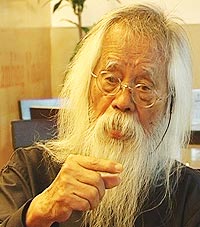
The sight of the reedy septuagenarian, trailing flowing white mane and whiskers, walking in the front ranks of protesters, has helped to endow the massed ranks of Bersih with iconic imagery...
COMMENT “Artists are the antennae of the race,” observed Ezra Pound, better known for his midwife role in the creation of literary masterpieces of the last century than for his own oeuvre.
It’s not too strenuous a leap from Pound’s opinion of whose radar is the more sensitive among society’s early warning systems to the role played by A Samad Said in the current movement for political change in Malaysia.
 The news that Bersih plans to stage a demonstration, a sit-down actually, on April 28 at Dataran Merdeka was flagged by the presence of the literary eminence at the press conference yesterday to announce the event.
The fact the national literary laureate will take part in the Bersih protest, as he did in the two previous editions of the electoral reform body’s push for change, will no doubt galvanise the movement.
The sight of the reedy septuagenarian, trailing flowing white mane and whiskers, walking in the front ranks of protesters, has helped to endow the massed ranks of Bersih with iconic imagery.
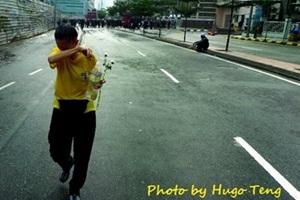 Just as it is not hard to relate Pound’s concept of an artist’s change-heralding role to Samad’s activism, so it’s not a long leap from the poet-cum-novelist’s involvement with Bersih to the emergence of Aunty Annie Ooi, dubbed ‘Lady of Liberty’, during the powerful Bersih march of last July.
In that march’s aftermath, which conferred an iconic aura on the figure of a gray-haired woman walking the streets heedless of tear gas and massed police ranks, Ooi revealed that her consciousness was raised through watching protest plays.
Lethal choice
This afternoon, in a court in Kuala Lumpur, counsel for the cartoonist Zunar will argue for the validity of the role of an artist in raising people’s awareness of the need for change in society.
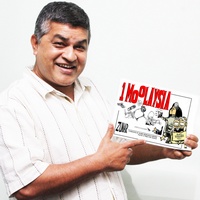 Zunar was thrown in jail for a day in 2010 after his book ‘Cartoon-o-phobia’ was seized by police. He then sued for wrongful arrest.
The case is being heard before a Kuala Lumpur court where lawyer N Surendran, a PKR vice-president, will hold forth on how art can conscientise society.
This is a question that has troubled polities from Hellenic times when Socrates drank hemlock as a sign of his fidelity to the truth.
Fortunately, no comparably lethal choice confronts the artist in Samad Said in his quest for political reform for his society.
In the past year, with two poems of lilt and luminosity, ‘Unggun Bersih’ (Cleansing Fire) and ‘Merindu Ruang’ (Yearning for Unbound Space), the author of the famed novel ‘Salina’ has called attention to Shelley’s dictum: “Poets are the unacknowledged legislators of the world.”
Certainly, the potency of lines from ‘Merindu Ruang’ hold ominous warnings for the powers-that-be:
Ada sang perubah permainan
kami perubah kekuasaan
Inilah tekad generasi baru
akarnya keadilan syahdu
(Ranged against game-change purveyors
Stand regime-change cadres
Harnessing the force of emergent forces
Rooted in the sublimity of noble justice)
A member of Angkatan Sasterawan ’50, better known as Asas ’50 - the literary movement of the 1950s that aimed at raising sociopolitical consciousness among the Malays through literary works - Samad Said was marinated in the school of art for social change.
This movement produced the best writers of its pioneering generation, among them Usman Awang, Keris Mas, A Samad Ismail, and Samad Said himself.
Iconic work
Samad, now pushing 80, produced the iconic work of that generation, ‘Salina’. After the early promise of that novel, Samad’s trajectory was expected to arrive at a Magsaysay-winning apotheosis.
Many had expected that the great Malaysian novel would be written by him. At least, the tremulations given off by ‘Salina’, a work produced in the early 1960s, indicated so.
 But Samad in succeeding decades appeared to be a writer in desiccation. During all that time the feeling grew that the sophomore who produced ‘Salina’ would not be able to come up with an encore.
The literature of the Asas ’50 generation was essentially a response to a political moment: the struggle of the Malays against a background of their lack of education and economic opportunity to assert themselves in conditions of colonial ferment.
Literary works endure when they transcend the ephemeral moment; creative wellsprings wither when too dependent on the transient for their inspiration.
Could it be that when the socio-political ferment that produced the Asas ’50 corpus of works segued into post-colonial disappointment and the fraying of hopes, the creative juices of that era’s best writers dried up for lack of the stimulus of a restive society?
If so, socio-political ferment is back, what with Bersih agitating for electoral reform, the Greens restive against Lynas, and Malaysia’s opposition pushing for regime change.
Ideal conditions, one might say, for the likes of Samad Said and Zunar to test the veracity of Pound’s and Shelley’s dictums.
TERENCE NETTO has been a journalist for close on four decades. He likes the occupation because it puts him in contact with the eminent without being under the necessity to admire them. It is the ideal occupation for a temperament that finds power fascinating and its exercise abhorrent.


Are you sure you want to delete this comment?
This action cannot be undone.