




Najib plays potentially risky election waiting game
Prime Minister Najib Abdul Razak could call national elections anytime between now and March 2013, but he may wait to announce a generous budget on Sept 28 as he plays a potentially risky waiting game.
Prime Minister Najib Abdul Razak could call national elections anytime between now and March 2013, but he may wait to announce a generous budget on Sept 28 as he plays a potentially risky waiting game.
Holding back until after September would give Najib more time to shore up flagging support among ethnic Chinese voters, and to convince Malaysians that his reform efforts are working as he tries to reverse the ruling coalition’s worst election showing in 2008.
It would also make him vulnerable to any worsening of the global economy or the emergence of fresh corruption scandals that could push swing voters over to the three-party opposition.
Malaysia’s economy grew at an annual pace of 4.7 percent in the first quarter of the year, the central bank said in May, slowing from the previous three months but beating market expectations as firm domestic demand helped offset a slump in exports. Economic growth is expected to slow to 4-5 percent this year as exports suffer, the central bank said in March.
Election approaching
The election promises to be the most fiercely fought in Malaysia’s history, and tensions are high after opposition leader Anwar Ibrahim was charged over his role in a major street protest for electoral reform in April.
Najib’s personal approval rating is high at 65 percent, according to a May survey, but it is unclear if that will translate into votes for his less popular coalition.
The polls will be a test of Najib’s gradual efforts to reform the state-heavy economy and roll back repressive security laws without upsetting the status quo that has seen his dominant United Malays National Organisation (Umno) party rule since independence in 1957.
Najib’s goal is to win back the two-thirds parliamentary majority that the coalition lost for the first time in 2008. That would give him a strong platform to push through reforms that have encountered resistance from conservatives within Umno.
The ruling National Front coalition is widely expected to win the election but further gains by the opposition could undermine Najib’s standing and prompt a leadership challenge from a more conservative, less reformist candidate.
 In March, Malaysia’s cabinet approved a national minimum wage for the first time in the country's history, a clear sign Najib is positioning himself for a vote. That followed the announcement early this year of cash payments to poorer families and an increase in pay for civil servants.
Malaysia’s oil palm farmers are due for a US$553 million election-year windfall from an initial share sale of a giant state-controlled palm oil plantation company. About a fifth of the proceeds from the sale of shares in Felda Global Ventures Holdings (FGV) will be distributed between 112,635 farmers.
.
 In April, Najib announced a new security law that ends indefinite police detention of suspects, fulfilling a pledge to abolish colonial-era legislation that has long been used to stifle political dissent. The proposal was aimed squarely at winning over middle-class, urban voters.
The April protest, attended by tens of thousands of demonstrators, ended in violence when protesters broke through barricades, prompting police to respond with tear gas and water
cannon.
An opinion poll published in early June showed Najib’s support slipped to 65 percent in May from 69 percent in early 2012 as a small rise in approval among majority Malays was offset by souring sentiment among ethnic Chinese voters.
Political uncertainty has weighed on foreign investment since 2008 but speculative inflows in search of higher-yielding markets have boosted the ringgit currency.
Economic reform
Najib pledged to reform a decades-old affirmative action policy favouring ethnic Malays and replace it with a ‘New Economic Model’ to promote greater competition and boost domestic investment that has lagged in recent years.
But the prime minister has since softened his stance on reforming the policy for fear of alienating conservatives among the majority ethnic Malays who make up about 60 percent of the electorate. Investors and the opposition complain that the race-based policy has been widely abused, fostering cronyism.
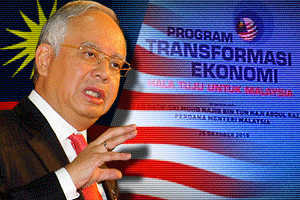 The government is implementing a US$444 billion initiative, called the Economic Transformation Programme, that is aimed at propelling the country to developed nation status by 2020.
The government says the ETP has helped it turn the corner on years of sub-par investment, pointing to a 19 percent jump in private investment last year. Critics say the ETP is overly reliant on government funding, which could end up putting further strains on a budget deficit that hit 5.4 percent in 2011.
The central bank has kept its benchmark interest rate on hold at 3 percent since May 2011. The government expects the budget gap to fall to 4.7 percent this year but that target could be put at risk by election spending and a worse-than-expected global slump.
Many analysts believe that Najib is waiting until after the election to announce politically sensitive cuts to fuel subsidies that he has described as economic “opium”. That move, as well the implementation of a new goods and services tax, is seen as crucial to tackling the chronic budget deficit and reducing the government’s heavy dependence on the oil sector.
In the annual economic assessment it released in March, the central bank said it expected inflation to hover within a 2.5-3 percent range, slightly lower than last year’s 3.2 percent.
- Reuters


