




Hindraf issues challenge to BN and Pakatan
COMMENT Three significant characteristics of the system of Malaysian electoral politics make it inimical to the interests of the Indian Malaysian poor. The system is based on simple electoral majorities, it is ethnocentric and it works to provide moral cover for the Malaysian elite.
And, it has become conventional wisdom that since Indian Malaysians do not form a majority in any single constituency, and are an economically depressed community, it will be nigh impossible for them to gain true representation for their socio-economic interests. This implies that Indian Malaysians will continue to be dependent on the largesse of the party in power.
Hindraf challenges these three assumptions and the first stones were cast with the 2007 Hindraf rally. Hindraf has been unrelenting in this challenge ever since...
COMMENT Three significant characteristics of the system of Malaysian electoral politics make it inimical to the interests of the Indian Malaysian poor. The system is based on simple electoral majorities, it is ethnocentric and it works to provide moral cover for the Malaysian elite.
And, it has become conventional wisdom that since Indian Malaysians do not form a majority in any single constituency, and are an economically depressed community, it will be nigh impossible for them to gain true representation for their socio-economic interests. This implies that Indian Malaysians will continue to be dependent on the largesse of the party in power.
Hindraf challenges these three assumptions and the first stones were cast with the 2007 Hindraf rally. Hindraf has been unrelenting in this challenge ever since.
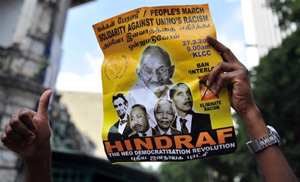 Effectively, what Hindraf is seeking for the minority Indian Malaysian community is a more equitable power-sharing formula that addresses these inherent weaknesses of the system as far as minorities are concerned.
What Hindraf is seeking is a more just Malaysia, where the citizens' worth, or rights, are not determined by their ethnicity or their economic status, but more by fundamental and natural rights as citizens. Hindraf works for the larger cause of a more just Malaysia, regardless of what our detractors have to say.
Given the workings of the electoral system, the leading parties in power must win the Indian votes so they can continue to rule. They, therefore, resort to a wide range of deceptions to garner the Indian votes.
One key technique is to have Indians in their ranks in the state assemblies and in Parliament and tout this as "Indian representation". They work very hard with Makkal Sakthi, MIC and the latest addition to this motley list, Indraf, to achieve this deception.
However, truly representative policies for the socio-economic interests of Indian Malaysians are non-existent on both sides of the political spectrum. This has been the de facto BN policy for 55 years and stated (yes, stated) Pakatan Rakyat policy in the last four years.
Hindraf, on our part, wants to see changes to the forces driving the increasing criminalisation of Indian youths, the increasing oppression and marginalisation of the Indian poor, the continuing denial of life opportunities, the chronic underemployment of Indians and the chronic poor life performance of the Indian poor.
Can anyone deny that neither BN nor Pakatan have stepped up to this plate?
Fundamental change needed
Indian Malaysians who are really crying out for a fundamental change in the performance of the country's socio-political system are those in the lowest rungs of Malaysian society. All the BN and Pakatan coalitions have done is to keep imitating each other in their approach to this problem.
BN keeps on bribing and promising and asking for nambikei (trust). Pakatan touts cosmetic efforts such as the appointment of a deputy chief minister in a state or increases the allocation to Tamil schools and even names streets after Indians as its approaches to the problems.
BN and Pakatan both fail miserably with these unimaginative deceptions. They completely ignore the problems.
It is not that BN and Pakatan are missing the point. They just do not have it in their current political DNA to address issues of the working class Indian poor. The not-so-obvious truth is that both only represent interests of factions of the moneyed Malaysian elite.
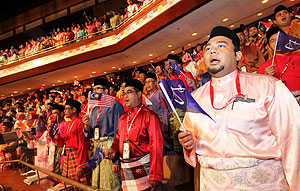 BN represents the Malay elite, who have been on the ascendancy for the last 40-odd years. Pakatan, by default now, increasingly represents the Chinese elite and a smaller disgruntled section of the Malay elite. Being the elite, their preoccupation is to get control of the levers of policy so that they can garner the resources of the nation, disproportionately, for themselves.
In the next general election (GE13), the choice for Indian Malaysians, as Helen Ang put it in her article ( Hindraf in slipstream of two-race system ), is not between the Chinese and the Malays; it is really between the Chinese elite and the Malay elite.
Being the elite, like everywhere else in the world, the primary preoccupation of the elite is to control the levers of policy, so that they can usurp the larger part of the resources of this nation.
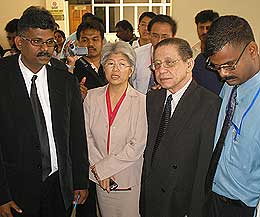 Ethnicity matters only to the extent of gaining that control.
The contention between the Chinese elite and the Malay elite is intensifying. The period of post-Merdeka collusion between the two elites within the BN and the consequent marginalisation of the DAP is gone.
Now, the Chinese and Malay elites are standing eye to eye in contention - so, why else have the ‘towkay' abandoned MCA and openly shifted their support to the DAP?
So, it is between the Chinese elite and the Malay elite that the Indian poor have to choose. The experience with the Malay elite has been one of systematic discrimination, racism and marginalisation of the Indian Malaysian poor.
The experience with the Chinese elite and a smaller section of the Malay elite has equally been disastrous for the Indian poor in a much shorter space of time - if you look at the experiences of the poor Indians in Kedah, Penang, Perak and Selangor.
If you have been watching the issues we have raised in the Pakatan-controlled states, then the story will be clear.
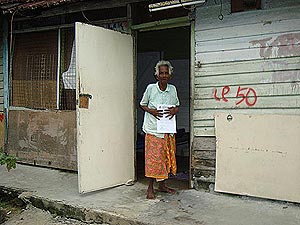 These experiences suggest that it makes no significant difference to the Indian poor, either way.
If things are not going to change, not voting for either is clearly an option for the Indian poor: why should they vote for BN or for Pakatan? What is the point? There is no race or religion here - only simple pragmatics.
Hindraf's 18-point demand
The demands of the Indian Malaysian poor are encompassed in the 18-point demand of Hindraf, which Hindraf has persisted with since its formulation. If either of the elite groups want the votes of the Indian poor, it can have it in its entirety - but each group needs to adjust the power-sharing formula to accommodate these demands.
This effectively means creating a new paradigm for Malaysia. It does not matter that this sounds farfetched now. No one gave Galileo an ear when he first suggested that the Earth was not the centre of the universe. But history does have its way of bearing out the truth, ultimately.
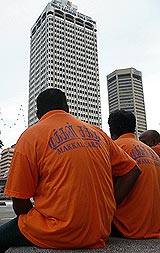 There is no 1Malaysia. There are any number of Malaysias as there are ethnic groups in the country today. And there are as many impotent policies and programmes as there are issues working against the social, economic and cultural development of Malaysia.
BN's Economic Transformation Programme (ETP) is a pie-in-the-sky programme with little mooring in the political reality of a multiethnic, multicultural Malaysia. Pakatan's programme sounds good, but can it even bridge the most obvious differences between the Islamic state agenda and the Malaysian Malaysia agenda of its component parties?
So is there really any substance here?
The reality of Malaysia is that every ethnic group is here to stay. They are not going anywhere. Every Malaysian will continue to live here and die here. Everyone must do well, or no one will do well.
Pushing and shoving is not going to cut it. Only a fair and just Malaysia can make the real difference. That is what the new paradigm calls for. This what Hindraf calls for.
If Pakatan or BN can indeed rise to this challenge, they can have the Indian vote, in-toto. But only if they can do this.
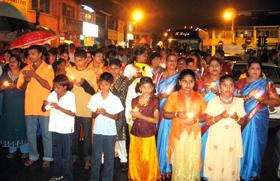 They now need to come up with a plan with which they can address our
18-point demand
- which they know is bitter medicine. But they do know that it is medicine. Medicine that our country so sorely needs.
They now need to come up with a plan with which they can address our
18-point demand
- which they know is bitter medicine. But they do know that it is medicine. Medicine that our country so sorely needs.
Their political imperative requires that they win the forthcoming general election - and that imperative to win can certainly produce the necessary political will to accept the challenge that Hindraf is throwing at them.
If they think they can win GE13 with their Makkal Sakthi parties and MIC and Indraf, they do so at their own peril. Plus, if they have deception planned up their sleeves, they will only be postponing whatever that we raise here.
BN and Pakatan need to come up with a binding and a real programme, announce it and immediately begin work on it. And there will be the chance that we will come out like we did in 2008, in favour of whoever does this.
Otherwise, the Chinese elite and the Malay elite can fight it out and let the bloody mess continue. Let this go on for more years and maybe, one day in the future, they will realise the wisdom in Hindraf's challenge.
N GANESAN is national adviser for Hindraf.


