




Utusan's witness grilled on Islam and communism
An expert witness called by Utusan Malaysia in the civil suit filed against it by PAS deputy chief Mohamad Sabu was "grilled" on how he arrived at the conclusion that independence fighter Mat Indera was a communist.
An expert witness called by Utusan Malaysia in the civil suit filed against it by PAS deputy chief Mohamad Sabu was "grilled" on how he arrived at the conclusion that independence fighter Mat Indera was a communist.
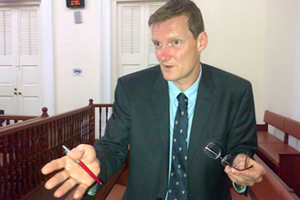 Mohammed's lawyer Hanipa Maidin questioned the credibility of information provided by UK-based senior history lecturer Karl Hack (
right
) to the High Court in Penang yesterday.
Mohammed's lawyer Hanipa Maidin questioned the credibility of information provided by UK-based senior history lecturer Karl Hack (
right
) to the High Court in Penang yesterday.
Hack's information was derived solely from Mat Indera's statement to the police when he was held in jail.
Mohamad, better known as Mat Sabu, is suing the Umno-owned daily, for publishing a series of reports on his speech delivered at a ceramah in Tasek Gelugor on mainland Penang in August last year.
He claims the reports painted him as a supporter of communism, which is taboo to Muslims, when he spoke on the attack on Bukit Kepong police station by communist insurgents.
 Hack was challenged on whether it was his field to determine Mat Indera's ideology without having full knowledge of Islam nor its position on communism.
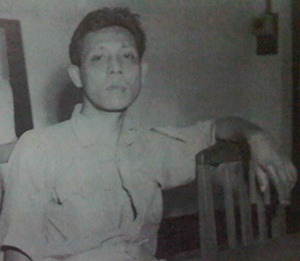
"Mat Indera (left) possessed one special feature, in that he often cited the Quran. You need to understand Islam before concluding that he was a communist," Hanipa said in cross-examining Hack.
"Were you aware that the British were then very forceful towards the Malayan Communist Party (MCP)? That in the 1950s, when it was wrong to join the communists?" Hanipa asked.
"His (Mat Indera's) statement could have been twisted as it was from the police. (Did you find out) how the statement came about? That he was lured (and under duress) to surrender to the police?" the lawyer queried.
With Hack appearing flustered by this line of questioning, judge Zakaria Sam clarified that the lawyer had merely wanted to ask, "Was the police statement reliable?"
'Mat Indera a martyr'
Hack, who lectures at the Open University, was called in to provide expert opinion on Mat Indera's political ideology as Mohamad had insisted that the soldier was "a martyr, a very religious man, and not a communist".
Utusan was represented by Fairus Hussein and Hafarizam Harun, while Mat Sabu's legal team comprised Hanipa, Amiruddin Zulkipli and Azhana Mohd Khairuddin.
In his reply, Hack said it was the MCP-linked Malayan National Liberation that carried out the attack on the police station, leaving left 26 people dead.
Hack disagreed that it was beyond his field to determine one's ideology, saying he had published many works on the history of Singapore and Malaysia, and rejected the notion that he needed Islamic knowledge before concluding that Mat Indera subscribed to communism.
Asked if he truly understood the position of Islam on communism, Hack shot back, "Is this relevant? Mat Indera had admitted he was a communist, and that he found a certain degree of conflict between the ideology and his religion.
"However, he also said he was able to be a good Muslim and a communist. There was also no need to understand Islam to decide if Mat Indera was indeed a true Muslim.
"It is for you to decide if he is a good Muslim. I decide whether he is a communist," Hack said.
Hanipa dismissed the assumption that one is automatically a party member just because one joined the MCP and used it as a platform to fight the British colonial authority.
Hanipa said it was "mandatory" for a Muslim to fight colonialism or imperialists, but this did not mean he was a communist but was more of a fighter for the country’s independence.
"That it was a 'jihad' (holy war) as no Muslim can tolerate external forces invading his or her country. We can work with anyone to fight imperialism," Hanipa told Hack.
Hanipa then dismissed Hack's finding as non-conclusive as he did not seek opinions or comments from other Islamists before arriving at his conclusion about Mat Indera.
Hack explained that he relied on two other sources - the memoir of former MCP chairperson Abdullah CD and another individual (not a communist) who said that Mat Indera took instructions from the party and attended its meetings.
No proof of formal MCP membership
On whether Mat Indera was a card-carrying member of the MCP, Hack denied saying that Mat Indera had officially joined the party.
"I said there was strong evidence that he might have done so, or was at least ideologically a communist," said Hack.
He added that the British did not need to prove that Mat Indera was a communist but that he was captured for being in possession of a weapon, which was a capital offence.
"I have no final proof that he had joined MCP formally. I did say that he decided to subscribe to the communist ideology but I did not say that he formally joined MCP," Hack clarified.
Before the session ended at 4pm, Fairus in re-examining Hack asked if he could repeat why he concluded that Mat Indera was a communist.
"He accepted dialectical materialism and revolution as a vehicle for his struggle. He believed he was a Muslim but said he could be both Muslim and communist," Hack replied.
The case will resume on Jan 2, with the court hearing more witnesses from Utusan , including a police special branch officer and former inspector-general of police, Rahim Noor.


Are you sure you want to delete this comment?
This action cannot be undone.