




'Revolving door' approach may hurt regulatory efforts
The Health Ministry should study whether job offers for civil servants in the industries that they are supposed to regulate are hampering the ministry’s regulatory efforts, urged Sungai Siput MP Dr Jeyakumar Devaraj.
The Health Ministry should study whether job offers for civil servants in the industries that they are supposed to regulate are hampering the ministry’s regulatory efforts, urged Sungai Siput MP Dr Jeyakumar Devaraj.
“This is called the ‘revolving door’ or ‘regulatory capture’. I hope a part of the funds that we are approving today (Nov 8) would go into studying this phenomena,” he said.
Jeyakumar was addressing the Dewan Rakyat at the time, during the recent debates on the Health Ministry’s budget.
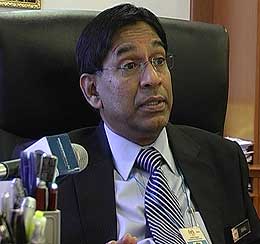 He said that as an example, former Health Ministry director-general Dr Ismail Merican (
left
) is now the chairperson and vice chancellor of Mahsa University College.
He said that as an example, former Health Ministry director-general Dr Ismail Merican (
left
) is now the chairperson and vice chancellor of Mahsa University College.
Another example is former Nursing Board director Dr Bibi Floriana Abdullah, whom he said is now a senior official at Lincoln University College.
He claimed that the college was recently given approval to start off-shore medical course in Ukraine with three medical universities that have yet to be recognised by the Malaysian Medical Council.
“These are only two examples. There are a few more cases where senior health ministry officials who were ‘captured’ and give a senior positions in companies that they used to control or regulate,” said Jeyakumar, who is a also a medical doctor.
'Regulatory systems failed'
He was arguing that Malaysia’s regulatory systems have failed because the private sector had successfully influenced the government officers that were supposed to monitor them.
For example, he said 61 nursing colleges have produced 12,000 nursing diploma holders last year. However, there are only 2,000 private sector vacancies available to them.
“Therefore, private colleges have supplied six times more that what the market can handle. What happened to the regulator?
“Why did the regulator approved National Higher Education Fund (PTPTN) loans to almost all 12,000 students?” he said.
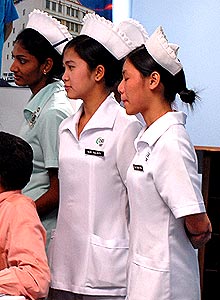 In his debate, Jeyakumar also urged the ministry to review the outsourcing of government hospital support services, such as the upkeep of the wards, laundry services, maintenance of the hospital’s yard, building maintenance, and other services.
“Five support services have been privatised to three companies in 1997. The cost of these five services have grown three times that year compared to 1996!” he said.
Poor job security
In addition, he pointed out that the tasks formerly performed by civil servants who have pensions schemes and adequate healthcare, are now replaced with subcontractor employees with poor job security.
“So what is the benefit of this outsourcing? The profit is for who, honourable minister, besides a small group of contractors and subcontractors?” he asked.
He also urged the Ministry to study Trans-Pacific Partnership (TPP) negotiations closely and reject it in case of doubt.
He said that the trade deal has provisions what may raise healthcare costs by extending the patent period of drugs and then delaying the availability of generic drugs after its patent has expired.
In addition, he pointed out the Doha Declaration allows countries to have “parallel imports” of drugs deemed vital to national public health even though its patent have yet to expire.
“Under the TPP, the defination of ‘national public health’ is being tightened, whereby a government’s opinion of a drug’s importance to public health can be disputed by the patent holder,” he said.
Jeyakumar also expressed concern on the partnership’s “expropriation clause”, which allows companies to bring governments to international courts if it takes action that would lower its profits.
“This clause has been used by cigarette manufacturer Philip Morris to bring the Paraguayan government to court because that country imposed a rule where pictures of cancer are to be displayed on every cigarette box,” he said.


Are you sure you want to delete this comment?
This action cannot be undone.