
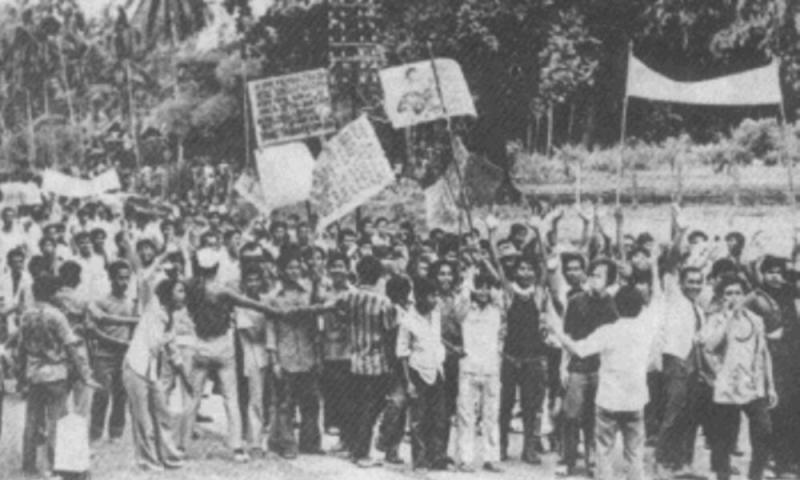
In the historical catalogue of events that have become signposts for the raising of human rights consciousness among Malaysians, the Baling incident of December 1974, which saw university students make common cause with impoverished peasants, has become an event rather like the 1955 Montgomery bus boycott was for the US civil rights movement.

Both events drew knee jerk repression from custodians of the status quo, while both a national audience and a watching world stood riveted by the spectacle of courageous defiance and the gamut of oppression it provoked.

Both episodes threw up charismatic leaders - Anwar Ibrahim in the Malaysian instance and Martin Luther King Jr in the American one - who would go on, with their statures enhanced by the travails they had to endure, to lead their embryonic movements to respective denouements, though in Anwar's case the culmination is some way from its vindicatory apotheosis.

Thus, the commemoration of the 1974 Baling incident that Parti Keadilan Rakyat elected to organise at the Dewan Sivik in Petaling Jaya yesterday in conjunction with the marking of the World Human Rights Day was apposite for reasons at once simple and profound.

NONE These were encapsulated by one of the commemoration's speakers, Syed Hamid Ali ( left ), who was involved in the Baling incident and was detained under the ISA for his pains.

"For me, the significance of the Baling incident lies in a simple truism: Where there is oppression there will be opposition," intoned the PKR leader who is the younger brother of Senator Dr Syed Husin Ali, the former deputy president of PKR who also spoke at the event.

Syed Hamid elaborated: "The Baling incident was just the symbolic effusion of a series of lead-up incidents during the early 1970s that culminated in university students and faculty members deciding that they could not stand apart from the sufferings of peasants in the rural areas and the labouring classes in towns who were feeling the effects of depressed rubber prices or were hungering for housing and other basic needs."

Earlier, speakers Kamarazaman Yaakob and Prof Gurdial Singh Nijar, who were both held under the ISA for their parts in the episode, each related vignettes of their involvement, the former, a Universiti Malaya student leader at that time, the more evocative speaker for reason of his emotive recall of and reflections on aspects of ordeal endured by the arrested students, faculty members and NGO leaders who demonstrated their support for the peasants hit by the steep fall in rubber prices.

NONE Syed Husin Ali ( right ), then an associate professor at UM who was held for six years under the ISA for his involvement - the longest span of detention suffered by a victim of the ISA dragnet that year - also spoke at yesterday's memorial.

Syed Husin opined that his concept of human rights entailed working to make sure that people had occupations that afforded a livable wage and affordable housing.

The final speaker was PKR adviser Anwar Ibrahim, who said that the concern for human rights should transcend boundaries of race and religion and that moral courage was a sine qua non of the fight against man's inhumanity to man.


TERENCE NETTO has been a journalist for close on four decades. He likes the occupation because it puts him in contact with the eminent without being under the necessity to admire them. It is the ideal occupation for a temperament that finds power fascinating and its exercise abhorrent.