




Our economy grew highest during NEP, says Dr M
Former prime minister Dr Mahathir Mohamad today refuted allegations that the New Economic Policy (NEP) stunted Malaysia's economic growth.
Former prime minister Dr Mahathir Mohamad today refuted allegations that the New Economic Policy (NEP) stunted Malaysia's economic growth.
"When the NEP was fully implemented, we recorded the highest growth," Mahathir said in his keynote address at a forum in Putrajaya.
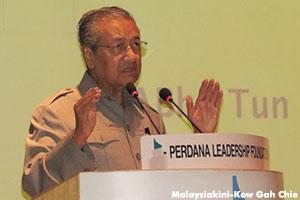 He told the Perdana Leadership Foundation's Perdana Discourse Series 15 titled 'The Future of Affirmative Action' that the stability generated by NEP's affirmative action policies helped to create an economy-friendly environment that laid the groundwork for the economy to expand.
Mahathir argued that under the NEP, Malaysia had economically exceeded not only other nations that had gained independence at the same time, but also some developed countries.
To say that the NEP discouraged growth, Mahathir reasoned, is to deny this fact.
He also defended the government’s practice of issuing a lot more approved permits (APs), contracts and licences to Malays as a means of addressing the failures that they know are bound to happen.
'Like bending a bamboo'
This, despite many Malays not being equipped to use the facilities given to them or taking the short cut to quick wealth by selling out to the non-Malays.
The government needed "to overdo" the awards to the Malays, Mahathir added, in order to take into account the failures, which he likened to bending bamboo.
"If you bend bamboo and then let it go, it will return to the same position, as if it has a memory. In order to ensure that it does not return to the same position, maybe you will have to bend it further."
Though, Mahathir admitted, without naming names, that there are some who overdid the "bamboo bending" even for elections, when they were not confident of winning.
This, he said, was the result of the "democratic process intruding into the system" of delivering affirmative action.
"In a democratic system, you want to get popular. If you are not popular then you won't get re-elected."
 The need to get popular then distorts the process, with APs, licences and projects being distributed to curry electoral favour, instead of truly targeting those who are capable.
Mahathir admitted that he had failed to change the mindset of the Malays in general, but expressed pleasure that some Malays had at least proven themselves capable of using the economic opportunities presented by the government to learn about business and enrich themselves.
In particular, he praised the owner of the Naza group of companies for using government-issued APs to build an automotive empire, despite other Malays only taking the easy way out and selling their APs to non-Malays.
"If every Malay given APs acted like Naza, the Malays would have dominated the automotive industry," lamented Mahathir.
 The veteran politician also defended the recent award of a 4G telecommunications licence to businessperson Syed Mohktar Albukhary (
right
), seen by many close to the ruling coalition, saying that the tycoon had demonstrated good track record and was capable of developing the business.
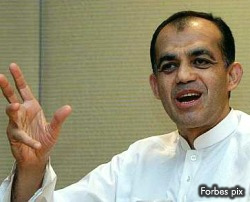
The veteran politician also defended the recent award of a 4G telecommunications licence to businessperson Syed Mohktar Albukhary (
right
), seen by many close to the ruling coalition, saying that the tycoon had demonstrated good track record and was capable of developing the business.
Non-Malay tycoons have also been given similar opportunities he said, though no one raised an eyebrow.
Just because a company was successful, Mahathir added, did not make it a crony . The company is chosen based on its capability and holding power.
Syed Mokhtar's company, telecommunications newcomer Puncak Semangat Sdn Bhd, was recently awarded the lion's share of 40MHz bandwidth for the 4G long-term evolution (LTE) spectrum, the highest share among nine companies.
Other more established telecommunications companies, such Maxis Broadband Sdn Bhd, DiGi Telecommunications Sdn Bhd, Celcom Axiata Bhd, U Mobile Sdn Bhd, Redtone Marketing Sdn Bhd, YTL Communications and Packet One Networks (M) Sdn Bhd, only received 20MHz of bandwidth each.


Are you sure you want to delete this comment?
This action cannot be undone.