




A solution to the blueprint-manifesto 'spat'
COMMENT There has been much a heated debate going on in the reluctance of Pakatan Rakyat to have a binding endorsement with the Hindu Rights Action Force (Hindraf) regarding its five-year blueprint.
COMMENT There has been much a heated debate going on in the reluctance of Pakatan Rakyat to have a binding endorsement with the Hindu Rights Action Force (Hindraf) regarding its five-year blueprint.
The Hindraf blueprint, which is based on social justice as its foundation, had proposed a specific, pointed and targeted programme of rehabilitation measures - quite similar to the existing Federal Land Development Agency (Felda) settlers programme - to a specific group of community, the displaced estate workers (DEW). This covers a proposal for intervention in six major problem areas that transcends racial and religious barriers:
1) 800,000 internally displaced estate workers,
2) 350,000 stateless people,
3) The denial of adequate and equal educational opportunities,
4) Unequal employment and business opportunities,
5) The impunity of the Royal Malaysian Police (PDRM), and
6) The standards of human rights practices.
Pakatan leaders had agreed in principle to the blueprint, but fell short of giving a binding agreement citing certain wordings and languages which were needed to be reviewed. Hindraf had reciprocated by not only agreeing to go through with the Pakatan
 team to review these issues, but were even willing to debate allocations of the necessary budget to be meted out for the realisation of the various programmes in the blueprint proposal.
Ironically, Pakatan to date has failed to come forward to iron out these details with Hindraf.
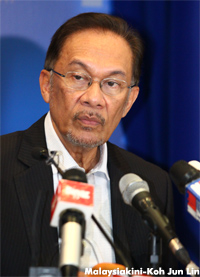
Anwar Ibrahim ( right ) recently had to do a damage-limitation exercise of claiming that Pakatan will be including specific details of the Indian community’s needs into the Pakatan manifesto. This was in response to pressure from mainly Hindraf leaders who slammed the manifesto for leaving out specific concerns of the Indian community, while mentioning almost all other races. Anwar claims that Pakatan will now include five points into the manifesto:
1) Resolving the ‘long-standing issue of stateless people’ in Malaysia, without excluding Indians, in the first 100 days of Pakatan’s administration;
2) Technical training and job opportunities for school leavers, stressing the major beneficiaries to be the Indian community;
3) Ensuring all Tamil schools will be fully funded, and its infrastructure comparable to the national educational standards;
4) A government National Housing Board to build affordable homes that includes focus on helping build freehold homes for ex-estate workers around the country; and
5) The setting up of the Independent Police Complaints and Misconduct Commission (IPCMC).
Both sides not willing to give in
These points appear to have been taken in part from the Hindraf blueprint, but are not comprehensive in nature. It also does not explain how it will be implemented considering the huge ‘National Civics Bureau (BTN) brainwashed Umno bureaucracy’ hurdle that it will need to overcome to do so. On the other hand, the Hindraf blueprint clearly spells out how to overcome this.
Both Pakatan and Hindraf are not willing to give in when it comes to the requirement of a binding agreement of the Hindraf blueprint to bring about a political electoral pact in the coming general election.
Hindraf, particularly, are aggrieved that although they had created the ‘tsunami’ for Pakatan Rakyat in 2008, there has not even been a single attempt by Pakatan in the past five years to engage with them into drawing up plans for the grouses of the 1.5 million marginalised Indians that they represent. It is also very evident that pre-election promises are seldom kept by politicians from both sides of the political divide.
 As such, Hindraf feels that it is all the more important that a binding agreement is in place so that history does not repeat itself.
A solution to this predicament lies within the Pakatan’s Buku Jingga itself, which Pakatan claims is their comprehensive and holistic policy document. It proposes a set of policies to lead the nation to a new and better future.
A clause under the heading, ‘Prosperity, solidarity and social justice with Pakatan Rakyat’ clearly states that Pakatan will “set up a council of experts to formulate and change existing national policies with regard to key economic, political and social challenges”. The Hindraf blueprint falls well within this jurisdiction and as such, Pakatan must activate the clause within the Buku Jingga and accept it.
After all, Pakatan leaders have already claimed to have accepted it in principle. Failure to do so may invite doubts of credibility on the very foundations of the Buku Jingga . More importantly, Pakatan will be able to prove to the nation that it has raised the bar in its credibility to its election promises.
PARAMAN SUBRAMANIAM, a general practitioner, strongly believes Malaysia requires comprehensive changes for the creation of a Malaysian society based on equality, justice and freedom.


Are you sure you want to delete this comment?
This action cannot be undone.