




Baram dam dampens Sarawak BN's spirits
ANTIDOTE The Baram dam controversy has awoken Sarawak rural communities to deals letting people own timber licences, oil palm plantations and land-grabbing at the Mulu National Park.
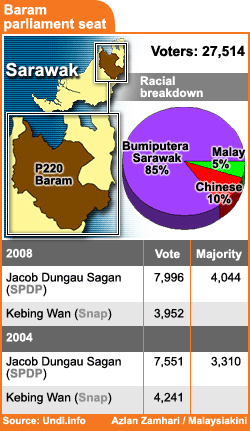
Sarawak BN is likely to lose Baram to PKR in the coming parliamentary election, as a consequence of BN forcing through plans for the hugely unpopular Baram hydroelectric mega-dam.
The dam across Sarawak’s second-longest river, budgeted to cost at least RM3 billion, will evict 20,000 farmers from their homes and submerge 40,000 ha of land - or half the size of Perlis.
ANTIDOTE The Baram dam controversy has awoken Sarawak rural communities to deals letting people own timber licences, oil palm plantations and land-grabbing at the Mulu National Park.
Sarawak BN is likely to lose Baram to PKR in the coming parliamentary election, as a consequence of BN forcing through plans for the hugely unpopular Baram hydroelectric mega-dam.
 The dam across Sarawak’s second-longest river, budgeted to cost at least RM3 billion, will evict 20,000 farmers from their homes and submerge 40,000 ha of land - or half the size of Perlis.
Baram stands to be the first rural parliamentary seat to fall to an opposition party since the heydays of the single-issue, ethnocentric Dayak party, Parti Bansa Dayak Sarawak, a generation ago.
“The Baram dam issue is definitely a major factor in the election,” Peter Kallang, leader of the Save Rivers Network, an alliance of Sarawakian activists, told Malaysiakini .
“Baram voters are aware of the disasters inflicted on the people by mega-dams already built in Sarawak… and the misappropriations and many unfulfilled promises made.”
The constituency is one of the largest, poorest and most rugged in Malaysia, features that clearly favour BN.
Yet the Iban and Orang Ulu voters here have a history of rebelliousness: Harrison Ngau Laing, an Orang Ulu lawyer imprisoned under the Internal Security Act in 1987, campaigned on an anti-logging platform in 1990, and became an independent MP by a tiny margin of 839 votes.
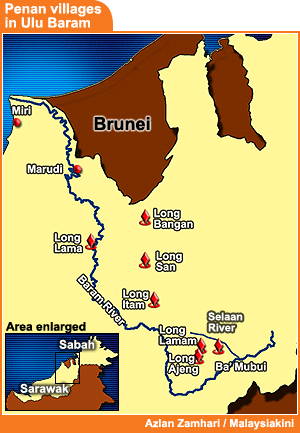 The Orang Ulu or ‘upriver people’ and the Iban are two large indigenous groups within the diverse Dayaks, accounting for six and 30 percent respectively of Sarawak’s population.
In the 2011 state election, BN’s Dennis Ngau defeated Harrison, by then a PKR candidate, in Telang Usan, one of the two state seats within the parliamentary constituency. BN scraped through with a majority of 845 votes, saved by Sarawak National Party and Independent spoiler candidates.
Telang Usan spans the upper reaches of the Baram river. Voters in Marudi, the other state seat downriver, will not be directly affected by losing land to the dam, but many are worried about the poor safety records of dams, as well as the catastrophic ecological damage witnessed after the overpriced Bakun dam was commissioned in the headwaters of the Rejang.
In 2011, BN’s Sylvester Entri Muran, a state minister, brushed aside the PKR’s Gerang anak Dagom, a petroleum company manager who had spent many years away from the state, with a 3,202-vote majority.
Deluge is 'development'
In the coming parliamentary election, BN’s candidate will presumably be three-term incumbent MP and deputy international trade and industry minister Jacob Dungau Sagan.
 Sagan
(left)
has desperately defended the dam, claiming it will bring jobs and “development”, even though his own home village, Long Anap, will be inundated.
Sagan
(left)
has desperately defended the dam, claiming it will bring jobs and “development”, even though his own home village, Long Anap, will be inundated.
Baram folk have grown sceptical over BN pledges of sealed roads and “development”. The dirt logging roads in Baram have allowed loggers and oil palm planters to pour in and dispossess natives of their ancestral forests, but have impoverished communities relying on the forests.
Loggers have raped children and women from local communities, and have inflicted sexually transmitted diseases and pollution on these native communities.
The logging and oil palm companies, close allies of Chief Mminister Abdul Taib Mahmud, have fallen far short of the Baram MP’s promises of “development”.
Sagan has fretted publicly that the population of Baram has halved over the past decade, from 90,000 to only 45,000 now.
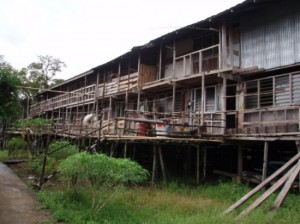 The drift to towns in Sarawak and Peninsular Malaysia, in a bedraggled search for employment, has quickly become a rural-urban flood. Many longhouses have been abandoned to the elderly and small children.
Sarawak Report
has accused Sagan’s immediate family of benefitting from a logging concession of 1,500 ha. Sagan has not challenged this in court.“Sagan does not care about the imminent disaster or misery of the Baram people, and the traumatic prospect in starting their lives from square one in a completely new setting, once their lands are flooded,” Kallang said.
Pakatan pledges to stop dams
The frontrunner to be PKR’s candidate is lawyer Roland Engan.
Kallang has hailed Pakatan’s promise to scrap the dam if it takes over the federal government. Sarawak had an existing energy surplus even before the recent shambolic commissioning of Bakun.
“Fighting the Baram dam proposal is one of the major issues highlighted by Roland,” Kallang noted.
“Roland’s campaign is on the ground, and heart-to-heart. He does not keep the campaign on the podium in big hotels or flying with planes and helicopters. He does it the good old way, he uses land transport on the timber roads or longboats on the rivers.”
 Roland’s
(left)
campaign
has been colourful and highly visible. PKR flags are flapping above wooden-walled shops and houses in remote outposts in upriver Baram, and Kallang’s Save Rivers network manoeuvred a ‘Baram Wave’ flotilla of longboats down the Baram River, stopping to brief villages lining the mighty river.
Roland’s
(left)
campaign
has been colourful and highly visible. PKR flags are flapping above wooden-walled shops and houses in remote outposts in upriver Baram, and Kallang’s Save Rivers network manoeuvred a ‘Baram Wave’ flotilla of longboats down the Baram River, stopping to brief villages lining the mighty river.
Taib is unrelenting in his scheme for 12 giant dams across this ‘land of many rivers’. Sarawak Energy, a privatised company helmed by Taib’s cousin and chairperson Hamed Sepawi and a handpicked CEO Torstein Dale Siøtveit, plans to produce an electricity glut 15 times in excess of the state’s current energy requirements.
The Norwegian CEO has dismissed native opponents of the Baram dam. He was quoted as saying they are merely “making noise” and they “take advantage of Baram people’s ignorance”.
Taib argues the electricity will be used for his brainchild, the Sarawak Corridor of Renewable Energy (Score).
But with multinational Rio Tinto’s withdrawal from a proposed aluminium smelter, and with no major industrial projects able to take up the extra electricity in the offing, Score has begun to look less like a corridor than a road to nowhere.
 Opponents accuse the government of using the dams as a ruse to evict natives from land they own under customary law or adat by the native communities, and allowing political allies to log the forests.
Taib (right) has also come under fire for awarding construction contracts to companies like Cahya Mata Sarawak, run by his son Mahmud, and Naim, headed by Hamed himself.
“The Baram communities know the dam will benefit the political elite, existing cronies and those in power. They also know who owns timber licences, oil palm plantations, who have been grabbing land at the Mulu National Park,” Kallang said.
Next: S'wak Pakatan aims to bag a dozen of seats
KERUAH USIT is a human rights activist - ‘ anak Sarawak, bangsa Malaysia ’. This weekly column is an effort to provide a voice for marginalised Malaysians. Keruah Usit can be contacted at keruah_usit@yahoo.com


Are you sure you want to delete this comment?
This action cannot be undone.