


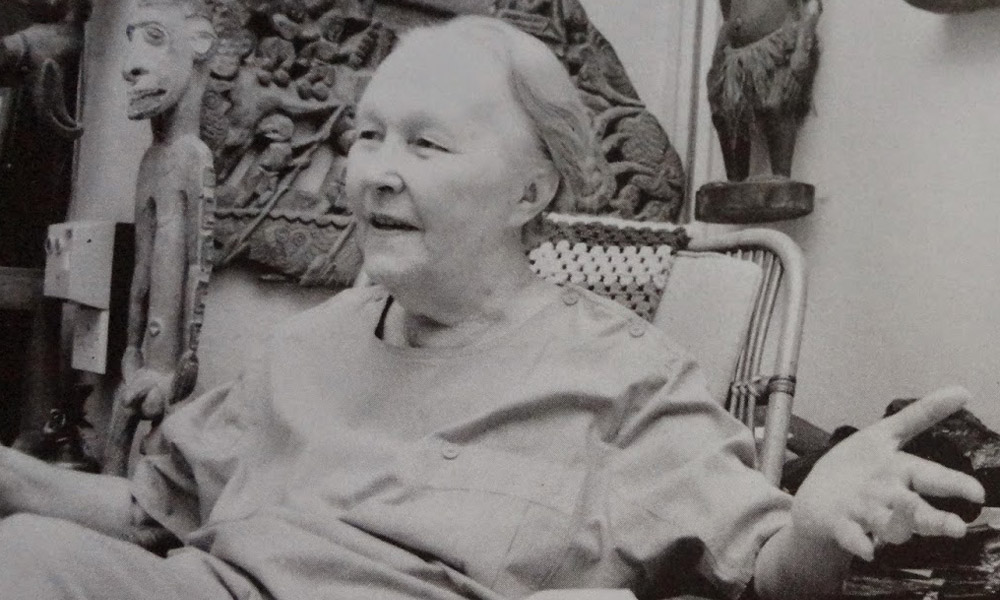

A life extraordinary: Ibu Alijah Gordon 1929-2003
In death, the dead live on in the memories of the living. Fortunate are those whose lives have been filled with events and experiences worth recounting, valuable enough to be fished out of the stream of historical flotsam and rescued for the sake of posterity. Not many of us will be privileged enough to fall into this category, but I can at least claim to have known one who did: ''Ibu'' Alijah Gordon: academic, activist, traveller and adventurer, the gutsiest woman I have ever met and the biggest chain-smoker to boot.
 Alijah Gordon - known to many who knew her simply as ''Ibu Alijah'' - passed away on the night of 18th November/ 23rd Ramadhan. She would have wanted me to include the date of the Arabic calendar as well, not for the sake of cosmetic exoticism or a false pretension to assumed piety, but in order to remind ourselves that there are always other dates, other places, other
topographies and discursive registers that need to be taken into account as well. A life-long advocate of cultural diversity and pluralism, she lamented the homogenisation of the world brought about by globalisation and the McDonald-isation of popular culture. A modernist who lived in the here-and-now, she was nonetheless dismayed at the erasure of the past, the flattening of the world and its cultures thanks to capitalism and crass consumerism.
In death, the dead live on in the memories of the living. Fortunate are those whose lives have been filled with events and experiences worth recounting, valuable enough to be fished out of the stream of historical flotsam and rescued for the sake of posterity. Not many of us will be privileged enough to fall into this category, but I can at least claim to have known one who did: ''Ibu'' Alijah Gordon: academic, activist, traveller and adventurer, the gutsiest woman I have ever met and the biggest chain-smoker to boot.
 Alijah Gordon - known to many who knew her simply as ''Ibu Alijah'' - passed away on the night of 18th November/ 23rd Ramadhan. She would have wanted me to include the date of the Arabic calendar as well, not for the sake of cosmetic exoticism or a false pretension to assumed piety, but in order to remind ourselves that there are always other dates, other places, other
topographies and discursive registers that need to be taken into account as well. A life-long advocate of cultural diversity and pluralism, she lamented the homogenisation of the world brought about by globalisation and the McDonald-isation of popular culture. A modernist who lived in the here-and-now, she was nonetheless dismayed at the erasure of the past, the flattening of the world and its cultures thanks to capitalism and crass consumerism.
Fiery-tempered and hard-headed, she was a hugely complex and controversial figure who courted confrontation wherever she went. Born in New Jersey, the United States in 1929, she left the US for the Arab world shortly after her student days to ''crack (her) head on the reality of the people rather than intellectualise on socialism and revolution''. When she turned to her family for whatever financial support they could give her, her father paid for a single ticket out of the US and told her that she would have to find her own way back. She never did. Instead this marked her departure further afield, to lands and places that few Americans had visited then. With only a hundred dollars in her pocket the idealistic (though never quiet) American student from Columbia University embarked on a journey that would eventually consume her entire life and work, bringing her into contact with some of the greatest figures of the post-war and post-colonial era.
Television debate
Before that she had made her mark in the arena of American student politics when she took on the future Foreign Minister of Israel, Abba Eban, in a television debate about the fate of the Palestinians and the military aggression of Israel and its Zionist elite. This was in 1953, when she was just 24 years old. As a result of being able to take on the Israeli leader in public, she won the support and admiration of her student colleagues, not least the Palestinian and other Arab students studying in the United States then. Soon after came the offer to study in Egypt, delivered by the Egyptian government, no less.
Her travel to Egypt brought her face-to-face with the leader of the Egyptian modernist-nationalist movement, Gammel Abdel Nasser. Her stay in that country would mark her for life, for it was there and then that she witnessed at close quarters the plight of a young nation struggling to free itself from the yoke of neo-colonial bondage and the shackles of the past.
Four decades later her time in Egypt would be recounted in her book, In the Time of the Mish Mish . The book reads as a poignant eyewitness account of the political turmoil and social developments in Egypt during the era of Nasser. Set at the time when the star of the hero and ''saviour of the Arab peoples'' was about to wane, it captured the hopes and anxieties of a
generation who were mesmerised by the indomitable persona and aura of the fabled leader whose kingdom was about to crumble around him.
In Mish Mish , Alijah's sweeping narrative spans a cross section of Egyptian society - from the Coptic Christians to the Muslim brotherhood, from the political elite barricaded behind their fortress-mansions to the subaltern voices stirring in the slums of the cities. It is a story of the courage and determination of the ordinary man, struggling against all odds to win his freedom at whatever cost. It is also a story of betrayals and intrigue, of conspiracies hatched among powerful nations to bring down the soaring spirit of the wretched of the earth.
But Alijah was not one to record the events around her quietly. In time she became drawn into the Byzantine world of Egyptian politics, as well as the plight of the Kurds and Palestinians that was hotly debated in the country. This earned her the suspicion of the Egyptian politicians and military elite, and her multiple commitments cost her dearly: finally she was expelled from the country and forced to travel again.
She then travelled to Lebanon, and arrived just in time to see the country tear itself apart thanks to the rise of communitarian and religious-sectarian politics that would put an end of the civilised life of the land that was once regarded as the most modern, democratic and pluralist in the Arab world. She failed to understand why Arabs could not live together as Arabs, but instead chose to emphasise their religious differences when their common cultural, linguistic and historical legacy could and should have served as stronger bonds that bound them together. The answer was painfully obvious, but most of us would prefer to overlook the danger of religion being abused for political reasons until it hits us in the face.
Home to call her own
From Lebanon she travelled to Burma as the guest of its Prime Minister U Ba Swe, who had been impressed by her performance during the 1956 Asian Socialist Conference at Bombay. Struck by the spirit of the feisty young woman from the United States, U Ba Swe openly asked her: "what does a blonde-haired girl have to do with this problem?" As she notes in the first volume of her autobiography On Becoming Alijah :
''It was a question that would haunt me through all my life: Why? It is not your bangsa - not your race - not your problem. The time of insan, the truly human being, is not upon us.''
On Becoming Alijah is a book about such an insan - soul - in search of a home to call her own but never being able to find it. It is more than an account of the life of an individual who was a global citizen long before the term became fashionable: It is, in many ways, a summing up of the hopes and dreams of an entire generation who longed for a better world as the crumbling edifices of colonial rule and imperialism came tumbling down one by one.
In Alijah's narrative we encounter the luminaries of Egypt, Lebanon, Palestine, India and Burma: Men and women like the Egyptian historian Mohamed Malik Ghorbal, Wing Commander Ali Sabri - personal advisor to none other than Gammel Abdel Nasser himself, the anti-Zionist activist Tarek Shawaf, the Zimbabwean nationalist M. Sipalo, the Kenyan leader Joseph Murumbi, the Burmese leaders U Nu and U Ba Swe as well as a host of characters ranging from the intellectual-activists of the Algerian resistance movement, Ba'ath party of Syria and the Ikhwan'ul Muslimin (Muslim Brotherhood) of Egypt down to the ordinary Arab peasant who braved the barbed wire and snipers of the Israeli army to serve a cup of coffee to passers-by, for ''without their culture, their adab, their politeness, where would they be?''
But Alijah does not hide from her readers the contradictions and uncertainties that were prevalent at the time. Her vivid accounts of Egypt, Lebanon, Palestine, India and Burma point to the internal contradictions, weaknesses and insecurities that would one day consume these countries and lay their noble ambitions to waste. From the Egypt of Nasser - a paranoid ''cocooned'' state where ''the non-entity was the star of the day'' and the ''freed'' citizens were constantly wary of the prying eyes of the secret police - to U Nu's Burma - then drawn into the orbit of Israel, that was on the verge of exploiting its vital natural resources and interfering in its domestic politics - we watch as the fateful events of the post-war years are played out before our very eyes.
Sadly her death has robbed us of the narrative that would have followed, which would have covered the period of her life from the 1960s onwards, when she came to Malaysia and made the country her home - and ultimately, her final resting place.
Setting up MSRI
In 1959 she helped to set up the Malaysian Sociological Research Institute (MSRI), - then based in Singapore - which set out to show to the world (and more importantly to Malaysians themselves) that Malaysians were capable of producing world-class academic scholarship. The people around her then - Za'aba, Dr Zainal Abidin Ahmad, Dr Ishak Muhammad (Pak Sako) - were at the forefront of progressive Malaysian writing and MSRI's journal Intisari was
regarded as the most progressive journal of ideas in the country at the time.
MSRI was equally concerned about the preservation of the country's past as it was in protecting the country's future. Among its earliest publications was the study of the Ramayana Saga in Malay literature as well as accounts of the early arrival of Islam to Southeast Asia. Of the latter, S Q Fatimi's study of the early Islamisation of the Indon-Malay world entitled Islam Comes to Malaysia (1) and Naquib al-Attas' Some Aspects of Sufism as Understood and Practised by the Malays (2) come to mind.
Alijah, however, was not the sort of person who could keep quiet and stay out of trouble for long. Soon enough she found herself the recipient of unwanted attention of Singaporean authorities. She was finally forced to leave Singapore and re-settle in Kuala Lumpur, and the MSRI went with her until in 1973 she was forced to leave Malaysia as well. For those with memories that stretch back that far, they will recall that this was the period of the great ''anti-Communist'' witch hunts in the government and the ruling Umno party. Thanks to its decrepit feudal ways, the Umno elite then - as now - were busy with the task of destroying each other for the sake of power. The talk of the 1970s was of a ''hidden cabal'' of alleged communists within the party. Soon enough a round of sweeps was carried out to root out the leftists in the country. Alijah Gordon - long since regarded as a radical who was too anti-American for her own good - was cast in the same group and forced to leave Malaysia. (Some other Umno leaders were not so lucky and ended up under the ISA during the time of Hussein Onn.)
Between 1973 and 1982 Alijah found herself living in exile - again - in Beirut. It was here that she witnessed the degradation and humiliation of an entire people and an entire generation of Palestinian youth before the onslaught of the Israeli war machine. The experienced traumatised her and scarred her somewhat, leaving her with a great distaste for the state of Israel and its Zionist leadership and military apparatus. In 1982 she wrote to the new Prime Minister of Malaysia - Dr Mahathir Mohamad - and asked for permission to come back to Malaysia. This was granted and as soon as when she was back in the country she began to campaign for the rights of Palestinians and the Palestinian state. The MSRI then became a humanitarian support group for Palestinian children, and ever since then it has collected millions of dollars that were sent to Palestinian refugees and orphans in that war-torn country that suffers till this very day. ''The Zionists are fascists, just like the Nazis'', she once told me, ''yet the world sits by and does nothing. If Hitler came back to life today would you not shoot him?''
It was only in the 1990s that I came to know Alijah Gordon. While studying in the United Kingdom I had pored over the books and journals of the MSRI, wondering who this woman was. I read and re-read the writings of Fatimi, al-Attas, et al. and was impressed that Malaysia could have produced such scholars in the past, while today the so-called academics who work in its crumbling ivory towers seem little more than expensive decoration, their pre-occupation being to produce politically-tame and uncontroversial material to soothe the egos of their political masters. Who was this woman, I wondered? How on earth did she get to Malaysia? Was she still alive, was the question that came after that.
I met Alijah for the first time in 1997, at a gathering organised by the Malaysian Islamic Youth Movement (Abim) on the Bosnian crisis. By then she was already wheelchair-bound but still an irrepressible chain smoker who lit a new cigarette before the previous one was out. I could immediately identify with that, and we hit it off from the start. ''So you are that trouble-maker writing anti-American articles in the press. ''Bet they hate you by now. Good for you! Come and see me next week'' she said, and I did.
Dedicated to academic work
Alijah held court on the first floor of the MSRI office where she lived. Her own ''office'' doubled as her bedroom and into this sacred precinct she summoned her unwitting victims - myself included. From the vantage point of her bed (for she was bed-ridden most of the time by then) she would harangue all of us, shouting at us for not doing enough for those who were suffering in Palestine, Bosnia, Kosovo, Kurdistan, Afghanistan, Kashmir and elsewhere. If and when I fell into a state of depression and self-pity (which happens quite regularly) she would shut me up by saying ''Stop feeling sorry for yourself! Think of the kids in Palestine who are forced to dodge bullets just to go out for a drink!'' That would normally keep us quiet.
Despite the ups and downs of the institute and the many obstacles that she had to face, Alijah dedicated much of her life towards academic work and the recovery of the marginalized voices of that ''other'' Malaysia we have forgotten. In 1999 the MSRI published The Real Cry of Syed Shaykh al-Hady , which brought back to life the long-forgotten and ill-recorded life and works of one of the greatest modernist-reformist Islamic scholars of the country, Syed Sheikh al-Hadi. (3) Had it not been for her dogged determination to follow through with the project, the legacy of Syed Sheikh al-Hadi would have been lost for good.
Thanks to Alijah and the MSRI, the labours of the entire generation of Kaum Muda reformers have remained with us and their criticisms of the antiquated ways of the feudal past remain as cogent and precise as ever. Speaking about the book later she told me ''I don't understand these Malays. Why are they so obsessed with rituals and costumes when the real, fundamental values of Islam are neglected? Why cant they see that what is needed today is an Islam that is cognisant of the needs of the age we live in, an Islam that can confront globalisation, dictatorship, oppression? What we need now is an activist Islam, but where are the Red Islamists?''
It was Alijah who showed me, through her own example, that academic life and activism overlap and are in fact necessarily bound to each other. ''What's the bloody point of you writing all that stuff if you don't use it?'' she would ask. ''Ideas cant change the world unless we act on them, so get off your ass and get about doing it! The Qur'an tells us that God will not change the condition of a people unless they start going about doing it themselves first.'' Nor does one have to be partisan in one's academic writing, as she herself showed through her work. A firm believer in reason and the power of truth above all else, she showed me that writing objectively is enough to break down the walls of prejudice and bigotry that exist in the world. ''Write, and write well. But most of all write truthfully - that's enough, for the truth always hurts the wicked and evil.''
Activism aside, Alijah Gordon was a keen and scrupulous scholar. On this point Prof Martin van Bruinessen had this to say of her: "In her attitude towards scholarly work, besides stimulating local scholars she showed a great appreciation of earlier Western scholarship. Two books that she personally invested a great deal of time, energy and emotion in were D A Rinkes' Nine Saints of Java (MSRI, 1996), which she had translated from the Dutch, and The propagation of Islam in the Indonesian-Malay Archipelago (MSRI, 2001), a collection of older articles by mostly colonial scholars that she edited. She believed these works were important and needed to be known by Malaysians and Indonesians of our time. She wanted the translations to be perfect and all obscure passages to be elucidated; she corresponded with scholars around the world until she was satisfied that the works were faithful to the original authors'.
She could be harsh, demanding and unbearable at times, and she was a terror to work with. I can say with a clear conscience that she was the most difficult and at times even impossible person I have ever had the pleasure to work with, but I never doubted the value and sincerity of her work and commitments. Her rough manners were enough to scare the living daylights out of adult men, but she had other endearing qualities as well, including an impish sense of humour and a concern for the welfare of others that was not clothed in mock sentimentality or wishy-washy emotionalism.
There were times, however, when I pushed my luck just to get back at her for her ever-increasing and never-ending list of demands. Being a chain smoker she was particularly fond of Davidoffs, but they had to be the ones made in Germany. On one occasion I forgot to buy her a carton from the Duty Free shop abroad and just bought one from a local Malaysian shop. Upon my visit I presented her with the counterfeit offering and she smiled at first. As soon as she took her first puff, she blurted out: ''Phwuargh!!! This is the disgusting local one lah! Why didn't you get me the imported ones you stingy bugger??'' Its odd how memories like that come back to you, but I suppose that is how we try to keep the dead close to us, living on even in our lighter moments.
Bouts of pneumonia
Alijah Gordon was as tough as old boots, hard as nails, had a mind as sharp as a razor right till the end and was fighting as she went down. My friend Ahmad Azzam, president of Abim, called me in Berlin the night she died, and told me that up till the end she was asking about the Palestinian children who were under the care of the MSRI. He assured her that all was all right and that everything had been taken care of. I was with him when she first fell ill and we read her the Surah al-Ikhlas together, and for the first time ever we realised that we were about to lose her for good. That was a month ago, and over the weeks that followed her body finally gave in after suffering numerous bouts of pneumonia.
I cannot, and will not, think of her as being dead. She would not have wanted that and in any case I - and many others, I'm sure - still feel her presence close. The dead live on in the memories of the living, and Alijah Gordon has left behind more than a share of memories - all colourful, all vivid - for those academics, activists, friends and colleagues who knew her. Her contribution to Malaysian studies and historiography has been monumental, and one hopes that future generations will come to realise this in time. Her struggle to speak and defend the rights of Palestinians and oppressed people the world over will also not be forgotten, least of all by the Palestinians whom she came to know. She leaves behind a body of academic writing, historical narratives and activist work that few of us could hope to match, though we will try to as that is what she would have wanted.
During our final meeting, when I realised I would never see her alive again, she made me swear to her that I will never give up writing, academic work and activism. ''Give me your word, swear on your life'' she demanded. I answered in the affirmative and so I will have to live up to that promise knowing that if she is anywhere right now, she will be keeping a close eye on me. Put in a good word for me while you're up there, IbuI''ll be joining you soon enough, and with a genuine imported carton of Davidoffs I promise!
I end with the opening lines of Alijah's In the Time of the Mish Mish , where we find her, ''the blonde of the Nordic fog'', standing before the sun-bleached Egyptian landscape, the first scene in a life that took a turn for the epic and extraordinary:
"Yet hope is born in dark places, in the confusion of a mind, in the mud of a fellah home. Hope mixes itself with dirty faces, seeps into the looking of trachoma-distorted eyes; persists in camps; grows madly in prisons; in the obscurity and mediocrity of an office clerk does it reside. Hope: man's condemnation and man's release. And they mirrored one another, the hope of the two, the blonde out of the paleness of an endless Nordic fog and the warm brown out of the brilliance of a dry unmitigated Egyptian sun; a projection of self multiplied by twenty-two million beings, a worthy ally."
In Loving Memory: ''Ibu'' Alijah Gordon, 1929 - 2003.
Endnotes:
(1) Fatimi, S Q, Islam Comes to Malaysia, Singapore, Malaysian Sociological Research Institute, 1963. Fatimi was one of the first to show that the arrival of Islam to Malaysia and Indonesia was not from the Arab world as had been claimed by many Western sources, but from India as well as China.
(2) Naquib al-Attas, Some Aspects of Sufism as Understood and Practised by the Mal ays. MSRI, Singapore, 1963.
(2) Alijah Gordon (ed), The Real Cry of Syed Shaykh al-Hady , Kuala Lumpur: Malaysian Sociological Research Institute, 1999.
Dr FARISH A NOOR is a Malaysian political scientist and human rights activist.


Are you sure you want to delete this comment?
This action cannot be undone.