




Miti: Why gov't cannot reveal the TPPA
The federal government is unable to disclose the details of negotiations over the much questioned Trans-Pacific Partnership Agreement (TPPA) because it has to ‘respect the position and views of other countries’ involved.
The federal government is unable to disclose the details of negotiations over the much questioned Trans-Pacific Partnership Agreement (TPPA) because it has to ‘respect the position and views of other countries’ involved.
The countries are Australia, Brunei, Canada, Chile, Malaysia, Mexico, New Zealand, Peru, Singapore, the US and Vietnam.
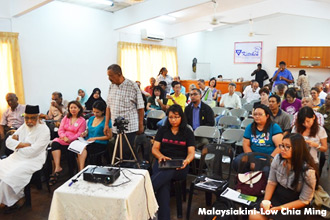
 International Trade and Industry Ministry (Miti) chief negotiator J Jayasiri
(right)
said the most important aspect of the negotiations is that the government will ensure the agreement will benefit the nation on the whole.
International Trade and Industry Ministry (Miti) chief negotiator J Jayasiri
(right)
said the most important aspect of the negotiations is that the government will ensure the agreement will benefit the nation on the whole.
"That is why we need to conduct a cost-benefit analysis. It is our responsibility to negotiate the best deal for Malaysia," he told a forum on the ‘Impact of the TPPA’, organised by the Consumers Association of Penang (CAP) on Saturday.
"The government will decide whether it serves the national interest before signing it," he said.
"I am a civil servant and need to work within the current system.(I cannot reveal the text of the negotiations) unless the cabinet gives (me) a different directive.”
However, Jayasiri revealed that 20 questions on the TPPA will be raised during the new parliamentary session which starts today, and that Miti will provide the answers.
"The negotiation is also about my children and (our) future, (so) definitely, I (would) want to get the best deal for Malaysia,” he noted.
 The next round of negotiations will be held from July 15-25, with Japan expected to participate for the first time.
Jayasiri also said Miti is not the only agency involved in the negotiations.
"Participation in the negotiations does not necessarily mean we will sign the agreement. The government will ensure that it is beneficial to the country and rakyat.
"It is not a zero-sum game, where you will not get everything that is good and other countries lose in other aspects. Many chapters have been discussed but those are references to the technical aspects, like use of terms and so on. Nothing has been agreed until everything is agreed.”
Furthermore, not all of the issues in the negotiations are being raised by the US, as other countries too have their own agenda, he pointed out.
The TPPA does not only touch on the opening of markets but on cooperation in terms of capacity building, he said.
"Sometimes, over-protection can result in local industries becoming too comfortable until they lose competitiveness," he added.
‘Reasons to reject TPPA’
CAP president SM Mohamed Idris gave five reasons why the TPPA must be rejected, including the requirement for all governments to maintain "secrecy on the negotiating texts until four years after the deal is signed".
Idris said another reason is that the investment chapter effectively empowers foreign corporations to "ignore and override" the domestic judicial, legal and parliamentary systems.
 "Other provisions could greatly restrict the government's ability to balance the protection of public interest, health, the environment and human rights against the private interest of corporations," he told participants.
"Access to affordable, life-saving medicines for millions of people is under threat as the TPPA would provide higher protections for the patents and clincial data of big pharmaceutical companies.
"This would make it harder for generic companies to produce affordable generic medicines, as well as delay and restrict access to the public.”
 Idris
(left)
said that, if the duration of copyright and patent is extended as the US has reportedly proposed - according to leaked texts - affordable access to information and knowledge would be harmed.
Idris
(left)
said that, if the duration of copyright and patent is extended as the US has reportedly proposed - according to leaked texts - affordable access to information and knowledge would be harmed.
There would be negative impacts on the research and education sectors, he said.
"Reducing tariffs on farms and manufactured products may result in many people losing their jobs and livelihoods due to the resulting influx of cheaper imported goods putting our local companies out of business,” he added.
Other than MiTi, organisations that sent speakers to the forum were the Malaysian Aids Council, EcoKnights, Majlis Tindakan Ekonomi Melayu, Third World Network, and Jaringan Rakyat Tertindas.
Pakatan Rakyat MPs have called for a parliamentary select committee on the issue, although the coalition has said it will not oppose the TPPA if the terms were "fair" .


Are you sure you want to delete this comment?
This action cannot be undone.