




Ramadan and high performance sport
COMMENT The question of the performance of Muslim sportspersons while fulfilling their fasting obligations during Ramadan has come up for some testy comment after national coach K Rajagobal attributed the poor play of the Malaysian team on their just completed Japan tour to fasting.
COMMENT The question of the performance of Muslim sportspersons while fulfilling their fasting obligations during Ramadan has come up for some testy comment after national coach K Rajagobal attributed the poor play of the Malaysian team on their just completed Japan tour to fasting.
PAS Youth Arts, Culture and Sports bureau deputy chief Fadhil Osman taxed Rajagobal with being "rude" for suggesting that the players' fulfillment of their fasting obligations had contributed to the dismal results of the team on the tour.
The national team was defeated 2-0 by division one club Shimizu S-Pulse and 5-0 by Shonan Bellmare on top of another 5-0 defeat by division two club Tokyo Verdy on the tour of Japan.
Fadhil offered the view that the explanation by Rajagobal for this poor outing by the national team was a convenient cover for his own shortcomings as a coach.
He alluded to the performances of Muslim participants in the London Olympics last year which was held during Ramadan and said some among them fulfilled their fasting obligations while giving a good account of themselves in competition.
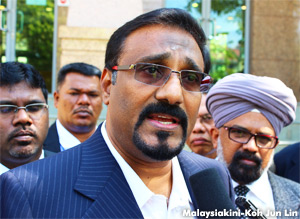 Fadhil's remarks drew a retort from MIC director of strategy S Vell Paari (
left
) who argued that competitive football was a demanding sport that required players to take refreshments regularly to replace lost fluids.
Fadhil's remarks drew a retort from MIC director of strategy S Vell Paari (
left
) who argued that competitive football was a demanding sport that required players to take refreshments regularly to replace lost fluids.
Hence, Vell Paari felt that Rajagobal was not being remiss in attributing the national team's pallor to the players' poor physical state in the course of matches where their fast from regular sustenance would have rendered them below peak condition.
Misgivings expressed
Some years back, no less a reputation in football coaching than current Chelsea coach Jose Mourinho expressed misgivings about the effect of Ramadan on the condition of one of his players in the Inter Milan team he was then managing.
Commenting on the performance of Muslim player Sulley Muntari, Mourinho said, "Ramadan has not arrived at the ideal moment for a player to play a football match."
His remarks stirred Muslim leader Mohamed Nour Dachan to respond: "I think Mourinho could do with talking a little less. A practising [Muslim] player is not weakened because we know from the Institute of Sports Medicine that mental and psychological stability can give a sportsman an extra edge on the field."
Liverpool's central defender Kolo Toure, an Ivory Coast international, would be apt to agree with this view.
Toure has been fasting during Ramadan throughout his career.
"I think it's amazing how Ramadan can make you really strong," he has opined.
"It's been tough, but at the same time I feel like I am much stronger, because my mental condition takes over. It's definitely hard, but when you believe in God, nothing is impossible," offered Toure.
One supposes the issue of fasting while engaging in high performance sport depends on the individual concerned. It is safe however to say that most coaches would frown on combining the two.
Years ago this reporter was intrigued to witness an episode during the Kedah team's tour of Czechoslovakia which was held during Ramadan.
The previous season Kedah had topped the local league and was rewarded with a European tour in April 1990 which also served as preparation for the new season.
The team was housed at a huge sports complex in the countryside some distance from the capital Prague. The arrangements had been made by Josef Venglos, a coach who was well regarded by both the Football Association of Malaysia and Fifa.
Kedah's coach was Milos Kvacek, also a Czech with a reputable standing in coaching circles.
One morning Kvacek had observed that the team's Muslim players had not come down from their rooms for breakfast but were present at the training session later that morning.
At lunchtime there was a similar no-show at the canteen by the Muslims.
An irate Kvacek then turned on an assistant coach who happened to just then take his seat at a table to tuck into his meal from the buffet spread: "Where are the rest of the players?"
"Coach, they ... are ...fasting," hemmed the assistant.
"Fasting! They were not fasting last year during Ramadan when we toured Thailand?" demanded Kvacek.
"Coach ... religion," stammered the assistant, visibly blanching before Kvacek's mounting ire.
"What religion? It's like Marxism ... only fit for the theatre," blurted Kvacek, as both the assistant and this scribe cringed at the table we occupied.
(It must be remembered this was just six months after the Berlin Wall had fallen and the division between communist Eastern Europe and the West had begun to evanesce. Kvacek, from the East, must have been relieved to have been liberated from communism's shackles.)
"You make sure they are out there at four for the evening session," stormed Kvacek at the assistant before striding to his table in the dining area.
The assistant coach and I were wordless for the rest of the meal. As we finished I asked why the tour was arranged during Ramadan.
"I think it was because the players did not fast during this time last year," the assistant said.
In the evening the squad was on the practice pitch at the appointed hour. Most of them were listless and ragged-looking.
Kvacek did not waste time exhaling incense in the cold spring air. The tense assistant coach must have heaved with relief.
TERENCE NETTO has been a journalist for four decades. He likes the occupation because it puts him in contact with the eminent without being under the necessity to admire them.


Are you sure you want to delete this comment?
This action cannot be undone.