




Anwar and Reformasi through ordinary eyes
"No one truly knows a nation until one has been inside its jails. A nation should not be judged by how it treats its highest citizens but its lowest ones." - Nelson Mandela
COMMENT Growing up, I remember sifting through my father's collection of old newspaper clips. One reported that a certain persona by the name of Anwar Ibrahim was about to join Umno. That paper clip was from 1982.
"No one truly knows a nation until one has been inside its jails. A nation should not be judged by how it treats its highest citizens but its lowest ones." - Nelson Mandela
COMMENT Growing up, I remember sifting through my father's collection of old newspaper clips.
One reported that a certain persona by the name of Anwar Ibrahim was about to join Umno. That paper clipping was from 1982.
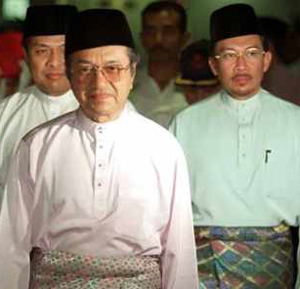 Many in Anwar's (
right in photo
) circles and followers at the time viewed him as their next hope for a leader that could strongly challenge the government.
Many in Anwar's (
right in photo
) circles and followers at the time viewed him as their next hope for a leader that could strongly challenge the government.
Needless to say that move to join Umno was not welcomed by many; my mum, a member of JIM included.
In 1996, while tabling the budget in Parliament -an annual event where I awaited with bated breath for him to introduce a new vocabulary - a practice he was famous for - Anwar was surprisingly spotting noticeable breakouts.
Mum responded: " Baru nak matang lah tu ... (He is probably just about to mature...)." The consternation she felt then remained.
The financial crisis a year later shook most of the tender Southeast Asian economies, while Anwar was at the pinnacle of his political career. I did not really understand my parent's remark then about how Anwar would soon "get it". I soon did.
Sudden plunge from pinnacle
I watched Sept 2, 1998 unravel on television while I was on campus down south. I will never forget that moment; sitting down dumbfounded trying to gather my thoughts.
From then onwards, keeping track of Anwar's ceramah around the country, news and developments, became a daily affair.
Anwar's famous "Ini adalah konspirasi dan fitnah jahat untuk membunuh karier politik saya", echoed in mind every day.
More arrests were subsequently made in that period, under the draconian ISA. The late Fadzil Noor then lead a coalition of political parties and NGOs known as Gerak. Gerak held massive protests to free Anwar. The Reformasi movement then gathered momentum, initially as an Anwar-specific cause.
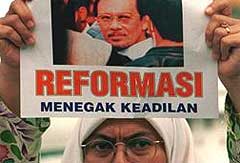 But what it evolved into was something far greater. It united all opposition, NGOs and Islamic movements and revolutionised to become something bigger.
Amidst major differences, opposition parties then realised that there existed transcendental values that they all fiercely subscribed to - such as justice, liberty, and freedom.
This realisation had major uniting capabilities. Activists made up of PRM, Abim, JIM and the men who left Umno then decided to form Adil, an organisation which eventually, graduated to become the Parti Keadilan Rakyat that we know today.
At the height of it all was Sunday - Sept 20, 1998 - where the largest ever demonstration took place in Dataran Merdeka, under the Reformasi umbrella.
Past turns puppet master
The crowd that had gathered at the National Mosque for Anwar's landmark Reformasi speech, rallied on to Dataran Merdeka for another speech, then on to Jalan Raja Laut and ended up in front of the EPF.
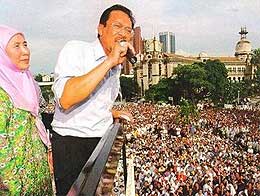 The energy and conviction I felt and witnessed being among the crowd at the time reminded me of our next-door neighbour. Only five months earlier, Indonesians ousted their own President Suharto.
Malaysia had never witnessed such resolute. But the important thing to note is that it was not all for Anwar alone.
It was a show of deep unhappiness over the grave injustices that the government seemed to be able to inflict against someone as high up as the deputy premier. What then was left for the ordinary rakyat.
We finally realised then how deep and structural were the extent of the government's tentacles controlling the country's police force, state media and the entire judicial system.
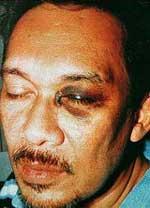 That very same night, balaclava-clad commandos stormed into Anwar's private home and roughly seized him. Nine days later, he made his first public appearance with a black eye. Malaysia had just witnessed the death of democracy.
What happened after, we all knew and followed. Anwar was put on a controversial trial, found guilty, and sentenced to nine years of imprisonment.
How could the once number two in Malaysia, be politically imprisoned, brutally beaten, and emotionally vilified to beyond any human extent, I wondered. Anwar Ibrahim became Malaysia's most controversial prisoner of conscience.
Reformasi's breath of life
Reformasi breathed new life into Malaysian youth of the 1990s, at a time when youthful zeal and activism spirit had diluted in favour of material wealth and pleasure.
This was a contrast from the youth of the 70s, whose idealism were more pro-poor, intellectually-driven, and in line with the spirit of merdeka, fitting of a recently liberated nation.
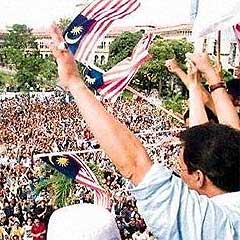 It is a mass movement that was manifested by rakyat from all walks of life, whose birth was spontaneous, honest and pulsing of the rakyat's aspirations. It still very much is; it belongs to everyone, within and out of political parties, young and old.
Fifteen years on, Malaysians have perhaps experienced an unconventional politically maturing process witnessing Anwar and our Reformasi.
We inherit a Malaysian with various realities to embrace; a rigged election system, highly racially sensitised plural society, a government which has overbearing control over all economic, judicial and social aspects of the country, and spatially and demographically unequal standards of living, amidst many others.
It is not easy to change the status quo, a system that has been deeply entrenched for the past 50 years. Not easy, yet not impossible.
Tomorrow: The man who triggered Reformasi
ANAS ALAM FAIZLI is an oil and gas professional. He is pursuing a post-graduate doctorate, co-founder of Blindspot, Bantah TPPA and tweets at @aafaizli.


Are you sure you want to delete this comment?
This action cannot be undone.