




Yet again, Anwar says Islam and democracy are compatible
Anwar Ibrahim's evolution as a Muslim democrat continued apace at this weekend's Adelaide Festival of Ideas when he propounded a familiar argument of his: there is no incompatibility between democracy and Islam.
Anwar Ibrahim's evolution as a Muslim democrat continued apace at this weekend's Adelaide Festival of Ideas when he propounded a familiar argument of his: there is no incompatibility between democracy and Islam.
Speaking at a segment of the festival entitled 'Dissent and Democracy' Malaysia's opposition leader was questioned by the moderator about Islam and democracy.
Anwar's response was to cite a familiar trope - the maqasid al-shariah, a 12th century concept enunciated by the Islamic thinker Al-Shatibi - which the Pakatan Rakyat leader is fond of citing as a precursor of the 18th century European Enlightenment principles that eventually inaugurated the constitutional democracies of the west.
Anwar told moderator Waleed Aly: "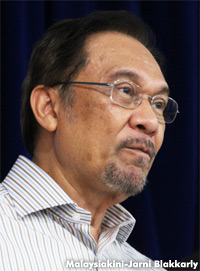 ...I'm glad you brought up this issue about Islam and democracy. The misconceptions surrounding it are not something to be brushed aside.
"First, as I've said time and again, there's no incompatibility between Islam and democracy. The principles of government as laid out in the maqasid al-shariah all point towards a convergence with democratic principles.
“By the maqasid, I mean the higher objectives of the shariah. Now, they point towards representative government, rule of law, transparency and accountability.
“I believe the problem is not the issue of compatibility but the question of how to deal with the overriding problems of violence and terrorism carried out in the name of Islam."
Expatiating on his notion of why dissent gives vitality to the practice of democracy, Anwar said: "As a check against dictatorship of the majority, dissent is absolutely crucial to give voice to the minority. So, you need strong and viable opposition. It doesn't have to be monolithic and leaders don't have to speak with one voice all the time on all issues. We don't need that kind of opposition."
Anwar said dissonance arising from infrequent plurality of views in the ranks of the opposition coalition he leads prompted his country's "controlled media" to "paint a picture of a very fractious opposition."
"We advocate dissent. So, we practice what we preach. They (controlled media) don't seem to get it - dissent is part of democracy," he stressed.
Anwar vows to continue struggle
Asked about his intimation that he would quit politics if his coalition did not win the elections, Anwar replied, "Now this thing about me quitting politics has been taken out of context."
He explained that his decision to quit was based on the condition that "we lose the elections, that we are rejected by the people."
He elaborated the context in which that intimation was shelved: "Now, as I've said we didn't make it to Putrajaya not because we lost or that we couldn't get the people's mandate. On the contrary, we didn't make it to Putrajaya in spite of getting the popular vote and getting the resounding mandate from the people."
Anwar said that under these circumstances, his coalition felt that they were "cheated of victory". Hence his exit from politics would tantamount to "an act of cowardice to throw in the towel."
He cast his decision to stay on in moral terms. "The moral imperative is to stay on and continue the fight," he asserted.


Are you sure you want to delete this comment?
This action cannot be undone.