




15 years of pump-priming, but little to show for it
COMMENT "What you cultivate during the next seven years, when the time of harvest comes, leave the grains in their spikes, except for what you eat. After that, seven years of drought will come, which will consume most of what you stored for them. After that, a year will come that brings relief for the people, and they will, once again, press juice (olives and grapes)." - Joseph: 47-49, Quran
As the lesson from the story of the Prophet Joseph goes, livelihood is a cycle of economic ease and hardship. Keep during the good times and sustain during the bad. With patience and fortitude, the good will eventually rise again.
However, this situation is not the same with the Malaysian economy, or in particular, with the annual federal budget...
COMMENT "What you cultivate during the next seven years, when the time of harvest comes, leave the grains in their spikes, except for what you eat. After that, seven years of drought will come, which will consume most of what you stored for them. After that, a year will come that brings relief for the people, and they will, once again, press juice (olives and grapes)." - Joseph: 47-49, Quran
As the lesson from the story of the Prophet Joseph goes, livelihood is a cycle of economic ease and hardship. Keep during the good times and sustain during the bad. With patience and fortitude, the good will eventually rise again.
 However, this situation is not the same with the Malaysian economy, or in particular, with the annual federal budget.
In this second series, in anticipation of the 2014 budget, I will address issues with the BN government's budget, and Pakatan Rakyat's practical steps to improve the process.
Since 1997, Malaysia's economic growth has slowed to an average of four to five percent a year. In the 1980s and 1990s, the pace averaged nine percent. Malaysia's loss of self-confidence and being stuck in the middle-income trap is compounded by the fact that the country is extremely blessed with natural resources, but yet it has continuously squandered opportunities and is being overtaken by its neighbours.
The last time Malaysia had great economic growth was in the early to mid-1990s, which was also the period when Anwar Ibrahim was finance minister. Incidentally, that was also the period when we had a five-year streak of continuous surplus in our national budget.
However, since then, the budget philosophy has changed and the fiscal astuteness has not been seen again. The BN government's fiscal management continues its blatant disregard of good practices.
A spendthrift government
For one, there is wrong priority on budget allocations and continuous wasteful expenditure.
The Umno-BN government is, unfortunately, a spendthrift government. We are now in our 15th year of deficit. A deficit is not necessarily a bad thing, and in times of economic challenges, it is even a necessity. A government can spend more to stimulate the economy.
 But 15 years in a row is a long time, without any visible plans to reduce the deficit in the future. Fifteen years of pump-priming and what do we have to show? A barely mediocre average growth rate of five percent a year for a still developing nation.
The (mis)allocations to the Prime Minister's Department, to the tune of more than RM10 billion, is of grave concern. Prior to 2008, the PM Department's budget was less than half of what it is today.
The allocation between operational expenditure at 77 percent and development expenditure at 23 percent is suboptimal. The government needs to drive budget allocation towards development, targeting more than 30 percent of the budget to ensure that monies are spent directly and effectively.
And certainly, the annual reports of the auditor-general are testament to the frequent and continuous wasteful expenditures, with there being no visible effort to combat these excesses.
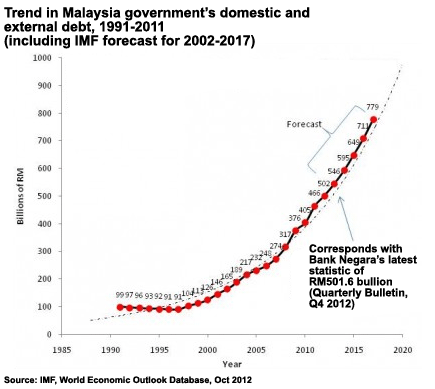
Secondly, there is the ballooning debt situation, which we continue to fund from borrowings.
Fifteen years of deficit spending by Umno-BN has also given us a large national debt of more than RM441 billion. In addition, our government-linked companies (GLCs) are in debt to the tune of RM118 billion. These GLC debts are guaranteed by the government, therefore the total debt exposure of the government is an even larger RM559 billion, or 66 percent of the 2011 GDP.
As comparison, Spain's sovereign debt is 68 percent. Malaysia may have many more other debts that are off the balance sheet, including pension obligations. On top of all this, the mother of all debts will be in the form of financing the grossly-inflated MRT project.
Full disclosure, please
According to the Open Budget Report 2012, a man from Likoni, a poverty-ridden area on the outskirts of Mombasa in Kenya, was asked what had happened to the more than US$55,000 that the local government was supposed to have used to build the Mrima Secondary School.
The man, in his mid-30s, stood next to a hole surrounded by his neighbours. The hole was reportedly where the Constituency Development Committee had begun digging the foundation for the school and then inexplicably abandoned the project. According to the man, the project wasn't the right one, anyway.
"No one came to the community to ask if we wanted to put a school here. What we need is a dispensary," he said, with the others nodding and murmuring their assent.
In the Open Budget Index 2012, an international index evaluating the quantity and type of information governments make available to the public, Malaysia is ranked 62 out of 100, placing it in the category of providing "minimal info".
This puts the country in the same league as Angola and Burkina Faso, and behind Indonesia, which is in the "significant info" list, while the Philippines and Afghanistan are listed under "some info".
Transparency in national budget documents is important in empowering citizens to evaluate and track spending, revenue collection and borrowing during the year.
The BN government therefore has to provide more details on the budget to the citizens. It should develop full details on how it plans to reduce the large operating expenditure in the short-term to alleviate public concerns that these cuts will be made at the expense of social services and other areas of public expenditure that go to helping the poor and needy.
Full disclosure of where these cuts will be made, the savings obtainable, how adverse impacts will be mitigated, etc, will help generate the support necessary to implement what may be regarded by some sections of the public as 'painful and unpopular' and hence, politically incorrect measures.
In the medium-term, the government should exercise continued thrift in public spending so as to restore the country's financial strength and international confidence. The target of reducing the budget deficit to one to two percent of the GDP should be established in the next five years.
Transparency is another crucial area for the BN government to improve. Prior to drawing up the budget, mechanisms for public involvement in the budget process should be institutionalised, including public hearings during formulation and discussion of the Budget and at regular intervals throughout the budget cycle.
Getting the rakyat involved throughout the budget process will ensure adequate buy-in and ease the difficulty of accepting unpopular decisions for the greater good.
Post-budget approval, the BN government should make public and easily accessible all relevant budget documents it produces for scrutiny. The government must be accountable to the wider population by ensuring that the people are aware and understand the sources of revenues and allocation of operational and development expenditures in the budgetary process.
Key practices
The following recommendations are proposed in the Open Budget Report 2012:
During the budget formulation stage, governments should publish a "Pre-Budget Statement" that will include the assumptions used to develop the budget, such as total expected revenue, expenditure and debt levels, and broad sector allocations.
Also to be published is the "Executive's Budget Proposal", which will present the government's detailed plans, in terms of policy priorities and budgets for each ministry and agency, for the coming budget year.
During the budget execution stage, governments should publish "In-Year Reports", which will include information on revenues collected, actual expenditures made and debt incurred at a given point in time, generally through monthly or quarterly publications.
A "Mid-Year Review" that summarises the actual budget data for the first six months of the year (revenues, expenditures and debt), reassesses the economic assumptions upon which the budget was initially drafted and adjusts the budget figures for the remaining six months accordingly.
Lastly, a "Year-End Report", which shows the situation of the government's accounts at the end of the fiscal year and ideally includes an evaluation of the progress made toward achieving the policy goals spelled out in the budget the of that year.
Pakatan's fiscal approach differs greatly from the BN's. Pakatan, in a nutshell, is rakyat-centric. The interest of the rakyat is paramount and self-interest, party or individual, takes a back seat.
Rather than shroud sources of spending and wastage in secrecy, Pakatan will adopt rakyat-friendly measures by ensuring the right priority in fiscal allocations, removing wastages and reducing the federal borrowings.
All these measures will be done partly by taking into account views from the rakyat prior to and post-budget approval by adopting leading international practices. The rakyat reigns supreme in the eyes of Pakatan.
Part 1: Sustaining growth in an increasingly competitive world
RAJA AHMAD SHAHRIR is a research associate with Institut Rakyat, a think tank affiliated with PKR. He tweets at @RajaShahrir and his Facebook is RajaAhmadShahrir.


Are you sure you want to delete this comment?
This action cannot be undone.