




Pakatan's 'alternative budget' takes aim at deficit
Pakatan Rakyat is confident that its shadow budget, which aims to change the country's taxation system to a more progressive form with higher taxes on the very rich, will help reverse the annual deficits by 2018.
Pakatan Rakyat is confident that its shadow budget, which aims to change the country's taxation system to a more progressive form with higher taxes on the very rich, will help reverse the annual deficits by 2018.
The BN government will unveil Budget 2014 tomorrow and widely expected in it are subsidy cuts and a broad-based goods and services tax.
Unpopular though these moves are, they are nevertheless expected to be proposed in the bdget because the government has been carrying out a loose fiscal policy for the last 15 years and Malaysia's debts have bloated.
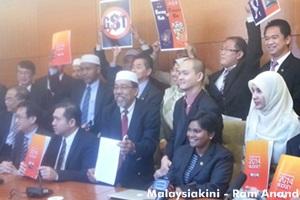 However, Pakatan said it can offer less painful alternatives.
Its budget would not consider the GST but first look at cutting government wastage, including putting an eagle-eye on defence spending.
It would also take the Auditor-General's Report seriously and abolish ineffective and costly government programmes like the National Service. Also, salary increments for ministers would be frozen.
"It is worth noting that taxpayers seem to be doing their best to avoid paying taxes because of their unhappiness with the way the government spends public funds," the shadow budget says.
"With better governance, accountability and transparency under a Pakatan Rakyat government, Malaysia should be able to increase its tax collection without much fuss."
Besides belt-tightening measures, Pakatan's fiscal reforms would next hinge on making the taxation system more progressive.
"If Pakatan Rakyat's programme of fiscal discipline on how to plug the gap is followed religiously from 2014 onwards, Malaysia should be able to achieve a balanced budget, even eke out a small surplus by 2018 at least," it says.
Increasing taxes on the rich
One key policy shift in the 40-page shadow budget is to tax the rich more by shifting the tax brackets up.
 It proposes that those with taxable income of less than RM10,000 a year would pay no tax, compared with the one percent tax now levied on those earning RM2,500 and below.
Instead, Pakatan will levy the highest income tax rate of 26 percent, on those earning RM250,000 a year and above. Currently, those earning RM100,000 and above are taxed 26 percent.
"It is hoped that these measures will help raise the national disposable income and discourage Malaysians from looking for greener pastures abroad," it says.
The move would "prevent the middle-income group from falling into the high top tax brackets at an accelerated speed".
Furthermore, the rich would pay more as Pakatan also plans to introduce a capital gains tax on the trading of shares, bonds and other securities.
 The tax on capital gains would work on a tiered structure to encourage long-term investments while dissuading excessive speculative elements.
To curb property price inflation, Pakatan plans to raise real property gains taxes back to the pre-2007 levels. Foreigners would only be allowed to buy apartments costing above RM1 million and landed properties above RM3 million.
Other highlights
Other highlights of the shadow budget include measures previously promised in its GE13 "orange" manifesto, such as:
- To fast track the completion of the Pan-Borneo Highway linking all towns and cities in Sabah and Sarawak;
- Abolishment of monopolies;
- Abolishment of PTPTN;
- 100 percent electricity and water service delivery rate in all the rural areas;
- Suspension of the National Service programme for at least a year;
- Investigation and review of the BR1M payments to ensure only really needy households get help;
- Faster and cheaper Internet service access for all; and
- More money for universities.


Are you sure you want to delete this comment?
This action cannot be undone.