




An eyewitness account of the Bertam Valley deluge
FOCUS Oct 23, 2013 - I woke up with a start. My wife was shaking my shoulders.
"Hubby, wake up, did you hear that? The dam sirens just sounded!"
It was around midnight. Groggy from sleep after a long day at the farm, it took me a while to collect my thoughts. For a fleeting moment, memories of a similar incident when I was just eight, came flooding back...
FOCUS Oct 23, 2013 - I woke up with a start. My wife was shaking my shoulders.
"Hubby, wake up, did you hear that? The dam sirens just sounded!"
It was around midnight. Groggy from sleep after a long day at the farm, it took me a while to collect my thoughts. For a fleeting moment, memories of a similar incident when I was just eight, came flooding back.
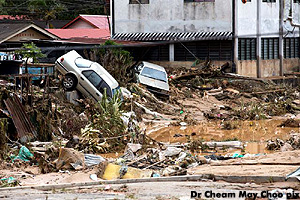 There was pounding on the door. The neighbours had come to warn us that the dam was releasing water, and my parents desperately ushered my siblings and I out of the house and onto higher ground.
That was in 1988. It was a terrifying moment for us kids. Twenty-five years on the same scenario seems to be playing out, except this time my house was on higher ground.
I was a lot calmer and I quickly advised my wife to pack all our important documents in the event that we had to evacuate.
I opened the sliding door to my house and looked down at the valley below. The rain was falling and there were faint lights in the distance.
What struck me was that though I could not see the river I could smell it. It was the smell of mud!
Cars floating by
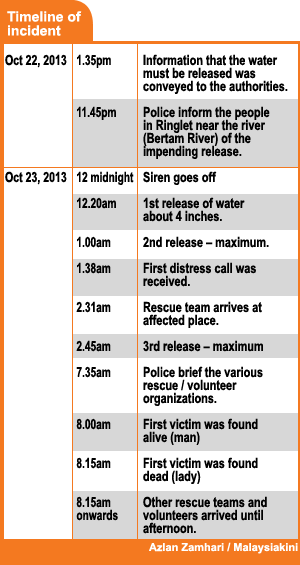
I called a friend who was in the village committee. He replied that the police had called him about half an hour ago to say that the dam would release some water soon and he was about to activate the siren at the fire station which was located in town. (There are two sirens. One at the dam and one at the local fire station.)
Then he added. "Wait a minute, wait a minute, I can see cars floating by. Oh no. This is going to be bad."
Sirens have sounded before but usually the release of water was not much.
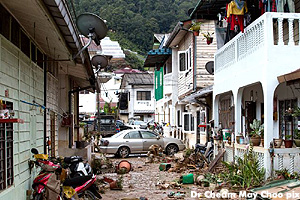 I informed my wife that I was going down to check on my elderly uncle and aunt who were staying at my old house in Section A of town.
(The catchment area of the Sultan Abu Bakar dam used to be the village of Lubuk Tamang. Before the dam was built in 1963, residents who were staying there were relocated to Bertam Valley and Kampung Raja. In Bertam Valley, they were resettled in neat rows of houses in Section A of town which were at a lower elevation and nearer the Bertam River compared to Section B.)
I rushed down to town and parked my truck on the main road near the local kopitiam. The lighting was poor and pandemonium reigned.
Car alarms short-circuited by water sounded continuously. The road was getting muddier. By now it was almost 1.30am.
No third siren
I hurried to the bridge leading to the older section of town. I could see residents crossing the bridge. (There were at least seven to eight such bridges connecting one side of town to the other.) Suddenly the remaining street lights went out.
My phone rang. A friend called and said they were going to release water for the third time.
I almost screamed: "Why aren't the siren sounding?"
"Because there is no electricity power," he replied.
"And there is no back-up generator?"
"No, no back-up generator."
(The electricity substation was located by the river bank of all places and it was probably deluged by now.)
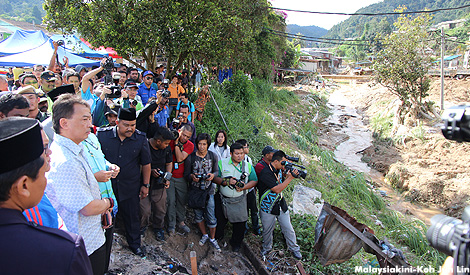 I was utterly speechless. Then just as I was about to cross the bridge, in the dim light I saw a three-foot wave of water striking the bridge.
To my horror I saw a man almost swept away as he reached the other side. He fell down but quickly picked himself up. What a narrow escape!
I gave up all thoughts of going to the older part of town and prayed that my uncle and aunt had gone to higher ground.
It was now almost 3am. Mud was begin to swirl along the main road and reaching the tyres of my truck. I felt that there was nothing further I could do and I drove home to my family.
Two earlier episodes
The first-hand account above was recounted to me by a resident of Bertam Valley who went through the ordeal last Wednesday when the Sultan Abu Bakar Dam gates were opened thrice to release water.
Many have asked what went wrong? How can a controlled release of water from the dam go so horribly wrong, resulting in loss of lives and property?
 This is not the first time there has been damage resulting from the release of water from the dam. There were two other major episodes, one in 1988 and another in the 1990s but residents here have said that what happened on Oct 23, 2013 was the most serious.
Was there a failure of the early warning systems? We believe so.
Though the rains preceding this incident were heavy with 60mm of rain in 24 hours on Oct 22, they were not as bad as the 30mm of rain in one hour in the Sg Ruil incident.
So as the water levels started to rise, why weren't the controlled water release done much earlier? Was this earlier rise even noticed? Were there any sensors monitoring the rise of water and if there were, were they in working condition?
Then what about the lines of communication between the staff at the dam and the village committee? Why can't there be direct lines of communication between dam staff and the village committee?
I thought it was rather odd to have a power substation right on the river's path. With the lack of electrical power, the sirens were compromised, escape to safer areas hampered and rescue work adversely affected.
An unforgiving river
Why was there such a massive volume of water and silt in the first place?
 Sungai Bertam originates around the Gunung Brinchang area and as it meanders through Brinchang and Tanah Rata, it collects water, silt and all the filth that we humans throw in.
There have been extensive land clearing in Brinchang and Tanah Rata in the last six months and most are without proper silt traps.
Sungai Bertam has become a river of mud and these silt all end up in the Habu dam, making it very shallow and unable to handle heavy rains. The dam which is generating minimum power if at all (as its turbines is clogged with mud) has become a giant silt trap.
It is easy to blame others but in a way we are all responsible. Many of us choose to remain silent as our environment gets destroyed.
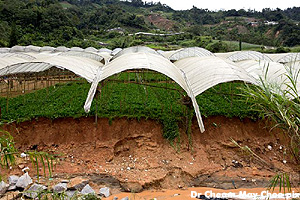 Farmers with plastic sheetings covering their crops should implement rain water collection systems. The holding tanks for rain water will slow down the water run-off.
Rivers should not be convenient dump sites for all manner of rubbish. There should be a buffer zone between the river and the settlements.
Sungai Bertam is suffering and it is not in a very forgiving mood. Tragedies similar to this will recur. Perhaps on a greater scale if safety and preventive measures are not taken soon.
The people of Bertam Valley living downstream to the dam are indeed living very dangerously.
DR CHEAM MAY CHOO is a medical doctor based in Cameron Highlands. She writes at http://www.cheammaychoo.com/
Related stories
'Rainfall forecast could have averted Bertam flood'
Alarm over Bertam flood risk raised years ago


Are you sure you want to delete this comment?
This action cannot be undone.