




On monarchy, four say a vital lot
COMMENT If brevity is the soul of wit, its analogue - concision - may be the distinctive hallmark of supple command of one’s material.
Practically all four speakers at the launch yesterday of Dr Syed Husin Ali’s book ‘The Malay Rulers: Regression or Reform’ tried to emulate the brevity of the work under discussion - aptly described as a “booklet” by Anwar Ibrahim who launched it - in the conviction that ‘less is more’.
COMMENT If brevity is the soul of wit, its analogue - concision - may be the distinctive hallmark of supple command of one’s material.
Practically all four speakers at the launch yesterday of Dr Syed Husin Ali’s book ‘The Malay Rulers: Regression or Reform’ tried to emulate the brevity of the work under discussion - aptly described as a “booklet” by Anwar Ibrahim who launched it - in the conviction that ‘less is more’.
The result: an illuminating discourse on the subject of our constitutional monarchy that was a useful reminder of its essence, probable causes of its weakening, and, interestingly enough, the avenue for its rejuvenation.
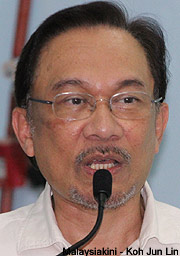 Anwar (left) set the succinct tenor with remarks that managed to cover the angles of history, present-day relevance, and possible path of rejuvenation of the monarchy in a style that had the hallmarks of the swift, sensitive touch of a safecracker.
Constitutional law expert Dr Aziz Bari, in the course of an overview of its role and functions, seemed positive that the constitutional monarchy, as in Spain and Japan, was helpful in the restoration of democracy.
Another speaker, Shamsul Bahrin, of aristocratic lineage he is rather prudish about, made a beeline for the subject of royal demeanour and deportment, something he said he knew fairly well from having golfed a lot with rulers.
Aficionados of the sport, admittedly not many in the 200-plus multi-racial, egalitarian-seeming audience (a sizeable crowd on the day, given the festive season) that turned up for the launch, will readily testify to the game’s facility at revealing character.
Shamsul was convinced that the characters of the royals he had teed up with were amenable to suasion, based on the ethos that is the raison d’etre of royalty: seigneurial dignity and honour.
The former Universiti Malaya dean and present chancellor of a private university broadly hinted that the manipulation of courtiers was more responsible for the monarchy’s decay than the actual conduct of royals.
In an apposite touch, in keeping with the occasion’s succinct tenor, Shamsul suggested that the rulers be referred to simply as “Rulers” rather than as “Malay Rulers” because they were symbols of unity of all the races in the country, a nice touch in these days of exclusivity and privatisation of linguistic terms.
Parlance of the palace
The final speaker was the author, Syed Husin, who zeroed on the parlance of the palace which he said was demeaning of ordinary folk and generative of a slavish mentality.
In tones reminiscent of George Orwell’s famous conviction of the power of language as a communicative mode of intent and meaning, Syed Husin urged the democratisation of court language.
His translation, from Malay to English, of examples of self-demeaning terms of expression powerfully made the case for their shedding, though it might expose him to a charge of lese majeste.
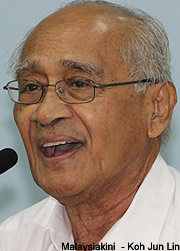 But as Anwar said in his book launch speech, Syed Husin (right) “is not in the business of saying things to please people”.
Not only is ingratiation alien to the nature of this former don of Universiti Malaya’s social anthropology department, Anwar reminded those familiar with Syed Husin’s writings that these constitute “an unbreakable chain in his overriding theme and that is the theme of social justice.”
In this aspect, Anwar was reiterating what he said, in June 2009, at the launch of Syed Husin’s ‘The Malays: Their Problems and Future’ when the PKR leader held forth on the author’s unremitting dedication to the cause of the social advancement of the Malays and of the Malaysian nation.
Syed Husin, now in his second term as a Senator from Pakatan Rakyat-controlled Selangor state, had retired from the deputy presidency of PKR in 2010 on the grounds that he wanted more time to devote to his writing.
Since that retirement, he has written a memoir of his political struggles (‘Memoir Perjuangan Politik’), published last year. Now he has come out with a book on the monarchy, though the latter, to cite what Shamsul said at yesterday’s launch in jest, is more “a pamphlet” than a book.
However, less could be more if a vital theme is handled with concision and clarity rather than smothered by a tome of unreadable girth.
TERENCE NETTO has been a journalist for close on four decades. He likes the occupation because it puts him in contact with the eminent without being under the necessity to admire them. It is the ideal occupation for a temperament that finds power fascinating and its exercise abhorrent.


Are you sure you want to delete this comment?
This action cannot be undone.