




BN MP: Gov't must educate public on GST implications
The government should find more means of educating the public on the Goods and Services Tax's (GST) implications to clear the confusion clouding this matter, says Labis MP Chua Tee Yong.
The government should find more means of educating the public on the Goods and Services Tax's (GST) implications to clear the confusion clouding this matter, says Labis MP Chua Tee Yong.
He said that GST will be beneficial for most consumers as taxes will only be implemented based on income levels, and will prove to be progressive rather than otherwise in the long run.
"The opposition gave the example to show GST is regressive by showing that regardless of income, the spending habit is still the same and this is illogical.
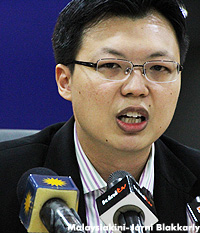 "A person with an income of RM1,000 will have a different spending habit compared to a person with a RM10,000 income," said Chua (left) in a press statement yesterday.
As a counter-argument, he said Singapore had implanted GST for nearly 20 years and 75 percent of the taxes collected came from high-income households and expatriates.
In addition, he said the government has already conducted studies on this issue, but most people are not aware of the results.
Citing the debate on whether GST would affect the price of medical services as an example, Chua said the government needs to hold more sessions to educate the public on GST's impact to "avoid further confusion and complications created by unnecessary parties."
He said consumer guidelines, hotlines, and websites to answer consumer's questions on GST will be important in this effort.
Health Minister Dr S Subramaniam had reportedly said that health services are exempt from GST and his ministry is working with the Finance Ministry to minimise its impact on medical services.
He said a study is under way to list health services and products that are GST-exempt.
 However, DAP publicity chief Tony Pua (right) argued that while GST is not directly imposed on patients, healthcare providers still have to pay the tax when purchasing drugs and medical supplies, and are likely to pass on the cost to patients.
Chua, who is also the MCA Young Professionals Bureau chairperson, pointed out that the there is still no detailed list of what would be GST-exempt, only a general statement that medical costs are exempted.
"Thus if there was previously sales or service tax being levied, then it is likely there might be a slight drop or minimal differences.
"If the medical product does not (already) have sales or service tax, then there would be an increase," he added.


