




'Why only five politicians charged with corruption?'
The Malaysian Anti-Corruption Commission (MACC) only arrested nine politicians over the past four years - and charged just five of them with committing offences.
The Malaysian Anti-Corruption Commission (MACC) only arrested nine politicians over the past four years - and charged just five of them with committing offences.
Paul Low, a Minister in the Prime Minister's Department, revealed this in a written parliamentary reply to PKR’s Pandan MP Rafizi Ramli yesterday.
Although asked for the number of investigation papers opened by the MACC on politicians, he did not respond to this.
Rafizi had also asked how many of these papers had been picked up by the Attorney-General’s Chambers (AGC) for further action, but this too was not answered.
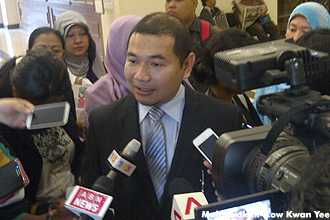 At a press conference later, Rafizi said the informationi was proof that the MACC "does not want" to investigate politicians for corruption.
Rafizi said the number of politicians arrested and charged was not consistent with public perception that "politicians are as corrupt as, if not more corrupt than, enforcement officers".
The MACC has shown an increasing conviction rate when it comes to corruption among the public, with the rate at 89 percent in June.
This, said Rafizi, shows that the MACC is capable of gathering sufficient evidence to charge offenders from among the public.
"Why does the MACC then give the excuse that it can't find enough proof to charge politicians?" he asked.
He said that the data also showed that MACC could no longer argue that it does investigate politicians but that the AGC does not act on many of the cases.
"I can conclude from this answer that the MACC too protects corrupt politicians, just like the attorney-general," Rafizi added.


