




After all these years, still no accord on NCR issues
ADUN SPEAKS Native customary rights (NCR) to land have been in existence for centuries in Sarawak and given recognition by Brooke and British administrations via the rules, regulations and ordinances drawn up and passed by them.
ADUN SPEAKS Native customary rights (NCR) to land have been in existence for centuries in Sarawak and given recognition by Brooke and British administrations via the rules, regulations and ordinances drawn up and passed by them.
NCR over land are held by the courts to be within the meaning of the right to livelihood, and therefore protected under Art 5(1) of the federal constitution.
The courts including the Federal Court recognise that NCR subsist over land comprising cleared/farmed land ( temuda ), reserved forests area ( pulau galau ) and communal land ( pemakai menoa ).
 The State authorities have failed and/or refused to recognise and enforce the courts' decisions, resulting in numerous legal actions thereby wasting the time and resources of the litigants and courts.
Even the state legal advisor continues to ignore the decisions of the courts by persisting in arguing that the custom and practice recognised by law as establishing rights to the land is confined to temuda only.
According to the 2010 census, 71.2% of Sarawak's population is made up of indigenous people belonging to 28 groups. This is a large proportion, to whom native customary rights land means everything.
Our esteemed prime minister said recently in London that to maintain stability, ‘the majority of the people must not be marginalised'.
It is not a comfortable truth but that appears to be happening in Sarawak, and will continue to be the case if we do not adhere to the decisions of the courts in this country.
In order to prevent the indiscriminate issuing of timber and plantation licences over NCR land and the subsequent litigation, I have submitted a motion to propose an amendment to the definition of ‘Native Customary Land' in the Sarawak Land Code to include the reserved forests area ( pulau galau ) and communal land ( pemakai menoa ) as recognised by the courts.
I hope that Mr Speaker and the members of this August house will support my motion, especially those from the indigenous groups, keeping in mind the PM's words that ‘the majority of the people must not be marginalised'. In the event that my motion is rejected, I humbly ask my friends, the honourable members of the government, to bring this proposal to the SAG's chambers as soon as possible.
No compensation
Still on the issue of NCR, I have been informed by the people of Uma Bawang, now at the Resettlement Scheme Asap Koyan, that no compensation has been made to them for their NCR lands submerged by the Bakun Dam.
The burial grounds of their ancestors were originally meant to be outside the submerged areas but were subsequently submerged as well.
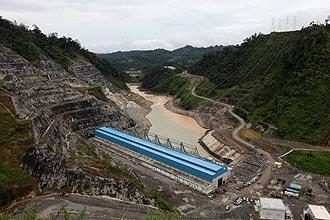 No compensation has been made for this area either. From my understanding this problem is not only faced by the people from Uma Bawang but a few other villages affected by Bakun Dam.
These affected people wish to know if the government intends to make compensation for such NCR Lands.
Added to their woes, the government has issued notices that it intends to gazette the islands created by the impoundment of the dam as Bakun National Park.
These islands are all that remain of the NCR lands of the people and it is totally unnecessary and extremely cruel to deprive them of even that.
The least the government can do is to admit their NCR over these "islands" and regulate the use of those islands rather than enforcing a total denial of their rights.
Otherwise the world would look at it as a sly exercise to finish off the last remaining claims the people have to the land left unsubmerged by the dam.
Like it or not, with this scenario, the government would be seen to be hell-bent on exterminating the natives of rural Sarawak.
I wish to remind the government of the international standards, which the chief minister pledged in the State Assembly to adhere to, in implementing projects which impact on the people, in particular, the United Nations Declaration on the Rights of Indigenous People.
The requirements include free, prior and informed consent, just and fair compensation and the right to participate in decision making in matters which affect their rights.
Perhaps it is time for the government to adopt these procedures consistent with the chief minister's undertaking of adhering to international standards and requirements in implementing public projects.
Sale and purchase of NCR temuda lands
In July of this year, the Federal Court held that NCR land (‘temuda') cannot be transferred to another party by sale and purchase agreements even amongst the same native tribe or community.
This decision caused much dismay to those who had been transacting such agreements and generated calls from many parties for a review of the laws regulating land in Sarawak so that the legislation and the adat of the communities would be consistent, as the court had also stated that the question of sale of NCR temuda is subject to the adat or custom of the community concerned.
Not allowing the disposition of NCR land among the communities is a disservice and an unfairness on the native peoples as it would in effect be making their NCR lands worthless, and thus does not promote the well-being of the natives, as observed by the court in the case of Mohamad Rambli Bin Kawi .
Therefore the calls for changes to be made to the law are to be expected.
I wish to bring to the attention of this Dewan that in fact, the state government had already made an amendment to the law by way of the Land Code (Amendment) Ordinance 2000, section 6 of which amends the Land Code to permit the transfer of registered native land rights from one native to another.
However, only selected sections of the ordinance were gazetted into law vide Sarawak government gazette dated 1st of April 2002 signed by the chief minister.
One wonders if this was an April fool's joke on the native community, as the relevant Section 6 was not one of the sections gazetted to come into force.
This peculiarity, has escaped the attention of many, and no explanation has ever been sought or given for it.
I call upon the chief minister to explain and to see to it that those sections of the Land Code (Amendment) Ordinance 2000 which were not gazetted into law be done so without delay. I would be most interested to find out why it was not gazetted accordingly.
Education long way to go
The Indigenous people of Sabah and Sarawak are caught in a vicious cycle of poverty. The main determinant for their economic progress is through the accumulation of human capital through education.
However, the government has far to go in terms of providing even the most basic infrastructure for rural schools, not to mention quality teachers and equipment.
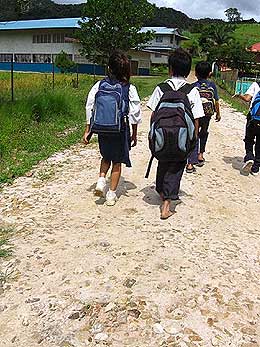 The education minister admitted earlier this year that rural schools in Sabah and Sarawak lagged behind in facilities and needed massive support to catch up with urban schools.
He said, "I agree that education facilities in rural areas should be better. There should be no discrimination just because they are located in remote areas".
The Education Blueprint had stated that the Education Ministry would ensure that 100% of schools meet basic infrastructure requirements including access to clean, treated water; at least 12-hours of electricity per day, along with sufficient toilets, classrooms, tables, and chairs for the student and teacher population by 2015, starting with Sabah and Sarawak.
It further stated that the ministry had conducted a detailed infrastructure audit to establish the amount of repairs required to bring all schools in line with the benchmark for basic infrastructure.
The repairs and upgrades would proceed in stages, starting with Sabah and Sarawak as schools in these states are in most need of repairs.
By the end of 2013, critical repairs and upgrades would be completed across all 1,608 schools with critical needs.
We are close to the end of 2013 but I can safely say that our rural schools with critical needs remain in dire straits.
Extreme danger
Of particular concern to me is the Physical Infrastructure Audit Report 2011 of the schools in severely damaged condition that 57% of all secondary schools and 28% of all primary schools have ‘very badly worn down electrical wiring'.
This poses extreme danger to students and staff and needs to be addressed without delay. Lives are at risk from fire or electrocution.
I hope that our Minister for Welfare will be able to enlighten us as to how many of the 57% secondary schools and 28% primary schools in this category are schools in Sarawak.
How much of the RM450 mil allocated in the Federal Budget 2014 to the Special Fund for Building Upgrading and Maintenance of Schools will be spent on our schools?
It is disappointing to note that there was no special allocation made for our schools, even after the government had acknowledged that our schools are most in need of repairs.
The news was splashed all over the newspapers earlier this month of the chief minister and other state leaders patting themselves on the back for the fact that Sarawak has RM22bil in reserves.
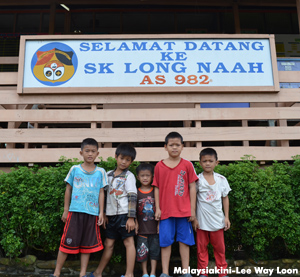 And on the other hand we get to read regularly of the atrocious condition of schools in rural areas, many in dilapidated disrepair, without access to piped water or grid electricity.
There is nothing to be proud of, and actually it is downright embarrassing to keep proclaiming Sarawak as being one of the richest states and is set be the richest state by 2030, if we cannot even provide basic education facilities for the children of Sarawak.
I came back from visiting at least four primary schools in my area few months ago and was appalled at the fact that the physical condition of these schools is wanting.
I commented to one of the school heads, "the only difference between my time in Lg Semadoh primary school in the 1960s and these kids in 2013 are, one, they have lights and two, they have mattresses but still no beds."
The Persatuan Ibu-Bapa Guru (PIBG) in some schools are pressured to build teachers quarters at their own cost. To me this is not right.
I am aware that education is under the purview of the federal government and that not all the schools are in a dire straits, but perhaps since we have proudly declared that we have a very healthy financial status, education should be one of the areas that the state government should come along side to assist as and when the need arises.
The above is Ba' Kelalan assemblyperson Baru Bian's speech during the debate on Sarawak's budget 2014 presented by the chief minister on Nov 18, 2013.


Are you sure you want to delete this comment?
This action cannot be undone.