




'Pressure Lynas through key financial backer from Japan'
The Health, Safety and Environment (HSE) policy of one of Lynas' key financial backers can be used to pressure the Japanese government to act, said the economist Yoshihiko Wada.
The Health, Safety and Environment (HSE) policy of one of Lynas' key financial backers can be used to pressure the Japanese government to act, said the economist Yoshihiko Wada.
He explained that the Japanese government, through the Japan Oil, Gas, and Metal National Corporation (Jogmec), had extended a USD200 million loan to Lynas, without which it could not survive.
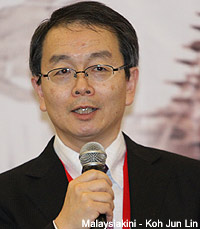 "It clearly says that we have to pay attention to and be accountable for social and environmental damages. We can use this in order to give pressure to the (Japanese) government," he said at a seminar organised by Save Malaysia Stop Lynas (SMSL) today.
However, he said when he spoke to Jogmec officials regarding the opposition against Lynas, they replied that have already told the Malaysian government and Lynas to "do a good job" and saw no need to step in.
He said he it would be more effective for a Japanese MP made formal inquiries on the matter, and a member of the opposition, Takashi Shinohara has agreed to help.
A draft inquiry document has already been submitted to Shinohara last week and will soon be submitted to Jogmec, said Doshisha University professor.
Among others, it asks Jogmec whether it has evaluated Lynas to see if it is in line with its HSE and whether it is willing to withdraw its loan to Lynas if it finds social and environmental problems with Lynas.
HH and SMSL heads down under
Meanwhile at a press conference later, Himpunan Hijau chairperson Wong Tack announced that he would mobilise a campaign to "totally paralyse" Lamp’s operations on June 29 next year.
However, he remained tight-lipped despite repeated request for details.
"It will be more than (a street protest). We said 'shut down'. We are committed to totally paralyse the operations of Lynas. That is our commitment. June 29, Lynas will be shut down.
"Right now we are not going to reveal what we are going to do, but we already started to engage some experts. We will do proper organisation and training. We believe in people power," he said when asked whether it will be another round of street protests.
He said he and SMSL chairperson Tan Boon Teet will be flying to Sydney tomorrow for Lynas' annual shareholder meeting on Nov 29.
"Tan will be inside the AGM. We will be interrupting outside. We will be flying there tomorrow, camp out right outside the entrance of Lynas’ headquarters, and cause all disturbance that we can to get the attention of Australia and particularly the shareholders.
"We will announce to the shareholders: Six months from the AGM, which is 629, we Malaysians will shut down Lynas," he said.
New target: Shaming Japan
Wong added that since the Japanese embassy has refused to see him despite repeated attempts over the past three weeks, he said Himpunan Hijau will mount on a campaign to highlight “wrongdoings of Japanese foreign economic policy” in the world.
"In the month of June commemorating the end of the Second World War, we will have a whole month of activities to display and to inform the people of Malaysia what Japan has, under their economic policy, have done to the world.
"That is our commitment. From now on, we will not contact the Japanese anymore. It is up to the Japanese whether they want to contact us or not," he said.
Wong Tack had wanted to reach the embassy to urge the Japanese government to withdraw its financial support for Lynas, which in turn will supply Japan with 30 percent of its rare earth metal demand.
He said a committee will be formed under Himpunan Hijau to engage with "the best historians" on the matter and ensure no detail is left out.
To a question whether the campaign would include the war or only focus post-war activities, he said this would depend on whether there is enough other material and will be decided later since the war atrocities are already well-known and is emotionally sensitive.
When asked for examples of the alleged wrongdoings, he named the now-defunct Asia Rare Earth refinery in Bukit Merah, the Sarawak Corridor of Renewable Energy (Score) project and the proposed Kepong incinerator, which he claims involved Japanese investment.


