




For Pakatan, a subtler art of governance
COMMENT Nothing better can come out of the host of internecine quarrels in recent days within Pakatan Rakyat than broadly accepted agreement on a modus operandi by which to avert recurrences or, at least, to tamp down controversies when they flare up.
Last week's public airing of resentment by the Penang chapter of PAS over their alleged marginalisation by the DAP-dominated state government had a lack of consultation as its main driver written all over it...
COMMENT Nothing better can come out of the host of internecine quarrels in recent days within Pakatan Rakyat than broadly accepted agreement on a modus operandi by which to avert recurrences or, at least, to tamp down controversies when they flare up.
Last week's public airing of resentment by the Penang chapter of PAS over their alleged marginalisation by the DAP-dominated state government had a lack of consultation as its main driver written all over it.
Clearly, the lack, or worse, the absence of meetings of the Pakatan state leadership council at which issues, and the selection and appointment of candidates to positions on a range of committees, should properly be brought up, discussed and decided, was a factor to the grouses aired by Penang PAS.
A coalition of political parties, especially one empowered to run a government, be it state or federal, must hold regular meetings to consult partners, formulate and vet policies, and decide appointments.
Otherwise parties with paltry representation in the government will feel left out. The resulting discontent will cause intra-coalition tension and feuds.
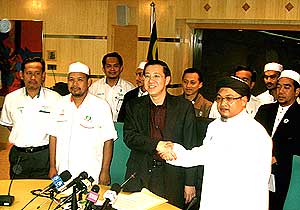 In the early years of Lim Guan Eng's first term as Penang chief minister (2008-2013), he paid laudable attention to the needs of Penang PAS, visiting strong pockets of the party's support in places like Bayan Lepas and Permatang Pasir.
PAS supporters in those wards were much taken with Guan Eng's attention to their problems.
No doubt, the busy newbie CM would have found it difficult to spare time for the details of specific PAS concerns, but because of the amiability and agreeableness of the former PAS commissioner for Penang, the late Mohd Hamdan Abd Rahman, who died in July 2009, Guan Eng would have been drawn to help as much as he could.
New PAS man at the helm
Mohd Salleh Man, who took over after Hamdan's death, is equally amicable but perhaps not as effective, which is probably why PAS' sole representative from Permatang Pasir in the state assembly cannot quite convey to the rest of his state chapter the consensus arrived in private and personal discussions with other principals in the state Pakatan leadership council.
More the reason, then, meetings of state Pakatan leadership councils should be periodically held and matters affecting inter-component cooperation be discussed and decided and the rationale behind them transmitted through to the ground.
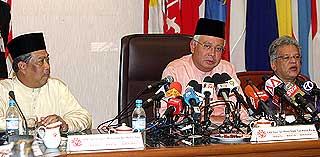 The last thing Pakatan would want is to be compared to BN, where after the initial years of the coalition's existence, major decisions affecting the country were made in the supreme council of Umno before being railroaded through the BN.
Umno's hegemony is a major cause for the BN's loss of popularity, which the results of the 2008 and 2013 general elections have confirmed as set to continue.
In matters like these, once a political coalition has lost a beachhead, it is likely to wade in the backwash for a long time before recovery can begin.
Having in Penang vaulted into government from the tsunami of discontent with the BN at the 2008 polls, and having done enough to justify a more thumping re-endorsement in the 2013 election, Pakatan must bend over backwards to avoid the pitfalls that led to the widespread perception that BN is a coalition in name and one-party hegemony in fact.
Derogatory language
Another certain way of preventing intra-coalition fractures and feuds would be to avoid using derogatory language when publicly airing grouses on internal matters.
 Many would understand the
frustration vented
by DAP MP for Jelutong Jeff Ooi (
right
) over the alleged apathy of Penang Municipal Council administrators on the issue of illegal traders, but they would refrain from supporting the use of less than parliamentary terms in decrying the indifference.
Many would understand the
frustration vented
by DAP MP for Jelutong Jeff Ooi (
right
) over the alleged apathy of Penang Municipal Council administrators on the issue of illegal traders, but they would refrain from supporting the use of less than parliamentary terms in decrying the indifference.
In a society with our diversity of cultures, the use of impolite terms soon lends itself as an excuse to cover up niggling shortcomings with the result that the whole exercise in intended correction is defeated.
Furthermore, Pakatan politicians have only to look at what has happened in the Pahang state assembly where a PKR representative, Lee Chean Chung, was suspended for two sessions for legitimate criticism that was not improperly delivered.
In fact, from the terms - anjing, bodoh, tiada otak, and babi - that were hurled against him, Lee was more sinned against than sinning.
For his fortitude, Lee was 'rewarded' with a six-month suspension from the state assembly which only goes to demonstrate the extent of forbearance Pakatan representatives have to display when jousting with adversaries in the BN.
In referring to the civil service, self-restraint must be equally prized. Pakatan has enough difficulty dealing with its political enemies: it shouldn't want to add nominal (because of Umno's control over it) opponents in the civil service to the list.
Finally, in addition to the requisites of periodic intra-coalition consultation and linguistic propriety, Pakatan leaders must also flavour valour with discretion as its supremo Anwar Ibrahim did not quite do in choosing to rap Selangor Menteri Besar Khalid Ibrahim for tardiness in fulfilling the 'people's welfare is primary' imperative of Pakatan's rule before a PKR convention in Shah Alam last Sunday.
Though couched in decorous terms, the criticism was one too many, coming as this one did after Khalid had only just unveiled a state budget that proposed to spend up to RM430 million of the state's prudentially-conserved reserves on projects that would warm Pakatan's communitarian heart.
Pakatan leaders must know when enough is enough.
TERENCE NETTO has been a journalist for four decades now. He likes the profession because it keeps him in touch with the eminent without being under the necessity to admire them.


Are you sure you want to delete this comment?
This action cannot be undone.