




Penang DAP polls deal mild rebuff to Guan Eng
COMMENT The outcome of internal polls in Penang DAP last weekend is seen as having dealt a mild rebuff to Chief Minister Lim Guan Eng.
It was no big blow but that it was delivered at all was a signal to him not to disregard local sentiment - Guan Eng is regarded as less Penangite than Malaccan.
COMMENT The outcome of internal polls in Penang DAP last weekend is seen as having dealt a mild rebuff to Chief Minister Lim Guan Eng.
It was no big blow but that it was delivered at all was a signal to him not to disregard local sentiment - Guan Eng is regarded as less Penangite than Malaccan.
That old saw that ‘all politics is local’, attributed to former US House of Representatives speaker Thomas Phillip O’Neill, retains its wisdom, no matter where in the world the game of politics is played.
Malacca-born and Petaling Jaya-raised Guan Eng is seen as having deprecated the need to be solicitous of local Penang DAP sentiment as he sought to shore up his position in the state chapter of the party with handpicked placemen.
Some candidates thought to have been favored by him, such as Danny Law, Ng Aik Wei and Chong Eng, did not make it to the 15 elected slots in the state committee.
This combined with the election of Koay Teng Hai, disfavored by Guan Eng and dropped as the incumbent state assemblyperson for Pulau Tikus.
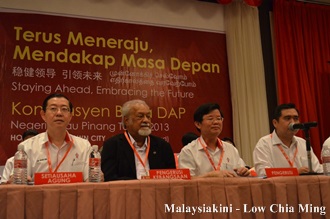 To his credit, Chow Kon Yeow (
second from right in photo
), re-elected for the seventh straight time to the chairpersonship of the state chapter, co-opted the unsuccessful Guan Eng minions into the committee.
To his credit, Chow Kon Yeow (
second from right in photo
), re-elected for the seventh straight time to the chairpersonship of the state chapter, co-opted the unsuccessful Guan Eng minions into the committee.
After the polls, Kon Yeow was at pains to pooh-pooh stories of the growth of factionalism in the party. He countered by saying that there was only one faction which is the DAP faction.
This was disingenuous. Factions are integral to a growingly popular political party such as the DAP; denying their inevitability is like hoping that rivers would flow uphill.
Co-opting factions such as Kon Yeow did after the polls by including the unsuccessful Guan Eng placemen, such as Law, Aik Wei and Chong Eng, in an expanded state committee is a wise way to deal with the phenomenon of factionalism.
The mounting popularity of the DAP in Penang - and indeed the nation - was partly reflected in the fact that 49 candidates, a record number, vied for 15 elected slots in the state committee.
Another 16 who wanted to be candidates allowed themselves to be persuaded to stand down; such was the clamour for elected positions.
The 16 were from the growing contingent of volunteers a seemingly successful political party is apt to attract to its ranks, the better to do the multifarious tasks of a political party.
Channelling the energies flowing into the party
DAP’s new-fangled projects, codenamed Impian Sarawak and Impian Sabah , are the ways in which DAP central has sought to channel the energies flowing into the party from mounting interest and membership in it.
The 16 volunteers in Penang who were persuaded to stand down felt they had worked for the party and now they wanted to contest for the chance to lead.
All this is inevitable. Seasoned leadership will be able to aid the process of sorting the grain from the chaff so that the greater inflow would crystallise in the sharper mettle of the few that will be chosen to lead from the many that would inevitably vie for the chance to do so.
This process of course would not be aided by the nepotism and cronyism that all political parties are vulnerable to and that a Pakatan Rakyat component such as the DAP ought to be wary of.
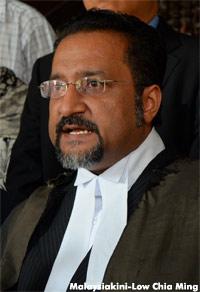 While the election of Jagdeep Singh Deo (
right
) to the 15-member state committee could be attributed to his own merits, which would be considerably embellished if his efforts to avail Penangites of affordable housing succeed, the same cannot be said about the election of Harvinder Singh.
While the election of Jagdeep Singh Deo (
right
) to the 15-member state committee could be attributed to his own merits, which would be considerably embellished if his efforts to avail Penangites of affordable housing succeed, the same cannot be said about the election of Harvinder Singh.
Harvinder got in on the steam of his patron Karpal Singh, just as he did when selected to the DAP quota of city councillors for the past several years despite not having the basic academic qualification for it.
He was more of an embarrassment than a credit as councilor. Whether he would redeem himself as Penang DAP state councilor in the 2013-2015 term is a question that will test the ‘no nepotism, no cronyism’ criteria which Pakatan has fought for.
TERENCE NETTO has been a journalist for four decades now. He likes the profession because it keeps him in touch with the eminent without being under the necessity to admire them.


Are you sure you want to delete this comment?
This action cannot be undone.