




Rural Sarawak students denied good education
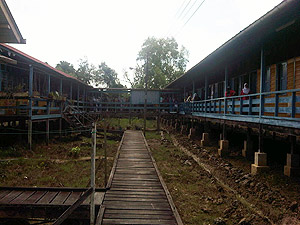
For the past 30 years, Sarawak has been given too little funds to improve the standard of education, particularly in the rural areas where the schools are not only in deplorable or dilapidated conditions, but also lack basic facilities.
Most of these schools do not have science laboratories or even enough classrooms, where the students also have ample "do nothing" time because of insufficient teachers as a result of the high rate of transfers, as well as poor accessibility and connectivity.
For the past 30 years, Sarawak has been given too little funds to improve the standard of education, particularly in the rural areas where the schools are not only in deplorable or dilapidated conditions, but also lack basic facilities.
Most of these schools do not have science laboratories or even enough classrooms, where the students also have ample "do nothing" time because of insufficient teachers as a result of the high rate of transfers, as well as poor accessibility and connectivity.
 "The lack of funds is a deliberate attempt to deny education to the rural people of Sarawak, so that they can be easily manipulated," says Bukit Saban PKR branch chairperson Noel Changgai Bucking.
"The lack of education among the people can weaken their spirit to fight for their rights," Noel told a media conference. "That is an agenda purposely carried out.
"If you look at the budget, it is mainly to pay the salaries of teachers and their allowances. In terms funds for the development of schools and facilities, there is none.
"To us, this move of the federal government is a subtle attack on the rural people and on Sarawak as a whole, so that we will continue to be subservient to Putrajaya."
He said the Sarawak Education Department has been forwarding a lot of proposals to the federal government for school development and the human capital of teachers for the past 30 years.
'BN government worse that the colonials'
"Sadly, very little has come from the federal government," said Noel, an economist who has been with the State Planning Unit of the Chief Minister's Office for nearly six years.
"The BN government is worse than the colonial government," he added.
Concurring with Noel, his colleague Boniface Willy Tumek,Mas Gadding PKR division leader, said annually thousands of rural students are forced to drop out because of below average performance in the Form 3 PMR and Form 5 SPM examinations.
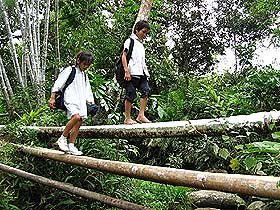 Based on the achievements of students in these two public examinations in 2012, only two secondary schools in Sarawak are in ‘Band 1' which is the ‘excellent' category, 110 secondary schools are in ‘Band 5', the ‘average' category and 12 secondary schools are in ‘Band 6', the ‘below average' category, Boniface said.
"In other words, a whopping 66 percent of the secondary schools in rural Sarawak are in the average and below average categories," he said.
These under-qualified Dayak students, Boniface added, could not get scholarships or enter universities, or even get jobs in the civil service or in the government-linked companies.
Social problems will arise...
"When you have a huge section of the population uneducated and unable to find something meaningful to do economically, it will inevitably lead to social problems," he said.
The long-term impact is already seen among the rural population, which continues to live in poverty and suffer diseases, does not get employment opportunities and lacks progress and development.
"Inevitably, social problems will arise - gangsterism, drug addiction and prostitution, and these will pose a serious threat to our society," Boniface added, going on to blame the federal government for all these.
The RM1.2 billion allocated to Sarawak under the 2014 Budget for building 33 new secondary schools and for upgrading and maintaining existing schools would not be enough, Boniface said.
Sarawak now has 184 secondary schools and of these, 119 are located in the rural areas.
"In view of this situation, we from PKR Sarawak demand that Prime Minister Najib Abdul Razak and Education Minister Muhyiddin Yassin channel more funds to the education sector of the state," he added.


