




PKR: Don't blame highway operators for toll hike
A federal minister’s call to the public to accept a hike in toll charges next year has been panned by PKR director of strategy Rafizi Ramli.
A federal minister’s call to the public to accept a hike in toll charges next year has been panned by PKR director of strategy Rafizi Ramli.
Abdul Wahid Omar, a Minister in the Prime Minister's Department, had also said that the government is under a contractual obligation to highway concessionaires.
He had further claimed that these companies have suffered because toll-charges have not been increased since 2011.
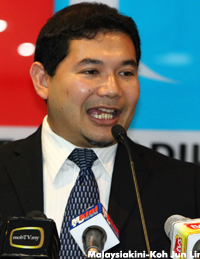 "It's mischievous to blame the concessionaires and to think that we are stupid ... it all goes back to the pockets in Putrajaya. It is just moving money from left pocket to the right pocket," Rafizi (left) told reporters at the PKR headquarters today.
He pointed out that three government-owned entities are responsible for 80 percent of the highways, which were built with public funds.
Projek Lebuhraya Utara Selatan (Plus), Prolintas and Gamuda could therefore be made to listen to the government, Rafizi said.
The attack on Wahid is part of PKR's overall challenge of federal government spending, which Rafizi claimed has remained imprudent.
This year, the government cut subsidies for sugar and petrol, and has approved an increase in the electricity tariff and public transport fares effective next year.
Rafizi said the BN is out to punish the people and that he will provide more proof of the government's reckless finances later this week.
On the highway concessions, for example, Rafizi said he has data to prove that these have become "cash cows" due to the increase in the number of vehicles using the highways.
For this reason, he said, it is unreasonable of the government to allow concessionaires to make "obscene profits" at the expense of the people who already have to cope with higher cost of living.
‘Monitor Petronas’
On the need to raise money to reduce government debt, Rafizi said this could be easily met if national oil company Petronas is kept on a shorter leash.
In the next few days, he said he will expose details on Petronas' RM15.8 billion deal to buy Progress Energy last December. This was Malaysia's single biggest investment in shale gas in Canada.
"I think there are strong grounds to believe that this is a national issue (that creates a) a financial question mark," Rafizi said.
"It shows that we need a stronger governing body watching over Petronas' bigger investments and not leave it to the prime minister's discretion alone."
 Months before Petronas ventured into its single-largest investment abroad into “unproven shale gas territory”, companies such as Canada's Encana Corp, UK's BG Group and Australia's BHP had written off billions of dollars on their shale gas investments, he said.
"It is only natural that Petronas, if negotiating such a big acquisition, should have taken note of the industry trend," Rafizi said.
The prospects for Petronas' investment in British Columbia looks gloomy, he noted.
The price of natural gas in North America which averaged $7-12 per million British Thermal Unit from 2008-2010, has not budged beyond $3 in recent times.
"Petronas will say that it paid the right price but we will present our argument and we have strong grounds to believe that even the price paid was higher than the prevailing industry price."
Petronas alone accounts for up to 40 percent of the government's revenue every year.
Under the Petroleum Development Act of 1974, which nationalised Malaysia's oil and gas resources under Petronas, the company reports only to the prime minister.


