




Bank Negara: GST will help reduce illicit outflow
The goods and services tax, which will kick in Apr 1, 2015, will help in reducing trade mispricing, said Bank Negara Malaysia (BNM).
The goods and services tax, which will kick in Apr 1, 2015, will help in reducing trade mispricing, said Bank Negara Malaysia (BNM).
 This, it said in its statement, will shrink the volume of illicit outflow as the bulk of the estimated outflow is from trade mispricing.
It said that this is because GST "requires reporting of value-added at the various stages of production", making it more difficult to evade taxes.
Although it does not explicitly say so, Bank Negara was referring to a report by Washington-based watchdog Global Financial Integrity (GFI) which in its latest report estimated that Malaysia lost about RM174 billion in illiicit outflow in 2011.
GFI said that about 80 percent of this is from trade mispricing, while the remainder is "hot money" or due to corruption and other crime.
This translated into around RM139 billion of Malaysia's illicit capital outflows in 2011 due to transfer mispricing while RM34.8 billion is from crime.
Our illicit outflow 70 percent less
However, Bank Negara said that GFI's methods "grossly overstated" the outflows, and that the portion on trade mispricing should be about 70 percent smaller.
This would push down the trade mispricing portion to about RM41.7 billion and the total illicit outflow for 2011 to about RM76.5 billion.
 Echoing
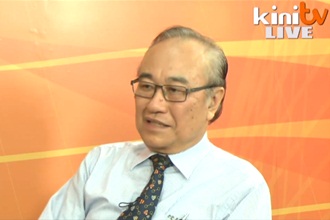
Minister in the Prime Minister's Department Paul Low (
right
), it said that GFI overstated the figures as it only took into account re-exports via Hong Kong, but not via another re-export hub, Singapore.
Echoing
Minister in the Prime Minister's Department Paul Low (
right
), it said that GFI overstated the figures as it only took into account re-exports via Hong Kong, but not via another re-export hub, Singapore.
"The removal of re-exports via Hong Kong is not significant for Malaysia as Malaysia's trade with Singapore that is or re-export is more than thrice the size of Malaysia's trade with Hong Kong.
"If re-exports via Singapore to Malaysia's top 10 trading partners were included, this would reduce Malaysia's trade mispricing by about 70 percent," it said.
Transfer mispricing is a ploy used by multinational companies to avoid paying high taxes. For example, goods produced by them in Malaysia are ‘sold' to their subsidiaries, conveniently located in a tax haven, at an artificially low price.
The same goods are then resold at market price to another subsidiary in the country, after which they finally go to consumers. The result - most of the profits are recorded in the tax-free country.
GFI had said it did not have the data from Singapore to make the concessions, and will take this into account if data on re-exports via Singapore was made available by Malaysia and Singapore.
Untraceable amount only two percent
As for the "hot money" portion, it said that the "errors and omissions (E&O)" or funds which cannot be traced in the balance of payments only make up two percent, far below the five percent benchmark proscribed by the International Monetary Fund (IMF).
"Importantly, not the entire E&O figure is attributable to illicit activities and Malaysia's cross-border statistics have consistently met all the international standards set by the IMF and the World Bank.
Nevetherless, it said it is intensifying enforcement and surveillance efforts and putting in place stronger regulatory framework through a high-level multi-agency special taskforce.
"Continued concrete and coordinated efforts between the enforcement agencies including across borders will continue to be pursued to ensure the integrity and stability of the Malaysian financial system," it said.


