




Airlines to meet, National Aviation Policy mooted
All airlines operating in Malaysia will soon partake in drawing up a National Aviation Policy (NAP) that aims to protect national interest, acting Transport Minister Hishammuddin Hussein said today.
All airlines operating in Malaysia will soon partake in drawing up a National Aviation Policy (NAP) that aims to protect national interest, acting Transport Minister Hishammuddin Hussein said today.
 Hishammuddin said that the NAP to address the issue of national airlines’ profitability in face of open skies agreements will be held at the end of this month. Among its participants are Malaysian Airlines, AirAsia, Firefly and Malindo.
“I have a commitment from all the airlines in principle that there must be certain grounds or national interest that they all must agree upon.
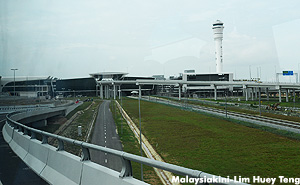
“There is a limit for us to be competing against each other at the expense of the national agenda,” Hishammuddin said at the site of the new KLIA2 airport.
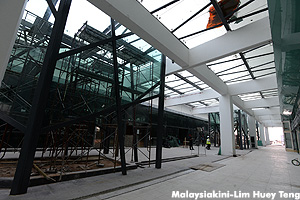
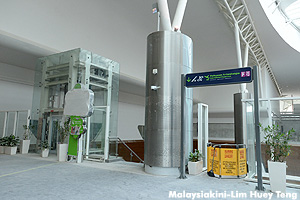 After touring KLIA2 with builders and reporters in tow, Hishammudin declared the airport “98 percent complete”. The airport has been delayed three times since 2010 and its construction costs have doubled to RM4 billion.
“It has not been an easy task.
“I am comfortable and encouraged... I promised not to disturb them until the end of the month so that they can focus on the work,” Hishammuddin said.
The contractors - UEM and BinaPuri - are due to hand over the completed airport at the end of January so that the three-month Operational Readiness and Airport Transfer (ORAT) process can commence. The airport is scheduled to open on May 2.
Noting that this will be the first time the airlines were meeting together, Hishammuddin however declined to specify what kind of rules will be drawn up.
 He would only say that the NAP would have to “realistically” take into account Malaysia’s other commitments as part of a “borderless world”. These would include international groups such as the International Civil Aviation Organisation (ICAO), Asean and the Asia-Pacific Economic Cooperation (Apec), he said.
“They are the experts, they have to guide me. I will have to make a decision based on their advice,” he said when asked if NAP was aimed at restricting or liberating Malaysia’s airline industry.
‘A catalyst to something bigger’
He said the NAP meet would however set policy direction and be a “catalyst to something bigger and more permanent for the sake of aviation industry in Malaysia”.
Hishammuddin declined to say whether rationalising flights was part of the agenda and whether people would end up paying more for airports and air tickets after the NAP.
 The NAP, he pointed out, was a vision given by PM Najib Abdul Razak in his Budget 2014 speech as an aspiration to transform Malaysia into a regional aviation hub. Najib had said that from January to July 2013, passenger traffic at airports nationwide rose to 43.9 million from 38.6 million passengers during the same period in 2012. With KLIA2, this could rise to over 70 million.
On KLIA2, Hishammuddin said that what remains to be sorted out by its handler Malaysian Airports Holding Berhad (MAHB) were mainly “integration and operations issues” including baggage and passenger handling and immigration and customs.
Hishammuddin swept aside all questions pertaining to KLIA2's inflated costs issue - who will be made accountable and who will end up paying for it.
“Why would you want to think about that?” Hishammuddin asked when a question about further possible delays was thrown at him.
“Unless you see around me that they’ve nothing to do... Let’s deal with it if it happens.”
For now, he said he just wanted to drop in and congratulate the contractors for working hard to meet the new deadline.
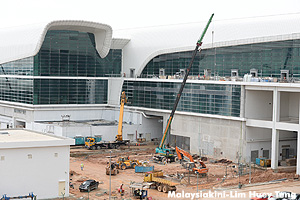 The project which began work in 2010 had been plagued with delays. It was first due to be completed at the end of 2011 but was later pushed to October 2012 and then to June 2013 and now end January. MAHB has said that the completion date for KLIA2 has been revised several times due to changes made to the original plan including building a bigger terminal to handle more passengers and installing an automated baggage handling system.
During a site visit today, Hishammuddin showed how the conveyor belts were already functional. The airport can handle up to 45 million passengers a year.
KLIA2 is said to be the world’s largest purpose-built airport for low-cost carriers. In August, a special task force led by Deputy Transport Minister Aziz Kaprawi however said that KLIA2 will no longer be a low-cost terminal, but Malaysia’s first “hybrid airport” with upgraded business class services.
When asked about this, Hishammuddin said he didn't care about “technicalities”, only that the airport is completed.


Are you sure you want to delete this comment?
This action cannot be undone.