




NGO puts out alternative delineation maps
In anticipation of further gerrymandering and malapportionment in the Election Commission’s (EC) upcoming redelineation exercise, an NGO has drawn up its own constituency maps and hopes that it will gain traction amongst voters.
In anticipation of further gerrymandering and malapportionment in the Election Commission’s (EC) upcoming redelineation exercise, an NGO has drawn up its own constituency maps and hopes that it will gain traction amongst voters.
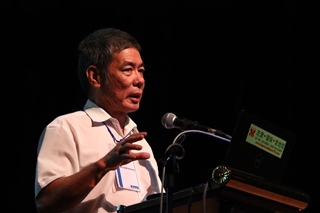 Tindak Malaysia delimitation analyst Ng Chak Ngoon (
left
) said this is because when opposition parties objected to past redelineation exercises, the EC would demand an alternative and the political parties could not respond to it.
Tindak Malaysia delimitation analyst Ng Chak Ngoon (
left
) said this is because when opposition parties objected to past redelineation exercises, the EC would demand an alternative and the political parties could not respond to it.
“So now as a first stop, we came up with all these maps of every state. If the EC were to hold a hearing tomorrow, we (would) have all these maps to say, ‘Look, we would like to object.’
“What we don’t have, is 100 volunteers from each constituency. This is the next effort that Tindak Malaysia wants to undertake together with Bersih,” he said during a seminar on redelineation yesterday.
Ng refers to provisions under the federal constitution, where groups of at least 100 voters may raise objections to a redelineation exercise if their constituency’s borders are being shifted. This needs to be done within 30 days after the EC gives notice of its proposed changes.
Another Tindak Malaysia analyst, Wong Kouk Yong, argued that if voters from multiple neighbouring constituencies object to a redelineation exercise and propose new borders based on the same map, it would give the EC little room to manoeuvre except to concede.
“It may not work if you propose only for your own constituency, because it affects your neighbours. Your neighbours may object to your own proposal.
 “This is what we think, so we would have to coordinate at least state-wide. When we go on (to submit the proposal to the EC), there is not much room for the EC to turn us down.
“This is why Tindak Malaysia tries to come up with all the maps, so that it will be our reference and our base to work on,” Wong ( left ) told the audience of about 150 activists.
He explained that the maps were drawn by reallocating existing polling districts between parliamentary constituencies, such that the discrepancies in the size of each constituency within a state is minimised.
Unlikely two-thirds majority
The number of constituencies in each state is maintained because for the EC to create new seats, it will require a two-thirds majority in Parliament, which is unlikely, given that no coalition can command the required votes.
This is to address the issue of malapportionment, which is seen as a hindrance in ensuring that every vote has equal value in putting election candidates in power.
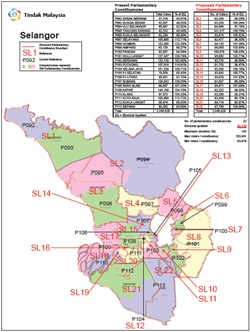 Attempts were also given to try to conform to administrative boundaries as much as possible, and to give consideration for issues such as geographical barriers, accessibility, and lines of communication.
As a result, the discrepancies between constituencies were reduced to within 10 percent of the average of the state it resides in for the peninsula, and 15 percent for Sabah and Sarawak due to its vast area.
In contrast, the largest intra-state discrepancy is between Kapar and Sabak Bernam in Selangor, where the average constituency should have 93,129 voters. Under existing electoral boundaries, Sabak Bernam has 37,318 voters (40.07 percent of average) whereas Kapar has 144,159 voters (154.79 percent of average).
If the 13th general election had been run based on Tindak Malaysia’s proposed borders, Ng said Pakatan Rakyat would have won 117 out of 222 parliamentary seats (53 percent), as compared to the actual 89 seats (40 percent).
This more closely reflects the proportion of popular votes garnered by each coalition in the election, which is 50.87 percent for Pakatan and 47.38 percent for BN.
However, Wong said the maps are only a first draft, and there is still work to be done to minimise discrepancies across state boundaries, to draw up borders for state constituencies, and to get feedback from local constituents.


Are you sure you want to delete this comment?
This action cannot be undone.